



Sundasalanx mekongensis Britz & Kottelat, 1999
Ladda upp din foton och Videor
Google image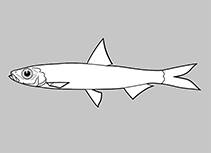 No image available for this species;
drawing shows typical species in Ehiravidae.
Google image
drawing shows typical species in Ehiravidae.
Klassificering / Namn Populärnamn | synonymer | Catalog of Fishes(Släkte, Arter) | ITIS | CoL | WoRMS | Cloffa
> Clupeiformes (Herrings) > Ehiravidae (River sprats)
Etymology: Sundasalanx: Composed from Sunda, Asiatic island + latinization of Philippines, salamga, French salangana = the name of a kind of swallow (Ref. 45335).
More on authors: Britz & Kottelat.
Etymology: Sundasalanx: Composed from Sunda, Asiatic island + latinization of Philippines, salamga, French salangana = the name of a kind of swallow (Ref. 45335).
More on authors: Britz & Kottelat.
Miljö: miljö / Klimatzon / djupintervall / distributionsområde Ekologi
; sötvatten bottenlevande. Tropical
Utbredning Territorier | FAO områden | Ekosystem | Förekomster | Prickkarta | Utplanteringar | Faunafri
Asia: Mekong basin in Laos and Thailand.
Storlek / Vikt / Ålder
Kort beskrivning Bestämningsnycklar | Morfologi | Morfometri
Mjukstrålar i ryggfenan (totalt) : 12 - 15; Mjukstrålar i analfenan: 16 - 20; Ryggkotor: 38 - 42. Differs from all except S. praecox in having vomerine tooth plates (versus missing), more maxillary teeth (30, versus 12-19), 1-3 teeth on caudal end of basibranchial 1-2 in most specimens (versus missing), a completely ringed proximal end of epibranchial 3 surrounding third efferent branchial artery (versus partially encircled), and in lacking in midventral row of melanophores (versus presence). Differs from S. malleti in lacking a basipterygium pigment ring (versus presence). Differs from S. praecox in having several (3-5) prepectoral melanophores (versus missing), more vertebrae (38-42, versus 37-38) and no palatine teeth (versus presence). Differs from all other Sundasalangidae (except S. praecox and S. malleti) in lacking a cardiac chamber pigmentation (versus presence). Also differs from all congeners in having a dermethmoid, supraorbitals, hyomandibulars, autopterotics, exoccipitals, basioccipital and ventral hypohyals (versus these bones not ossified), more gill rakers on branchial arches (10-16 on first arch [versus 2-9], 9-11 on second and third arches, 7-9 anteriorly and 6-8 posteriorly on fourth arch, 6-7 on fifth arch).
Body shape (shape guide): elongated.
Body shape (shape guide): elongated.
Found mostly in large rivers with muddy bottom, turbid water and slow to moderate current. Caught by seine and push net. In all habitats where it was collected by push-net, it was only present at depths greater than 1 meter, usually at a depth immediately below those at which a slight drop in temperature could be felt. Located above the bottom, usually above a layer of 10-20 cm loose ooze.
Livscykel och parningsbeteende Könsmognad | Reproduktion | Lek | Ägg | Fekunditet | Larver
Huvudreferens
Ladda upp dina referenser | referenser | Koordinator | Medarbetare
Britz, R. and M. Kottelat, 1999. Sundasalanx mekongensis, a new species of clupeiform fish from the Mekong basin (Teleostei: Sundasalangidae). Ichthyol. Explor. Freshwat. 10(4):337-344. (Ref. 38648)
Status på IUCN:s rödlista (Ref. 130435: Version 2025-2 (Global))
Least Concern (LC) ; Date assessed: 17 February 2012
CITES
Not Evaluated
Hot mot människor
Harmless
Mänskliga användningsområden
FAO - Publication: search | FishSource |
Ytterligare information
Trofisk ekologi
Livsmedelsartiklar (preys)
Födosammansättning
Födointag
Matransoner
Predatorer
Livsmedelsartiklar (preys)
Födosammansättning
Födointag
Matransoner
Predatorer
Ekologi
Ekologi
Ekologi
Populationsdynamik
Tillväxtparametrar
Max. åldrar / storlekar
Längd-vikt rel.
Längd-längd rel.
Längd-frekvenser
Massakonvertering
Rekrytering
Abundans
Tillväxtparametrar
Max. åldrar / storlekar
Längd-vikt rel.
Längd-längd rel.
Längd-frekvenser
Massakonvertering
Rekrytering
Abundans
Livscykel
Reproduktion
Könsmognad
Mognad/Gills rel.
Fekunditet
Lek
Lekande aggregat
Ägg
Utveckling av ägg
Larver
Larvdynamik
Reproduktion
Könsmognad
Mognad/Gills rel.
Fekunditet
Lek
Lekande aggregat
Ägg
Utveckling av ägg
Larver
Larvdynamik
Anatomi
Gälyta
Hjärna
Otolit
Gälyta
Hjärna
Otolit
Fysiologi
Kroppssammansättning
Näringsämnen
Syreförbrukning
Typ av simning
Simhastighet
Visuella pigment
Ljud från fisk
Sjukdomar & Parasiter
Toxicitet (LC50)
Kroppssammansättning
Näringsämnen
Syreförbrukning
Typ av simning
Simhastighet
Visuella pigment
Ljud från fisk
Sjukdomar & Parasiter
Toxicitet (LC50)
Genetik
Genom
Genetik
Heterozygositet
Ärftlighet
Genetisk mångfald
Genom
Genetik
Heterozygositet
Ärftlighet
Genetisk mångfald
Människorelaterad
Vattenbrukssystem
Vattenbruksprofiler
Avelslinjer
Ciguatera-fall
Frimärken, mynt, diverse.
Vattenbrukssystem
Vattenbruksprofiler
Avelslinjer
Ciguatera-fall
Frimärken, mynt, diverse.
Verktyg
Särskilda rapporter
Kontrollera för underhåll av akvarium | Kontrollera om det finns faktablad om arter | Kontrollera om det finns faktablad om vattenbruk
Ladda ner XML
Internet-källor
AFORO (otoliths) | Aquatic Commons | BHL | Cloffa | Websites from users | Check FishWatcher | CISTI | Catalog of Fishes: Släkte, Arter | DiscoverLife | ECOTOX | FAO - Publication: search | Faunafri | Fishipedia | Fishtrace | GloBI | Google Books | Google Scholar | Google | IGFA World Record | OneZoom | Open Tree of Life | Otolith Atlas of Taiwan Fishes | PubMed | Reef Life Survey | Socotra Atlas | TreeBase | Tree of Life | Wikipedia: Go, sök | World Records Freshwater Fishing | Zoobank | Zoologiskt register
Uppskattningar baserade på modeller
Index för fylogenetisk mångfald (Ref. 82804): PD50 = 0.5078 [Uniqueness, from 0.5 = low to 2.0 = high].
Bayesian length-weight: a=0.00468 (0.00190 - 0.01153), b=3.03 (2.82 - 3.24), in cm total length, based on LWR estimates for this (Sub)family-body shape (Ref. 93245).
Trofisk nivå (Ref. 69278): 3.0 ±0.3 se; based on size and trophs of closest relatives