



Sundasalanx mekongensis Britz & Kottelat, 1999
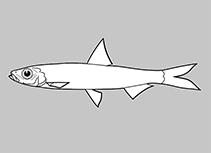
分類 / 名前 共通名の | 類義語 | Catalog of Fishes(部類, 種) | ITIS | CoL | WoRMS | Cloffa
> Clupeiformes (Herrings) > Ehiravidae (River sprats)
Etymology: Sundasalanx: Composed from Sunda, Asiatic island + latinization of Philippines, salamga, French salangana = the name of a kind of swallow (Ref. 45335).
More on authors: Britz & Kottelat.
Etymology: Sundasalanx: Composed from Sunda, Asiatic island + latinization of Philippines, salamga, French salangana = the name of a kind of swallow (Ref. 45335).
More on authors: Britz & Kottelat.
環境:環境 / 気候帯 / 深さの範囲 / 分布範囲 生態学
; 新鮮な水 底生の. Tropical
分布 領土 | 国連食糧農業機関の区域 | エコシステム | 事件 | 目的のマップ | 導入 | Faunafri
Asia: Mekong basin in Laos and Thailand.
サイズ / 重さ / 年齢
簡単な記述 検索表 | 形態学 | 形態計測学
背鰭 (合計) : 12 - 15; 臀鰭: 16 - 20; 脊つい: 38 - 42. Differs from all except S. praecox in having vomerine tooth plates (versus missing), more maxillary teeth (30, versus 12-19), 1-3 teeth on caudal end of basibranchial 1-2 in most specimens (versus missing), a completely ringed proximal end of epibranchial 3 surrounding third efferent branchial artery (versus partially encircled), and in lacking in midventral row of melanophores (versus presence). Differs from S. malleti in lacking a basipterygium pigment ring (versus presence). Differs from S. praecox in having several (3-5) prepectoral melanophores (versus missing), more vertebrae (38-42, versus 37-38) and no palatine teeth (versus presence). Differs from all other Sundasalangidae (except S. praecox and S. malleti) in lacking a cardiac chamber pigmentation (versus presence). Also differs from all congeners in having a dermethmoid, supraorbitals, hyomandibulars, autopterotics, exoccipitals, basioccipital and ventral hypohyals (versus these bones not ossified), more gill rakers on branchial arches (10-16 on first arch [versus 2-9], 9-11 on second and third arches, 7-9 anteriorly and 6-8 posteriorly on fourth arch, 6-7 on fifth arch).
Body shape (shape guide): elongated.
Body shape (shape guide): elongated.
Found mostly in large rivers with muddy bottom, turbid water and slow to moderate current. Caught by seine and push net. In all habitats where it was collected by push-net, it was only present at depths greater than 1 meter, usually at a depth immediately below those at which a slight drop in temperature could be felt. Located above the bottom, usually above a layer of 10-20 cm loose ooze.
ライフサイクルと交尾行動 成熟 | 繁殖 | 放精 | 卵 | 生産力 | 幼生
主な参考文献
参考文献のアップロード | 参考文献 | コーディネーター | 協力者
Britz, R. and M. Kottelat, 1999. Sundasalanx mekongensis, a new species of clupeiform fish from the Mekong basin (Teleostei: Sundasalangidae). Ichthyol. Explor. Freshwat. 10(4):337-344. (Ref. 38648)
CITES
Not Evaluated
人間に対する脅威
Harmless
人間の用途
FAO - Publication: search | FishSource |
より多くの情報
養殖生態
食料品(獲物)
餌の構成
摂食量
食料配給
捕食動物
食料品(獲物)
餌の構成
摂食量
食料配給
捕食動物
生態学
生態学
生態学
人口動態
成長のパラメーター
最大年齢/サイズ
長さ-重量比。
長短関係。
体長組成
質量変換
補充
豊度
成長のパラメーター
最大年齢/サイズ
長さ-重量比。
長短関係。
体長組成
質量変換
補充
豊度
ライフサイクル
繁殖
成熟
成熟度/エラ
生産力
放精
産卵群
卵
卵の開発
幼生
幼生の動力
繁殖
成熟
成熟度/エラ
生産力
放精
産卵群
卵
卵の開発
幼生
幼生の動力
解剖学
カマ
脳
オトリス
カマ
脳
オトリス
生理学
体組成
栄養素
酸素消費
水泳タイプ
泳ぐ速さ
視覚色素
フィッシュ・サウンド
病気と寄生虫
毒性(LC50)
体組成
栄養素
酸素消費
水泳タイプ
泳ぐ速さ
視覚色素
フィッシュ・サウンド
病気と寄生虫
毒性(LC50)
遺伝子の
ゲノム
遺伝子の
ヘテロ接合性
遺伝
遺伝的多様性
ゲノム
遺伝子の
ヘテロ接合性
遺伝
遺伝的多様性
用具
特記事項
XMLをダウンロードして下さい
インターネットの情報源
AFORO (otoliths) | Aquatic Commons | BHL | Cloffa | Websites from users | Check FishWatcher | CISTI | Catalog of Fishes: 部類, 種 | DiscoverLife | ECOTOX | FAO - Publication: search | Faunafri | Fishipedia | Fishtrace | GloBI | Google Books | Google Scholar | Google | IGFA World Record | OneZoom | Open Tree of Life | Otolith Atlas of Taiwan Fishes | PubMed | Reef Life Survey | Socotra Atlas | TreeBase | 生命の木 | Wikipedia: 行く, 検索する | World Records Freshwater Fishing | Zoobank | 動物に関する記録
モデルに基づく推定値
系統多様性指数 (参照 82804): PD50 = 0.5078 [Uniqueness, from 0.5 = low to 2.0 = high].
Bayesian length-weight: a=0.00468 (0.00190 - 0.01153), b=3.03 (2.82 - 3.24), in cm total length, based on LWR estimates for this (Sub)family-body shape (Ref. 93245).
栄養段階 (参照 69278): 3.0 ±0.3 se; based on size and trophs of closest relatives