



Priacanthus hamrur (Fabricius, 1775)
Moontail bullseye
Add your observation in Fish Watcher
| Native range | All suitable habitat | Point map | Year 2050 |

|
| This map was computer-generated and has not yet been reviewed. |
| Priacanthus hamrur AquaMaps Data sources: GBIF OBIS |
Upload your photos and videos
Pictures | Videos | Stamps, coins, misc. | Google image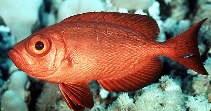 Priacanthus hamrur
Picture by Randall, J.E.
Pictures | Videos | Stamps, coins, misc. | Google image
Picture by Randall, J.E.
Classification / Names Common names | Synonyms | Catalog of Fishes(genus, species) | ITIS | CoL | WoRMS | Cloffa
Teleostei (teleosts) > Eupercaria/misc (Various families in series Eupercaria) > Priacanthidae (Bigeyes or catalufas)
Etymology: Priacanthus: Greek, prion = saw + Greek, akantha = thorn (Ref. 45335).
Etymology: Priacanthus: Greek, prion = saw + Greek, akantha = thorn (Ref. 45335).
Environment: milieu / climate zone / depth range / distribution range Ecology
Marine; reef-associated; depth range 0 - 250 m (Ref. 9710). Tropical; 36°N - 36°S, 24°E - 109°W
Distribution Territories | FAO areas | Ecosystems | Occurrences | Point map | Introductions | Faunafri
Indo-Pacific: Red Sea and southern Africa to French Polynesia, north to southern Japan, south to Australia. Reported from Easter Island (Ref. 33390).
Length at first maturity / Size / Weight / Age
Maturity: Lm 22.0 range ? - ? cm
Max length : 45.0 cm TL male/unsexed; (Ref. 4328); common length : 40.0 cm TL male/unsexed; (Ref. 5450)
Max length : 45.0 cm TL male/unsexed; (Ref. 4328); common length : 40.0 cm TL male/unsexed; (Ref. 5450)
Short description Identification keys | Morphology | Morphometrics
Dorsal spines (total): 10; Dorsal soft rays (total): 13 - 15; Anal spines: 3; Anal soft rays: 13 - 16. This species is distinguished by the following characters: body depth 2.5-2.9 in SL; poorly developed preopercular spine, reduced or inconspicuous to non-existent in adults (> 12.5 cm TL); total gill rakers in first gill arch 24-26; soft portion of dorsal fin taller than spinous portion, angular posteriorly; pectoral fins shorter than pelvic spine; pelvic fins long, reaching posterior to spinous portion of anal fin; distinctly emarginate caudal fin; scales modified, the posterior field elevated as a separate flange with spinules both on surface and posterior margin; vertical scale rows (dorsal-fin origin to anus) 48-57; swimbladder with pair of anterior and posterior protrusions. Colour of body entirely red or capable of quickly changing to silvery with about 6 red bars or large spots on upper side (dusky spots evident on dorsal and anal fin in blotchy or barred fish); membranes of caudal and pelvic fins blackish distally (Ref. 54980, 68288, 90102).
Body shape (shape guide): short and / or deep; Cross section: compressed.
Body shape (shape guide): short and / or deep; Cross section: compressed.
Uncommon species found in outer reef slopes and deep lagoon pinnacles from 8 to at least 80 m. In small aggregations, sometimes schools in oceanic locations (Ref. 48635). Also found under ledges or hovering next to coral heads during day (Ref 90102). Feeds on small fish, crustaceans, and other small invertebrates (Ref. 5213). Occasionally taken in moderate numbers in trawls and by hook-and-line (Ref. 68288). Generally marketed fresh, may be salted or dried (Ref. 5284). Minimum depth reported taken from Ref. 128797.
Life cycle and mating behavior Maturity | Reproduction | Spawning | Eggs | Fecundity | Larvae
Main reference
Upload your references | References | Coordinator | Collaborators
Starnes, W.C., 1988. Revision, phylogeny and biogeographic comments on the circumtropical marine percoid fish family Priacanthidae. Bull. Mar. Sci. 43(2):117-203. (Ref. 5403)
IUCN Red List Status (Ref. 130435: Version 2025-2 (Global))
Least Concern (LC) ; Date assessed: 10 March 2015
CITES
Not Evaluated
Threat to humans
Harmless
Human uses
Fisheries: minor commercial; aquarium: commercial
FAO - Publication: search | FishSource | Sea Around Us
More information
Population dynamics
Growth parameters
Max. ages / sizes
Length-weight rel.
Length-length rel.
Length-frequencies
Mass conversion
Recruitment
Abundance
Growth parameters
Max. ages / sizes
Length-weight rel.
Length-length rel.
Length-frequencies
Mass conversion
Recruitment
Abundance
Physiology
Body composition
Nutrients
Oxygen consumption
Swimming type
Swimming speed
Visual pigments
Fish sound
Diseases & Parasites
Toxicity (LC50s)
Body composition
Nutrients
Oxygen consumption
Swimming type
Swimming speed
Visual pigments
Fish sound
Diseases & Parasites
Toxicity (LC50s)
Tools
Bio-Quiz | E-book | Field guide | Identification keys | Length-frequency wizard | Life-history tool | Point map |
Catch-MSY |
Special reports
Download XML
Internet sources
AFORO (otoliths) | Aquatic Commons | BHL | Cloffa | Websites from users | Check FishWatcher | CISTI | Catalog of Fishes: genus, species | DiscoverLife | DORIS | ECOTOX | FAO - Publication: search | Faunafri | Fishipedia | Fishtrace | GloBI | Google Books | Google Scholar | Google | IGFA World Record | National databases | OneZoom | Open Tree of Life | Otolith Atlas of Taiwan Fishes | PubMed | Reef Life Survey | Socotra Atlas | TreeBase | Tree of Life | Wikipedia: Go, Search | | Zoological Record
Estimates based on models
|
Phylogenetic diversity index (Ref. 82804) |
PD50 = 0.5001 [Uniqueness, from 0.5 = low to 2.0 = high]. |
| Bayesian length-weight | a=0.01778 (0.01238 - 0.02554), b=2.88 (2.78 - 2.98), in cm total length, based on LWR estimates for this species (Ref. 93245). |
|
Trophic level (Ref. 69278) |
3.6 ±0.5 se; based on diet studies. |
|
Resilience (Ref. 120179) |
High, minimum population doubling time less than 15 months (K=0.5-0.7; Fec=13,133). |
|
Fishing Vulnerability (Ref. 59153) |
Low vulnerability (24 of 100). 🛈 |
|
Price category (Ref. 80766) |
High. |
|
Nutrients (Ref. 124155) |
Calcium = 46.8 [23.1, 75.7] mg/100g; Iron = 0.608 [0.355, 0.985] mg/100g; Protein = 18.9 [17.7, 20.0] %; Omega3 = 0.129 [0.079, 0.216] g/100g; Selenium = 55 [31, 104] μg/100g; VitaminA = 32.6 [9.2, 114.0] μg/100g; Zinc = 0.879 [0.600, 1.277] mg/100g (wet weight); |