



Satanoperca pappaterra (Heckel, 1840)
Pantanal eartheater
Uploaden van uw Foto's en video's
Afbeeldingen | Google afbeelding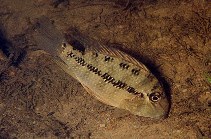 Satanoperca pappaterra
Afbeelding van Sazima, I.
Afbeeldingen | Google afbeelding
Afbeelding van Sazima, I.
Classificatie / Namen Lokale namen | Synoniemen | Catalog of Fishes(Genus, Soort(en)) | ITIS | CoL | WoRMS | Cloffa
> Cichliformes (Cichlids, convict blennies) > Cichlidae (Cichlids) > Geophaginae
Etymology: Satanoperca: Taken from the prince of darkness. Hube liked to name cave fishes with diabolic names based on the idea of hell being underground + Greek, perke = perch (Ref. 45335).
Eponymy: Named after the devil, and referring in the case of the blindcat to the species’ underground habitat. Günther’s use of a name meaning ‘Satan perch’ for the cichlids was probably inspired by Heckel (q.v.) having named a species as ‘Geophagus daemon’. (Ref. 128868), visit book page.
More on author: Heckel.
Etymology: Satanoperca: Taken from the prince of darkness. Hube liked to name cave fishes with diabolic names based on the idea of hell being underground + Greek, perke = perch (Ref. 45335).
Eponymy: Named after the devil, and referring in the case of the blindcat to the species’ underground habitat. Günther’s use of a name meaning ‘Satan perch’ for the cichlids was probably inspired by Heckel (q.v.) having named a species as ‘Geophagus daemon’. (Ref. 128868), visit book page.
More on author: Heckel.
Milieu: milieu / Klimaatzone / Diepte / verspreidingsgebied Ecologie
; zoet water benthopelagisch; pH range: ? - 7.0; dH range: ? - 10. Tropical; 24°C - 27°C (Ref. 2059)
Verspreiding Gebieden | FAO regio's | Ecosystemen | Voorkomen | Verspreidingskaart | Introducties | Faunafri
South America: Amazon River basin, in the Guaporé River in Brazil and Bolivia; Paraná River basin, in the Paraguay River drainage in Brazil and northern Paraguay (to the Aquidabán River).
Lengte bij maturiteit / Grootte / Gewicht / Leeftijd
Maturiteit: Lm 8.6 range ? - ? cm
Max length : 27.0 cm TL mannelijk / geslacht onbekend; (Ref. 115169); 27.5 cm TL (female); max. gepubliceerd gewicht: 383.00 g (Ref. 115169); max. gepubliceerd gewicht: 383.00 g
Max length : 27.0 cm TL mannelijk / geslacht onbekend; (Ref. 115169); 27.5 cm TL (female); max. gepubliceerd gewicht: 383.00 g (Ref. 115169); max. gepubliceerd gewicht: 383.00 g
Inhabits streams and lagoons with sandy to muddy bottom. Forages by plunging its protrusible mouth into the sandy or muddy bottom, filling it with sediment, and sorting out food inside the mouth. The bulk of the mouthful is expelled through the opercular openings and the
mouth, producing a cloud of sediment (substrate sifting). This feeding mode leaves a series of pits and mounds on the bottom. Feeds on insect larvae, crustaceans, plant debris and loose scales (Ref. 40396). Discourages piranha attacks by watching the predator, a tactic used when 2-5 fish feed in groups and the individuals take turns as the "watchman". Confronts an approaching piranha by charging towards the predator with an open mouth and erect dorsal fin (Ref. 9080).
Levenscyclus en paargedrag Maturiteit | Voortplanting | Paaien | Eieren | Fecunditeit | Larven
Ovophile mouth brooders.
Hoofdreferentie
Upload uw referenties | Referenties | Coördinator : Kullander, Sven O. | Medewerkers
Kullander, S.O., 2003. Cichlidae (Cichlids). p. 605-654. In R.E. Reis, S.O. Kullander and C.J. Ferraris, Jr. (eds.) Checklist of the Freshwater Fishes of South and Central America. Porto Alegre: EDIPUCRS, Brasil. (Ref. 36377)
Status op de Rode Lijst van het IUCN (Ref. 130435: Version 2025-2 (Global))
Niet bedreigd (LC) ; Date assessed: 21 November 2020
CITES
Not Evaluated
Gevaar voor de mens
Harmless
Gebruik door de mens
FAO - Publication: search | FishSource |
Meer informatie
Trofische ecologie
Voedsel (prooien)
Dieetsamenstelling
Voedselconsumptie
Voedselrantsoenen
Predatoren
Voedsel (prooien)
Dieetsamenstelling
Voedselconsumptie
Voedselrantsoenen
Predatoren
Populatiedynamica
Groeiparameters
Max. leeftijden / maten
Lengte-gewicht rel.
Lengte-lengte rel.
Lengtefrequenties
Massaconversie
Rekrutering
Abundantie
Groeiparameters
Max. leeftijden / maten
Lengte-gewicht rel.
Lengte-lengte rel.
Lengtefrequenties
Massaconversie
Rekrutering
Abundantie
Levenscyclus
Voortplanting
Maturiteit
Rijpheid/kieuwen rel.
Fecunditeit
Paaien
Paaibestanden
Eieren
Ontwikkeling van de eieren
Larven
Larvale populatiedynamiek
Voortplanting
Maturiteit
Rijpheid/kieuwen rel.
Fecunditeit
Paaien
Paaibestanden
Eieren
Ontwikkeling van de eieren
Larven
Larvale populatiedynamiek
Anatomie
Kieuwoppervlak
Hersenen
Otoliet
Kieuwoppervlak
Hersenen
Otoliet
Fysiologie
Lichaamssamenstelling
Voedingsstoffen
Zuurstofverbruik
Type zwemmen
Zwemsnelheid
Visuele pigmenten
Vis geluid
Ziekten en parasieten
Toxiciteit (LC50)
Lichaamssamenstelling
Voedingsstoffen
Zuurstofverbruik
Type zwemmen
Zwemsnelheid
Visuele pigmenten
Vis geluid
Ziekten en parasieten
Toxiciteit (LC50)
Genetica
genoom
Genetica
Heterozygositeit
Erfelijkheid
Genetische diversiteit
genoom
Genetica
Heterozygositeit
Erfelijkheid
Genetische diversiteit
Menselijk gerelateerd
Aquacultuursystemen
Aquacultuurprofielen
Kweeklijnen
Ciguatera gevallen
Postzegels, munten, diversen.
Aquacultuursystemen
Aquacultuurprofielen
Kweeklijnen
Ciguatera gevallen
Postzegels, munten, diversen.
Tools
Biologische quiz | E-boek | Veldgids | Lengtefrequentie Tool | Levenscyclus tool | Verspreidingskaart |
Vangst-MSY |
Speciale rapporten
Bekijk gegevens voor het houden in een aquarium | Bekijk Fact Sheets voor de soort | Bekijk Aquacultuur Fact Sheets
Download XML
Internetbronnen
AFORO (otoliths) | Aquatic Commons | BHL | Cloffa | Websites from users | Bekijk FishWatcher | CISTI | Catalog of Fishes: Genus, Soort(en) | DiscoverLife | ECOTOX | FAO - Publication: search | Faunafri | Fishipedia | Fishtrace | GloBI | Google Books | Google Scholar | Google | IGFA World Record | OneZoom | Open Tree of Life | Otolith Atlas of Taiwan Fishes | PubMed | Reef Life Survey | Socotra Atlas | TreeBase | Tree of Life | Wikipedia: ga naar, zoek | World Records Freshwater Fishing | Zoological Record
Schattingen op basis van modellen
Fylogenetische diversiteitsindex (Ref. 82804): PD50 = 0.5039 [Uniqueness, from 0.5 = low to 2.0 = high].
Bayesian length-weight: a=0.02754 (0.01755 - 0.04323), b=3.00 (2.87 - 3.13), in cm total length, based on LWR estimates for this species & (Sub)family-body (Ref. 93245).
Trofisch niveau (Ref. 69278): 2.8 ±0.34 se; based on food items.
Generation time: 1.1 ( na - na) years. Estimated as median ln(3)/K based on 2 growth studies.
Weerstandsvermogen (Ref. 120179): Hoog, minimale populatieverdubbelingstijd minder dan 15 maanden (Preliminary K or Fecundity.).