



Fowleria variegata (Valenciennes, 1832)
Variegated cardinalfish
Ajouter votre observation dans Fish Watcher
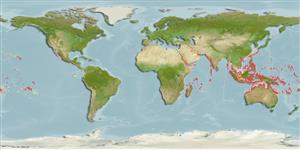
| Native range | All suitable habitat | Point map | Year 2050 |
|
| This map was computer-generated and has not yet been reviewed. |
| Fowleria variegata AquaMaps Data sources: GBIF OBIS |
Envoyez vos Photos et vidéos
Images | Images Google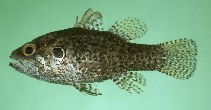 Fowleria variegata
Photo de Randall, J.E.
Images | Images Google
Photo de Randall, J.E.
Classification / Noms Noms communs | Synonymes | Catalog of Fishes(Genre, Espèce) | ITIS | CoL | WoRMS | Cloffa
> Kurtiformes (Nurseryfishes, cardinalfishes.) > Apogonidae (Cardinalfishes) > Apogoninae
Etymology: Fowleria: Taken from Fowler, ichthyiologist, 1945 (Ref. 45335).
Eponymy: Henry Weed Fowler (1878–1965) was an American herpetologist, ornithologist, ichthyologist and artist. [...] (Ref. 128868), visit book page.
More on author: Valenciennes.
Etymology: Fowleria: Taken from Fowler, ichthyiologist, 1945 (Ref. 45335).
Eponymy: Henry Weed Fowler (1878–1965) was an American herpetologist, ornithologist, ichthyologist and artist. [...] (Ref. 128868), visit book page.
More on author: Valenciennes.
Taxonomic Remarks
Junior synonym Apogonichthys polystigma Bleeker, 1854 is considered to be valid as Fowleria polystigma in Ref. 96888.
Environnement : milieu / zone climatique / profondeur / gamme de distribution Écologie
marin récifal; profondeur 0 - 27 m (Ref. 11441). Tropical; 30°N - 24°S
Distribution Territoires | Zones FAO | Écosystèmes | Occurrences | Carte par point | Introductions | Faunafri
Indo-West Pacific: Red Sea, Oman, Persian Gulf, Kenya, Maldives; east to the Samoa Islands; north to Ryukyu Islands and south to New South Wales (Australia).
Taille / Poids / Âge
Description synthétique Clés d'identification | Morphologie | Morphométrie
Épines dorsales (Total) : 8; Rayons mous dorsaux (Total) : 9; Épines anales: 2; Rayons mous anaux: 8. This species is distinguished by the following characters: D VII + I,9; A II,8; pectoral fin rays 12-14; lateral-line scales 23 (23rd overlapping caudal-fin base), the first 10-13 with tubes; median predorsal scales 4; total gill-rakers 3-4 + 11-13; developed rakers 1+ 5-6; rear edge of preopercle ridge smooth, the lower edge membranous and crenulate; body depth 2.5-2.95, head length 2.3-2.4 in SL; snout length 4.2-4.5, eye diameter 3.1-3.8, interorbital width 5.8-7.05, and upper-jaw length 1.9-2.0, all in head length; jaws and vomer with villiform teeth in bands, none on palatines; caudal-peduncle depth 1.15-1.45 in peduncle length, and peduncle length 4.2-4.7 in SL; round shaped caudal fin (Ref. 50837).
Body shape (shape guide): short and / or deep; Cross section: compressed.
Body shape (shape guide): short and / or deep; Cross section: compressed.
Found in coral reefs and seagrass beds of inner bays and shallow lagoons (Ref. 1602); also in dead reef and rubble (Ref. 48635). Nocturnal species (Ref. 7300). Solitary or in small groups (Ref 90102).
Cycle de vie et comportement reproducteur Maturité | Reproduction | Frai | Œufs | Fécondité | Larves
CDistinct pairing during courtship and spawning (Ref. 205).
Référence principale
Téléchargez vos références | Références | Coordinateur | Collaborateurs
Gon, O. and J.E. Randall, 2003. A review of the cardinalfishes (Perciformes: Apogonidae) of the Rea Sea. Smithiana Bull. 1:1-47. (Ref. 50837)
Statut dans la liste rouge de l'IUCN (Ref. 130435: Version 2025-2 (Global))
Préoccupation mineure (LC) ; Date assessed: 05 February 2021
CITES
Not Evaluated
Menace pour l'homme
Harmless
Utilisations par l'homme
FAO - Publication: search | FishSource |
Plus d'informations
Écologie trophique
Aliments (proies)
Composition du régime alimentaire
Consommation alimentaire
Rations alimentaires
Prédateurs
Aliments (proies)
Composition du régime alimentaire
Consommation alimentaire
Rations alimentaires
Prédateurs
Dynamique des populations
Paramètres de croissance
Âges / tailles maximales
Longueur-poids rel.
Rel. longueur-longueur.
Fréquences de longueurs
Conversion de masse
Recrutement
Abondance
Paramètres de croissance
Âges / tailles maximales
Longueur-poids rel.
Rel. longueur-longueur.
Fréquences de longueurs
Conversion de masse
Recrutement
Abondance
Cycle de vie
Reproduction
Maturité
Maturité/épines rel.
Fécondité
Frai
Agrégats de frai
Œufs
Développement de l'œuf
Larves
Dynamique des populations larvaires
Reproduction
Maturité
Maturité/épines rel.
Fécondité
Frai
Agrégats de frai
Œufs
Développement de l'œuf
Larves
Dynamique des populations larvaires
Anatomie
Surface branchiale
Cerveau
Otolithe
Surface branchiale
Cerveau
Otolithe
Physiologie
Composition corporelle
Nutriments
Consommation d'oxygène
Type de natation
Vitesse de nage
Pigments visuels
Son de poisson
Maladies et parasites
Toxicité (CL50)
Composition corporelle
Nutriments
Consommation d'oxygène
Type de natation
Vitesse de nage
Pigments visuels
Son de poisson
Maladies et parasites
Toxicité (CL50)
Génétique
génôme
Génétique
Hétérozygotie
Héritabilité
Diversité génétique
génôme
Génétique
Hétérozygotie
Héritabilité
Diversité génétique
Liées à l'homme
Systèmes d'aquaculture
Profils d'aquaculture
Souches
Cas de ciguatera
Timbres, pièces de monnaie, divers
Systèmes d'aquaculture
Profils d'aquaculture
Souches
Cas de ciguatera
Timbres, pièces de monnaie, divers
Outils
E-book | Guide de terrain | Clés d'identification | Générateur de fréquences de longueur | Outil de dynamique de population | Carte par point |
Capture-MSY |
Articles particuliers
Télécharger en XML
Sources Internet
AFORO (otoliths) | Aquatic Commons | BHL | Cloffa | Websites from users | FishWatcher | CISTI | Catalog of Fishes: Genre, Espèce | DiscoverLife | ECOTOX | FAO - Publication: search | Faunafri | Fishipedia | Fishtrace | GloBI | Google Books | Google Scholar | Google | IGFA World Record | Bases de données nationales | OneZoom | Open Tree of Life | Otolith Atlas of Taiwan Fishes | PubMed | Reef Life Survey | Socotra Atlas | TreeBase | Arbre de Vie | Wikipedia: aller à, chercher | World Records Freshwater Fishing | Zoological Record
Estimations basées sur des modèles
Température préférée (Réf. 123201): 25.3 - 29.3, mean 28.4 °C (based on 3220 cells).
Indice de diversité phylogénétique (Réf. 82804): PD50 = 0.5039 [Uniqueness, from 0.5 = low to 2.0 = high].
Bayesian length-weight: a=0.01445 (0.00864 - 0.02418), b=3.12 (2.97 - 3.27), in cm total length, based on LWR estimates for this species & (Sub)family-body (Ref. 93245).
Niveau trophique (Réf. 69278): 3.5 ±0.50 se; based on food items.
Résilience (Réf. 120179): Haut, temps minimum de doublement de population inférieur à 15 mois (Preliminary K or Fecundity.).
Nutriments (Ref. 124155): Calcium = 178 [87, 315] mg/100g; Iron = 1.13 [0.63, 2.05] mg/100g; Protein = 18.6 [17.3, 19.8] %; Omega3 = 0.129 [0.066, 0.250] g/100g; Selenium = 33.9 [15.6, 71.1] μg/100g; VitaminA = 54.6 [14.8, 203.3] μg/100g; Zinc = 1.99 [1.26, 3.06] mg/100g (wet weight);