



Add your observation in Fish Watcher
| Native range | All suitable habitat | Point map | Year 2050 |

|
| This map was computer-generated and has not yet been reviewed. |
| Labrus bergylta AquaMaps Data sources: GBIF OBIS |
Upload your photos and videos
Pictures | Videos | Google image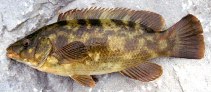 Labrus bergylta
Picture by Østergaard, T.
Pictures | Videos | Google image
Picture by Østergaard, T.
Classification / Names Common names | Synonyms | Catalog of Fishes(genus, species) | ITIS | CoL | WoRMS | Cloffa
Teleostei (teleosts) > Eupercaria/misc (Various families in series Eupercaria) > Labridae (Wrasses) > Labrinae
Etymology: Labrus: Name from Latin 'labrum' for lip, rim or edge; referring to the big lips of the fishes of the genus (from Ovid and Pliny according to Petrus Artedi).
Etymology: Labrus: Name from Latin 'labrum' for lip, rim or edge; referring to the big lips of the fishes of the genus (from Ovid and Pliny according to Petrus Artedi).
Environment: milieu / climate zone / depth range / distribution range Ecology
Marine; reef-associated; depth range 1 - 50 m (Ref. 5292), usually 2 - 30 m (Ref. 35388). Temperate; 5°C - 25°C (Ref. 132294); 64°N - 27°N, 32°W - 22°E
Distribution Territories | FAO areas | Ecosystems | Occurrences | Point map | Introductions | Faunafri
Eastern Atlantic: Norway to Morocco, including Madeira, the Azores and the Canary Islands. Doubtful reports from Mediterranean, Adriatic and Marmara seas (Ref. 4742), where it is often confused with Labrus merula.
Length at first maturity / Size / Weight / Age
Maturity: Lm ? range ? - ? cm
Max length : 65.9 cm TL male/unsexed; (Ref. 40637); common length : 50.0 cm SL male/unsexed; (Ref. 4742); max. published weight: 4.4 kg (Ref. 40637); max. reported age: 34 years (Ref. 131345)
Max length : 65.9 cm TL male/unsexed; (Ref. 40637); common length : 50.0 cm SL male/unsexed; (Ref. 4742); max. published weight: 4.4 kg (Ref. 40637); max. reported age: 34 years (Ref. 131345)
Short description Identification keys | Morphology | Morphometrics
Body rather massive. Mouth small with thick lips and large conical teeth. Coloration very variable, brownish and greenish predominating (Ref. 35388).
Body shape (shape guide): fusiform / normal.
Body shape (shape guide): fusiform / normal.
Adults are found in littoral (10-20 m) zone around rocks, offshore reefs, and seaweed. Young often in intertidal areas. All are born females and change sex when they are 4-14 years old (Ref. 35388). One (or more) female spawns in nest of algae, built by male in a crevice. Feed on crustaceans and mollusks (Ref. 4742). Oviparous (Ref. 205).
Life cycle and mating behavior Maturity | Reproduction | Spawning | Eggs | Fecundity | Larvae
Eggs are laid in nest built from algae; male guards nest 1-2 weeks until larvae hatch (Ref. 35388); larvae are pelagic.
Main reference
Upload your references | References | Coordinator : Westneat, Mark | Collaborators
Quignard, J.-P. and A. Pras, 1986. Labridae. p. 919-942. In P.J.P. Whitehead, M.-L. Bauchot, J.-C. Hureau, J. Nielsen and E. Tortonese (eds.) Fishes of the north-eastern Atlantic and the Mediterranean. UNESCO, Paris. Vol. 2. (Ref. 4742)
IUCN Red List Status (Ref. 130435: Version 2025-2 (Global))
Least Concern (LC) ; Date assessed: 10 August 2008
CITES
Not Evaluated
Threat to humans
Harmless
Human uses
Fisheries: subsistence fisheries; gamefish: yes; aquarium: commercial
FAO - Fisheries: landings search; Publication: search | FishSource | Sea Around Us
More information
Population dynamics
Growth parameters
Max. ages / sizes
Length-weight rel.
Length-length rel.
Length-frequencies
Mass conversion
Recruitment
Abundance
Growth parameters
Max. ages / sizes
Length-weight rel.
Length-length rel.
Length-frequencies
Mass conversion
Recruitment
Abundance
Physiology
Body composition
Nutrients
Oxygen consumption
Swimming type
Swimming speed
Visual pigments
Fish sound
Diseases & Parasites
Toxicity (LC50s)
Body composition
Nutrients
Oxygen consumption
Swimming type
Swimming speed
Visual pigments
Fish sound
Diseases & Parasites
Toxicity (LC50s)
Human related
Aquaculture systems
Aquaculture profiles
Strains
Ciguatera cases
Stamps, coins, misc.
Aquaculture systems
Aquaculture profiles
Strains
Ciguatera cases
Stamps, coins, misc.
Tools
Bio-Quiz | E-book | Field guide | Identification keys | Length-frequency wizard | Life-history tool | Point map |
Catch-MSY |
Special reports
Download XML
Internet sources
AFORO (otoliths) | Aquatic Commons | BHL | Cloffa | Websites from users | Check FishWatcher | CISTI | Catalog of Fishes: genus, species | DiscoverLife | DORIS | ECOTOX | FAO - Fisheries: landings search; Publication: search | Faunafri | Fishipedia | Fishtrace | GloBI | Google Books | Google Scholar | Google | IGFA World Record | National databases | OneZoom | Open Tree of Life | Otolith Atlas of Taiwan Fishes | Public aquariums | PubMed | Reef Life Survey | Socotra Atlas | TreeBase | Tree of Life | Wikipedia: Go, Search | | Zoobank | Zoological Record
Estimates based on models
|
Phylogenetic diversity index (Ref. 82804) |
PD50 = 0.5625 [Uniqueness, from 0.5 = low to 2.0 = high]. |
| Bayesian length-weight | a=0.00977 (0.00561 - 0.01702), b=3.07 (2.92 - 3.22), in cm total length, based on LWR estimates for this species & (Sub)family-body (Ref. 93245). |
|
Trophic level (Ref. 69278) |
3.2 ±0.0 se; based on diet studies. |
|
Resilience (Ref. 120179) |
Low, minimum population doubling time 4.5 - 14 years (K=0.1; tmax=34; tm=2-9). |
|
Fishing Vulnerability (Ref. 59153) |
Moderate to high vulnerability (51 of 100). 🛈 |
|
Climate Vulnerability (Ref. 125649) |
High to very high vulnerability (75 of 100). 🛈 |
|
Price category (Ref. 80766) |
High. |
|
Nutrients (Ref. 124155) |
Calcium = 10.7 [4.4, 18.8] mg/100g; Iron = 0.168 [0.091, 0.360] mg/100g; Protein = 18.7 [15.8, 21.0] %; Omega3 = 0.302 [0.162, 0.565] g/100g; Selenium = 7.99 [3.73, 17.31] μg/100g; VitaminA = 54.7 [13.8, 262.4] μg/100g; Zinc = 0.647 [0.426, 1.163] mg/100g (wet weight); |