



Ellochelon vaigiensis (Quoy & Gaimard, 1825)
Squaretail mullet
Ajouter votre observation dans Fish Watcher
| Native range | All suitable habitat | Point map | Year 2050 |

|
| This map was computer-generated and has not yet been reviewed. |
| Ellochelon vaigiensis AquaMaps Data sources: GBIF OBIS |
Envoyez vos Photos et vidéos
Images | vidéos | Images Google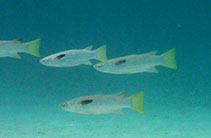 Ellochelon vaigiensis
Photo de Dubosc, J.
Images | vidéos | Images Google
Photo de Dubosc, J.
Classification / Noms Noms communs | Synonymes | Catalog of Fishes(Genre, Espèce) | ITIS | CoL | WoRMS | Cloffa
Taxonomic Remarks
Genetic data indicate that Ellochelon vaigiensis is a complex of species (Ref. 114224). At least 3 species have been recognized (Refs. 114224, 123263, work in progress) and are being described, with probable parapatric distributions (Durand, pers. comm., Nov. 2020).
Environnement : milieu / zone climatique / profondeur / gamme de distribution Écologie
marin; eau douce; saumâtre récifal; catadrome (Ref. 46888); profondeur 0 - 5 m (Ref. 89972). Tropical; 32°N - 24°S, 30°E - 141°W
Distribution Territoires | Zones FAO | Écosystèmes | Occurrences | Carte par point | Introductions | Faunafri
Indo-Pacific: Red Sea and from East Africa to the Tuamoto Islands, north to southern Japan, south to southern Great Barrier Reef and New Caledonia (Ref. 9812).
Taille / Poids / Âge
Maturité: Lm ? range ? - ? cm
Max length : 63.0 cm TL mâle / non sexé; (Ref. 9710); common length : 35.0 cm TL mâle / non sexé; (Ref. 9812)
Max length : 63.0 cm TL mâle / non sexé; (Ref. 9710); common length : 35.0 cm TL mâle / non sexé; (Ref. 9812)
Description synthétique Clés d'identification | Morphologie | Morphométrie
Épines dorsales (Total) : 5; Rayons mous dorsaux (Total) : 8 - 10; Épines anales: 3; Rayons mous anaux: 7 - 9. Diagnosis: This species is distinguished by the following characters: robust body; usually with 16 pectoral-fin rays; 25-29 longitudinal scales; 16 circumpeduncular scales; weakly ctenoid scales; adults with longer snout than eye diameter, shorter in juvenile; poorly developed adipose eyelid, forming narrow rim around eye; weak notch on anteroventral edge of preorbital; truncate caudal fin; colour olive-brown dorsally, flanks and belly silvery to whitish; about 6 brownish stripes on flank formed by longitudinal marks on scales; fins yellowish white with dusky margins except caudal fin yellow and pectoral black dorsally and yellow ventrally (completely black in young); no axillary scale visible in the pectoral fins (Ref. 9812, 90102).
Body shape (shape guide): fusiform / normal; Cross section: oval.
Body shape (shape guide): fusiform / normal; Cross section: oval.
Found in lagoons, reef flats, estuaries, and coastal creeks, in shallow coastal areas and protected sandy shores (Ref. 40488). Usually within tidal influence, but may enter fresh water, ascending 10 km into rivers (Ref. 40488). Forms large schools, frequently in mangrove areas (Ref. 2334). Juveniles may be found in rice fields and mangroves and may be used as bait fish (Ref. 9812). Oviparous, eggs are pelagic and non-adhesive (Ref. 205). Feeds on phytoplankton, small algae and detritus organisms (Ref. 89972). Caught in cast nets, stake
nets, beach seines, and gill nets; marketed fresh and salted; boiled (Thailand), canned or frozen (Australia). Roe also marketed salted and juveniles used as bait fish (Ref. 9812)..
Cycle de vie et comportement reproducteur Maturité | Reproduction | Frai | Œufs | Fécondité | Larves
Référence principale
Téléchargez vos références | Références | Coordinateur : Harrison, Ian | Collaborateurs
Myers, R.F., 1991. Micronesian reef fishes. Second Ed. Coral Graphics, Barrigada, Guam. 298 p. (Ref. 1602)
Statut dans la liste rouge de l'IUCN (Ref. 130435: Version 2025-2 (Global))
Préoccupation mineure (LC) ; Date assessed: 02 July 2016
CITES
Not Evaluated
Menace pour l'homme
Reports of ciguatera poisoning (Ref. 130160)
Utilisations par l'homme
Pêcheries: commercial; Aquaculture: commercial; Aquarium: Commercial; appât: occasionally
FAO - Systèmes d'aquaculture: production; ; Publication: search | FishSource | Sea Around Us
Plus d'informations
Écologie trophique
Aliments (proies)
Composition du régime alimentaire
Consommation alimentaire
Rations alimentaires
Prédateurs
Aliments (proies)
Composition du régime alimentaire
Consommation alimentaire
Rations alimentaires
Prédateurs
Dynamique des populations
Paramètres de croissance
Âges / tailles maximales
Longueur-poids rel.
Rel. longueur-longueur.
Fréquences de longueurs
Conversion de masse
Recrutement
Abondance
Paramètres de croissance
Âges / tailles maximales
Longueur-poids rel.
Rel. longueur-longueur.
Fréquences de longueurs
Conversion de masse
Recrutement
Abondance
Cycle de vie
Reproduction
Maturité
Maturité/épines rel.
Fécondité
Frai
Agrégats de frai
Œufs
Développement de l'œuf
Larves
Dynamique des populations larvaires
Reproduction
Maturité
Maturité/épines rel.
Fécondité
Frai
Agrégats de frai
Œufs
Développement de l'œuf
Larves
Dynamique des populations larvaires
Physiologie
Composition corporelle
Nutriments
Consommation d'oxygène
Type de natation
Vitesse de nage
Pigments visuels
Son de poisson
Maladies et parasites
Toxicité (CL50)
Composition corporelle
Nutriments
Consommation d'oxygène
Type de natation
Vitesse de nage
Pigments visuels
Son de poisson
Maladies et parasites
Toxicité (CL50)
Génétique
génôme
Génétique
Hétérozygotie
Héritabilité
Diversité génétique
génôme
Génétique
Hétérozygotie
Héritabilité
Diversité génétique
Liées à l'homme
Systèmes d'aquaculture
Profils d'aquaculture
Souches
Cas de ciguatera
Timbres, pièces de monnaie, divers
Systèmes d'aquaculture
Profils d'aquaculture
Souches
Cas de ciguatera
Timbres, pièces de monnaie, divers
Outils
E-book | Guide de terrain | Clés d'identification | Générateur de fréquences de longueur | Outil de dynamique de population | Carte par point |
Capture-MSY |
Articles particuliers
Télécharger en XML
Sources Internet
AFORO (otoliths) | Aquatic Commons | BHL | Cloffa | Websites from users | FishWatcher | CISTI | Catalog of Fishes: Genre, Espèce | DiscoverLife | ECOTOX | FAO - Systèmes d'aquaculture: production; ; Publication: search | Faunafri | Fishipedia | Fishtrace | GloBI | Google Books | Google Scholar | Google | IGFA World Record | OneZoom | Open Tree of Life | Otolith Atlas of Taiwan Fishes | PubMed | Reef Life Survey | Socotra Atlas | TreeBase | Arbre de Vie | Wikipedia: aller à, chercher | World Records Freshwater Fishing | Zoological Record
Estimations basées sur des modèles
Température préférée (Réf. 123201): 25.3 - 29.3, mean 28.5 °C (based on 3039 cells).
Indice de diversité phylogénétique (Réf. 82804): PD50 = 1.0000 [Uniqueness, from 0.5 = low to 2.0 = high].
Bayesian length-weight: a=0.01175 (0.00749 - 0.01843), b=3.02 (2.89 - 3.15), in cm total length, based on LWR estimates for this species & (Sub)family-body (Ref. 93245).
Niveau trophique (Réf. 69278): 2.2 ±0.1 se; based on diet studies.
Résilience (Réf. 120179): Milieu, temps minimum de doublement de population : 1,4 à 4,4 années (Preliminary K or Fecundity.).
Nutriments (Ref. 124155): Calcium = 47.6 [18.7, 154.6] mg/100g; Iron = 0.591 [0.262, 1.397] mg/100g; Protein = 19 [17, 21] %; Omega3 = 0.147 [0.070, 0.313] g/100g; Selenium = 24.3 [12.2, 55.8] μg/100g; VitaminA = 54.7 [12.3, 239.4] μg/100g; Zinc = 1.78 [1.12, 2.73] mg/100g (wet weight);