



Alburnus chalcoides (Güldenstädt, 1772)
Danube bleak
Ladda upp din foton och Videor
Bilder | Google image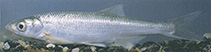 Alburnus chalcoides
Bild av Naseka, A.M.
Bilder | Google image
Bild av Naseka, A.M.
Klassificering / Namn Populärnamn | synonymer | Catalog of Fishes(Släkte, Arter) | ITIS | CoL | WoRMS | Cloffa
> Cypriniformes (Carps) > Leuciscidae (Minnows) > Leuciscinae
Etymology: Alburnus: From the city of Al Bura, where the fish was known (Ref. 45335).
Etymology: Alburnus: From the city of Al Bura, where the fish was known (Ref. 45335).
Miljö: miljö / Klimatzon / djupintervall / distributionsområde Ekologi
; sötvatten; brackvatten bentopelagisk; flodvandrande (Ref. 51243). Temperate; 5°C - 20°C (Ref. 12468); 61°N - 38°N, 9°E - 55°E
Utbredning Territorier | FAO områden | Ekosystem | Förekomster | Prickkarta | Utplanteringar | Faunafri
Europe and Asia: Caspian (mostly western to southern coast, rarely found in Ural and Volga). Populations from Aral Sea basin might belong to this species (Ref. 59043). Reported from the Black Sea basin (Ref. 58342).
Storlek / Vikt / Ålder
Könsmognad: Lm ? range ? - ? cm
Max length : 40.0 cm TL hane/ej könsbestämd; (Ref. 556); common length : 20.0 cm TL hane/ej könsbestämd; (Ref. 1441); common length :28 cm TL (female)
Max length : 40.0 cm TL hane/ej könsbestämd; (Ref. 556); common length : 20.0 cm TL hane/ej könsbestämd; (Ref. 1441); common length :28 cm TL (female)
Kort beskrivning Bestämningsnycklar | Morfologi | Morfometri
Ryggkotor: 42 - 45. Diagnosed from its congeners in Caspian and Black Sea basin by having the following characters: anal fin origin about 1½ -2½ scales behind last branched dorsal ray; lateral line with 54-65 + 4-5 scales; anal fin rays with 13-15½ branched rays; 18-23 gill rakers; ventral keel exposed for 8-12 scales in front of anus (up to almost 80% of distance between anus and pelvic base); head length 20-24% SL; predorsal length 52-56% SL; caudal peduncle depth 1.9-2.4 times in its length; nuptial males with few, large tubercles; lacking dark midlateral stripe. Morphology is variable which has been considered to be an adaptation to different habitats, but data suggest that this is probably due to several species being confused under this species (Ref. 59043).
Body shape (shape guide): fusiform / normal.
Body shape (shape guide): fusiform / normal.
Inhabit lower reaches of rives, coastal lakes, estuaries, and brackish areas of sea. Occur close to surface and tolerate salinities up to 14 ppt. Adults predominantly prey on planktonic crustaceans, terrestrial insects and small fish while larvae and young juveniles feed on zooplankton, algae and insect larvae. Spawn in small rivers or streams with heavy current on gravel bottom. Landlocked populations found in reservoirs spawn in reservoir tributaries (Ref. 59043). Eastern populations migrate upstream for spawning (Ref. 13696). Males assemble and wait at the spawning grounds for ripe females, which arrive later. Deposit sticky eggs which adhere on pebbles or stones. Embryonic development lasts 2-3 days, with larvae first staying among gravel for 8-11 days, then actively migrating to shallows and backwaters. Adults migrate back to sea, lakes or estuaries soon after spawning to forage. Young juvenile undertake downriver migration in autumn of same year or next spring. Due to dam constructions, almost all long-distance migrating populations lost as they were unable to reach spawning sites. Survive in small water courses and as landlocked populations in some reservoirs. Populations are expected to decline and to further decline due to expanding hydroelectric development and strong ecological impacts on Caspian sea (Ref. 59043).
Livscykel och parningsbeteende Könsmognad | Reproduktion | Lek | Ägg | Fekunditet | Larver
Males assemble and wait at the spawning grounds for ripe females, which arrive later. Deposit sticky eggs which adhere on pebbles or stones. Embryonic development lasts 2-3 days, with larvae first staying among gravel for 8-11 days, then actively migrating to shallows and backwaters. Adults migrate back to sea, lakes or estuaries soon after spawning to forage. Young juvenile undertake downriver migration in autumn of same year or next spring (Ref. 59043).
Huvudreferens
Ladda upp dina referenser | referenser | Koordinator | Medarbetare
Kottelat, M. and J. Freyhof, 2007. Handbook of European freshwater fishes. Publications Kottelat, Cornol and Freyhof, Berlin. 646 pp. (Ref. 59043)
Status på IUCN:s rödlista (Ref. 130435: Version 2025-2 (Global))
Least Concern (LC) ; Date assessed: 25 February 2022
CITES
Not Evaluated
Hot mot människor
Harmless
Mänskliga användningsområden
Fiskeri: kommersiell; Vattenbruk: kommersiell
FAO - fiskeri: landningar; Publication: search | FishSource |
Ytterligare information
Populationsdynamik
Tillväxtparametrar
Max. åldrar / storlekar
Längd-vikt rel.
Längd-längd rel.
Längd-frekvenser
Massakonvertering
Rekrytering
Abundans
Tillväxtparametrar
Max. åldrar / storlekar
Längd-vikt rel.
Längd-längd rel.
Längd-frekvenser
Massakonvertering
Rekrytering
Abundans
Livscykel
Reproduktion
Könsmognad
Mognad/Gills rel.
Fekunditet
Lek
Lekande aggregat
Ägg
Utveckling av ägg
Larver
Larvdynamik
Reproduktion
Könsmognad
Mognad/Gills rel.
Fekunditet
Lek
Lekande aggregat
Ägg
Utveckling av ägg
Larver
Larvdynamik
Anatomi
Gälyta
Hjärna
Otolit
Gälyta
Hjärna
Otolit
Fysiologi
Kroppssammansättning
Näringsämnen
Syreförbrukning
Typ av simning
Simhastighet
Visuella pigment
Ljud från fisk
Sjukdomar & Parasiter
Toxicitet (LC50)
Kroppssammansättning
Näringsämnen
Syreförbrukning
Typ av simning
Simhastighet
Visuella pigment
Ljud från fisk
Sjukdomar & Parasiter
Toxicitet (LC50)
Genetik
Genom
Genetik
Heterozygositet
Ärftlighet
Genetisk mångfald
Genom
Genetik
Heterozygositet
Ärftlighet
Genetisk mångfald
Människorelaterad
Vattenbrukssystem
Vattenbruksprofiler
Avelslinjer
Ciguatera-fall
Frimärken, mynt, diverse.
Vattenbrukssystem
Vattenbruksprofiler
Avelslinjer
Ciguatera-fall
Frimärken, mynt, diverse.
Verktyg
Särskilda rapporter
Kontrollera för underhåll av akvarium | Kontrollera om det finns faktablad om arter | Kontrollera om det finns faktablad om vattenbruk
Ladda ner XML
Internet-källor
AFORO (otoliths) | Alien/Invasive Species database | Aquatic Commons | BHL | Cloffa | Websites from users | Check FishWatcher | CISTI | Catalog of Fishes: Släkte, Arter | DiscoverLife | ECOTOX | FAO - fiskeri: landningar; Publication: search | Faunafri | Fishipedia | Fishtrace | GloBI | Google Books | Google Scholar | Google | IGFA World Record | Nationella databaser | OneZoom | Open Tree of Life | Otolith Atlas of Taiwan Fishes | Offentliga akvarier | PubMed | Reef Life Survey | Socotra Atlas | TreeBase | Tree of Life | Wikipedia: Go, sök | World Records Freshwater Fishing | Zoologiskt register
Uppskattningar baserade på modeller
Index för fylogenetisk mångfald (Ref. 82804): PD50 = 0.5000 [Uniqueness, from 0.5 = low to 2.0 = high].
Bayesian length-weight: a=0.00617 (0.00515 - 0.00738), b=3.12 (3.09 - 3.15), in cm total length, based on LWR estimates for this species (Ref. 93245).
Trofisk nivå (Ref. 69278): 3.4 ±0.41 se; based on food items.
Resiliens (Ref. 120179): Mellan, lägsta populationsfördubblingstid 1,4-4,4 år (tm=2-5; tmax=9; K=0.10).