



Alburnus chalcoides (Güldenstädt, 1772)
Danube bleak
Adicionar o seu Fotografias e vídeos
Fotografias | Imagem do Google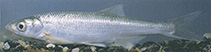 Alburnus chalcoides
Fotografia de Naseka, A.M.
Fotografias | Imagem do Google
Fotografia de Naseka, A.M.
Classificação / Nomes Nomes comuns | Sinónimos | Catalog of Fishes(Género, Espécies) | ITIS | CoL | WoRMS | Cloffa
> Cypriniformes (Carps) > Leuciscidae (Minnows) > Leuciscinae
Etymology: Alburnus: From the city of Al Bura, where the fish was known (Ref. 45335).
Etymology: Alburnus: From the city of Al Bura, where the fish was known (Ref. 45335).
Ambiente: milieu / zona climática / intervalo de profundidade / gama de distribuição Ecologia
; Água doce; estuarina bentopelágico; potamódromo (Ref. 51243). Temperate; 5°C - 20°C (Ref. 12468); 61°N - 38°N, 9°E - 55°E
Distribuição Territórios | Áreas FAO | Ecossistemas | Ocorrências | Mapa dos pontos | Introduções | Faunafri
Europe and Asia: Caspian (mostly western to southern coast, rarely found in Ural and Volga). Populations from Aral Sea basin might belong to this species (Ref. 59043). Reported from the Black Sea basin (Ref. 58342).
Tamanho / Peso / Idade
Maturidade: Lm ? range ? - ? cm
Max length : 40.0 cm TL macho/indeterminado; (Ref. 556); common length : 20.0 cm TL macho/indeterminado; (Ref. 1441); common length :28 cm TL (female)
Max length : 40.0 cm TL macho/indeterminado; (Ref. 556); common length : 20.0 cm TL macho/indeterminado; (Ref. 1441); common length :28 cm TL (female)
Descrição breve Chaves de identificação | Morfologia | Morfometria
Vértebras: 42 - 45. Diagnosed from its congeners in Caspian and Black Sea basin by having the following characters: anal fin origin about 1½ -2½ scales behind last branched dorsal ray; lateral line with 54-65 + 4-5 scales; anal fin rays with 13-15½ branched rays; 18-23 gill rakers; ventral keel exposed for 8-12 scales in front of anus (up to almost 80% of distance between anus and pelvic base); head length 20-24% SL; predorsal length 52-56% SL; caudal peduncle depth 1.9-2.4 times in its length; nuptial males with few, large tubercles; lacking dark midlateral stripe. Morphology is variable which has been considered to be an adaptation to different habitats, but data suggest that this is probably due to several species being confused under this species (Ref. 59043).
Body shape (shape guide): fusiform / normal.
Body shape (shape guide): fusiform / normal.
Inhabit lower reaches of rives, coastal lakes, estuaries, and brackish areas of sea. Occur close to surface and tolerate salinities up to 14 ppt. Adults predominantly prey on planktonic crustaceans, terrestrial insects and small fish while larvae and young juveniles feed on zooplankton, algae and insect larvae. Spawn in small rivers or streams with heavy current on gravel bottom. Landlocked populations found in reservoirs spawn in reservoir tributaries (Ref. 59043). Eastern populations migrate upstream for spawning (Ref. 13696). Males assemble and wait at the spawning grounds for ripe females, which arrive later. Deposit sticky eggs which adhere on pebbles or stones. Embryonic development lasts 2-3 days, with larvae first staying among gravel for 8-11 days, then actively migrating to shallows and backwaters. Adults migrate back to sea, lakes or estuaries soon after spawning to forage. Young juvenile undertake downriver migration in autumn of same year or next spring. Due to dam constructions, almost all long-distance migrating populations lost as they were unable to reach spawning sites. Survive in small water courses and as landlocked populations in some reservoirs. Populations are expected to decline and to further decline due to expanding hydroelectric development and strong ecological impacts on Caspian sea (Ref. 59043).
Ciclo de vida e comportamento de acasalamento Maturidade | Reprodução | Desova | Ovos | Fecundidade | Larvas
Males assemble and wait at the spawning grounds for ripe females, which arrive later. Deposit sticky eggs which adhere on pebbles or stones. Embryonic development lasts 2-3 days, with larvae first staying among gravel for 8-11 days, then actively migrating to shallows and backwaters. Adults migrate back to sea, lakes or estuaries soon after spawning to forage. Young juvenile undertake downriver migration in autumn of same year or next spring (Ref. 59043).
Referência principal
Carregar as suas referências | Referências | Coordenador | Colaboradores
Kottelat, M. and J. Freyhof, 2007. Handbook of European freshwater fishes. Publications Kottelat, Cornol and Freyhof, Berlin. 646 pp. (Ref. 59043)
Categoria na Lista Vermelha da IUCN (Ref. 130435: Version 2025-2 (Global))
Preocupação menor (LC) ; Date assessed: 25 February 2022
CITES
Not Evaluated
Ameaça para o homem
Harmless
Utilização humana
Pescarias: espécies comerciais; Aquacultura: espécies comerciais
FAO - pescarias: desembarques; Publication: search | FishSource |
Mais informação
Ecologia Trófica
Produtos alimentares (presas)
Composição da dieta
Consumo alimentar
Rações alimentares
Predadores
Produtos alimentares (presas)
Composição da dieta
Consumo alimentar
Rações alimentares
Predadores
Dinâmica das populações
Parâmetros de crescimento
Idades / tamanhos máximos
Comprimento-peso rel.
Comprimento-comprimento rel.
Frequência de comprimento
Conversão de massa
Recrutamento
Abundância
Parâmetros de crescimento
Idades / tamanhos máximos
Comprimento-peso rel.
Comprimento-comprimento rel.
Frequência de comprimento
Conversão de massa
Recrutamento
Abundância
Ciclo de vida
Reprodução
Maturidade
Maturidade/Rel. das guelras
Fecundidade
Desova
Agregações de desova
Ovos
Desenvolvimento dos ovos
Larvas
Dinâmica larvar
Reprodução
Maturidade
Maturidade/Rel. das guelras
Fecundidade
Desova
Agregações de desova
Ovos
Desenvolvimento dos ovos
Larvas
Dinâmica larvar
Anatomia
Área branquial
Cérebro
Otólitos
Área branquial
Cérebro
Otólitos
Fisiologia
Composição corporal
Nutrientes
Consumo de oxigénio
Tipo de natação
Velocidade de natação
Pigmentos visuais
Som de peixe
Doenças e Parasitas
Toxicidade (LC50s)
Composição corporal
Nutrientes
Consumo de oxigénio
Tipo de natação
Velocidade de natação
Pigmentos visuais
Som de peixe
Doenças e Parasitas
Toxicidade (LC50s)
Genética
genoma
Genética
Heterozigotia
Hereditariedade
Diversidade genética
genoma
Genética
Heterozigotia
Hereditariedade
Diversidade genética
Relacionado com o ser humano
Sistemas de aquacultura
Perfis para aquacultura
Estirpes
Casos de Ciguatera
Selos, moedas, diversos.
Sistemas de aquacultura
Perfis para aquacultura
Estirpes
Casos de Ciguatera
Selos, moedas, diversos.
Ferramentas
E-book | Guia de campo | Ferramenta auxiliar de frequências de comprimento | Ferramenta sobre a história de vida | Mapa dos pontos |
Captura-MSY |
Relatórios especiais
Descarregue XML
Fontes da internet
AFORO (otoliths) | Alien/Invasive Species database | Aquatic Commons | BHL | Cloffa | Websites from users | Consultar FishWatcher | CISTI | Catalog of Fishes: Género, Espécies | DiscoverLife | ECOTOX | FAO - pescarias: desembarques; Publication: search | Faunafri | Fishipedia | Fishtrace | GloBI | Google Books | Google Scholar | Google | IGFA World Record | Bases de dados nacionais | OneZoom | Open Tree of Life | Otolith Atlas of Taiwan Fishes | Aquários públicos | PubMed | Reef Life Survey | Socotra Atlas | TreeBase | Árvore da vida | Wikipedia: ir para, procurar | World Records Freshwater Fishing | Registo zoológico
Estimativas baseadas em modelos
Índice de diversidade filogenética (Ref. 82804): PD50 = 0.5000 [Uniqueness, from 0.5 = low to 2.0 = high].
Bayesian length-weight: a=0.00617 (0.00515 - 0.00738), b=3.12 (3.09 - 3.15), in cm total length, based on LWR estimates for this species (Ref. 93245).
Nível Trófico (Ref. 69278): 3.4 ±0.41 se; based on food items.
Resiliência (Ref. 120179): Médio, tempo mínimo de duplicação da população 1,4 - 4,4 anos (tm=2-5; tmax=9; K=0.10).