



Sube tu fotos y Vídeos
Imágenes | Google image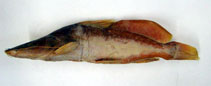 Bagrus bajad
Foto de Musschoot, T.
Imágenes | Google image
Foto de Musschoot, T.
Clasificación / Nombres Nombres comunes | Sinónimos | Catalog of Fishes(Género, Especie) | ITIS | CoL | WoRMS | Cloffa
> Siluriformes (Catfishes) > Bagridae (Bagrid catfishes)
Etymology: Bagrus: Mozarabic, bagre, taken from Greek, pagros = a fish (Dentex sp.) (Ref. 45335).
Etymology: Bagrus: Mozarabic, bagre, taken from Greek, pagros = a fish (Dentex sp.) (Ref. 45335).
Entorno: milieu / zona climática / rango de profundidad / gama de distribución Ecología
; agua dulce demersal; potamodromo (Ref. 51243); rango de profundidad ? - 60 m (Ref. 43507). Tropical; 22°C - 28°C (Ref. 12468)
Distribución Territorios | Áreas FAO | Ecosistemas | Ocurrencias, apariciones | Mapa de puntos | Introducciones | Faunafri
Africa: Nile River, Lake Chad, Niger and Senegal rivers, lakes Mobutu [=Lake Albert] and Turkana (Ref. 3236). Reported from Sanaga River basin (Ref. 27691).
Longitud en la primera madurez / Tamaño / Peso / Edad
Madurez: Lm 37.4, range 29 - 34 cm
Max length : 112 cm FL macho / no sexado; (Ref. 43434); common length : 50.0 cm TL macho / no sexado; (Ref. 13851); peso máximo publicado: 12.5 kg (Ref. 43434); edad máxima reportada: 8 años (Ref. 51644)
Max length : 112 cm FL macho / no sexado; (Ref. 43434); common length : 50.0 cm TL macho / no sexado; (Ref. 13851); peso máximo publicado: 12.5 kg (Ref. 43434); edad máxima reportada: 8 años (Ref. 51644)
Descripción breve Claves de identificación | Morfología | Morfometría
Espinas dorsales (total) : 1; Radios blandos dorsales (total) : 8 - 12; Espinas anales: 0; Radios blandos anales: 13 - 15; Vértebra: 48 - 53. Diagnosis: head much depressed, often ridged (Ref. 4903), roundly pointed when viewed from above (Ref. 28714). Head width 1.6-2.2 times in head length (Ref. 28714, 57125) or 47.5-63% HL (Ref. 81641). Body rather elongate, 5-6 times longer than deep (Ref. 7324, 57125). Premaxillary tooth plate 6-7 times as long as broad, a little shorter than the vomerine tooth plate (Ref. 43434). Occipital process 4-6 times longer than broad (Ref. 57125). 9-11 branched dorsal-fin rays (Ref. 57125), the first prolonged into short filaments (Ref. 13851, 31256, 57125). Longest filament comprised 3-4 times in standard length (Ref. 7324, 57125). Predorsal length 2.4-2.6 times in standard length (Ref. 57125). Adipose fin long, its origin well in front of the anal fin (Ref. 28714), narrowly separated from dorsal fin (Ref. 43434). Width of premaxillary tooth plate 2.5-2.8 times in head length (Ref. 57125). Lobes of caudal fin often with short filaments (Ref. 7324, 13851, 57125). Upper caudal-fin lobe comprised 2-3 times in standard length (Ref. 57125).
Body shape (shape guide): fusiform / normal; Cross section: circular.
Body shape (shape guide): fusiform / normal; Cross section: circular.
Found in lakes, swamps and rivers (Ref. 31256). Avoids salt water (Ref. 31439). Spends nearly the whole of the daylight hours in crevices of rocks and is therefor seldom seen (Ref. 51850). Lives and feeds on or near the bottom (Ref. 3034). Adults exclusively piscivorous (Ref. 31256). Preys on small fish, particularly Alestes spp. (Ref. 13851), or Chrysichthys auratus as in Lake Kainji (Ref. 3034), but also feeds on insects, crustaceans and molluscs (some debris and vegetable matter may also be ingested) (Ref. 28714). Efficiency of catching prey catfish is maximised by face to face attack, avoiding damage by dorsal and pectoral spines of the prey (Ref. 33614). There is some indication that the species comes to shallower water to breed (Ref. 43507). Spawning season extends from April to July (Ref. 51850). Parents build and guard the nest, which is like a flat disc with a central hole where the eggs are dropped; size of the nest and the central hole depend on the fish size (Ref. 51638). Males become up to 7 years old, females 8 years (Ref. 51644). Mean sizes and weight of males are less than those of females from the same age (Ref. 51644, 51645). An important food fish. Flesh is good eating and of economic importance (Ref. 36900), commonly sold as food (Ref. 43521). Reputed to reach 100,000 g.
Ciclo vital y comportamiento de apareamiento Madurez | Reproducción | Puesta | Huevos | Fecundidad | Larva
Reproduction takes place during high water (Ref. 2756). There is some indication that the species comes to shallower water to breed (Ref. 43507). From 4 breeding fish taken, 3 were from inshore waters and 1 from 40m depth in the open water (Ref. 49805). The nest is a relatively large depression with the shape of a flat dish and proportions relative to the size of the fish (Ref. 51638). A single well formed hole of about 10-15cm in diameter and 10-15cm depth is present nearly in the middle (Ref. 51638). Eggs are laid inside this hole (Ref. 51638). Eggs are white, having a diameter of little more than 1 millimeter (Ref. 45962). Larvae stay in the hole a couple of days after hatching (Ref. 51638). They swim above the nest when disturbed and return to hole after disturbance has stopped (Ref. 51638).
Referencia principal
Suba sus referencias | Referencias | Coordinador | Colaboradores
Risch, L.M., 1986. Bagridae. p. 2-35. In J. Daget, J.-P. Gosse and D.F.E. Thys van den Audenaerde (eds.) Check-list of the freshwater fishes of Africa (CLOFFA). ISNB, Brussels; MRAC, Tervuren; and ORSTOM, Paris. Vol. 2. (Ref. 3236)
Situación en la Lista Roja de la UICN (Ref. 130435: Version 2025-2 (Global))
Least Concern (LC) ; Date assessed: 13 January 2020
CITES
Not Evaluated
Amenaza para el ser humano
Harmless
Usos humanos
Pesquerías: comercial; pesca deportiva: si
FAO - Sistemas de acuicultura: producción; ; Publication: search | FishSource |
Más información
Ecología Trófica
Alimentos (presas)
Composición de la dieta
consumo de alimento
Raciones de comida
Despredadores
Alimentos (presas)
Composición de la dieta
consumo de alimento
Raciones de comida
Despredadores
Dinámica de la población
Coeficiente del crecimiento para
Edades / tallas máximas
Longitud-peso rel.
Longitud-longitud rel.
Longitud-frecuencias
Conversión de masas
Reclutamiento
Abundancia
Coeficiente del crecimiento para
Edades / tallas máximas
Longitud-peso rel.
Longitud-longitud rel.
Longitud-frecuencias
Conversión de masas
Reclutamiento
Abundancia
Ciclo de vida
Reproducción
Madurez
Madurez/Gills rel.
Fecundidad
Puesta
Agregaciones de desove
Huevos
Desarrollo de los huevos
Larva
Dinámica larvaria
Reproducción
Madurez
Madurez/Gills rel.
Fecundidad
Puesta
Agregaciones de desove
Huevos
Desarrollo de los huevos
Larva
Dinámica larvaria
Distribución
Territorios
Áreas FAO
Ecosistemas
Ocurrencias, apariciones
Introducciones
BRUVS - Vídeos
Territorios
Áreas FAO
Ecosistemas
Ocurrencias, apariciones
Introducciones
BRUVS - Vídeos
Anatomía
Superficie branquial
Cerebro
Otolito
Superficie branquial
Cerebro
Otolito
Fisiología
Composición corporal
Nutrientes
Consumo del oxígeno
Tipo de natación
Velocidad de natación
Pigmentos visuales
Sonido de peces
Enfermedades y parásitos
Toxicidad (CL50)
Composición corporal
Nutrientes
Consumo del oxígeno
Tipo de natación
Velocidad de natación
Pigmentos visuales
Sonido de peces
Enfermedades y parásitos
Toxicidad (CL50)
Genética
Genoma
Genética
Heterocigosidad
heritabilidad
Diversidad genética
Genoma
Genética
Heterocigosidad
heritabilidad
Diversidad genética
Relacionados con el ser humano
Sistemas de acuicultura
Perfiles de acuicultura
Razas
Ciguatera cases
Sellos, monedas, varios
Sistemas de acuicultura
Perfiles de acuicultura
Razas
Ciguatera cases
Sellos, monedas, varios
Herramientas
Cuestionario orgánico | Libro electrónico | Guía de campo | Claves de identificación | Asistente para frecuencias de tallas | Herramienta de ciclo de vida | Mapa de puntos |
Catch-MSY |
Informes especiales
Comprobar el mantenimiento del acuario | Buscar fichas sobre especies | Consulte las hojas informativas sobre acuicultura
Descargar XML
Fuentes de Internet
AFORO (otoliths) | Aquatic Commons | BHL | Cloffa | Websites from users | Check FishWatcher | CISTI | Catalog of Fishes: Género, Especie | DiscoverLife | ECOTOX | FAO - Sistemas de acuicultura: producción; ; Publication: search | Faunafri | Fishipedia | Fishtrace | GloBI | Google Books | Google Scholar | Google | IGFA World Record | OneZoom | Open Tree of Life | Otolith Atlas of Taiwan Fishes | PubMed | Reef Life Survey | Socotra Atlas | TreeBase | Árbol de la vida | Wikipedia: Go, búsqueda | World Records Freshwater Fishing | Expediente Zoológico
Estimaciones basadas en modelos
Índice de diversidad filogenética (Referencia 82804): PD50 = 0.5005 [Uniqueness, from 0.5 = low to 2.0 = high].
Bayesian length-weight: a=0.01072 (0.00855 - 0.01343), b=2.95 (2.89 - 3.01), in cm total length, based on LWR estimates for this species (Ref. 93245).
Nivel trófico (Referencia 69278): 4.0 ±0.2 se; based on diet studies.
Generation time: 5.6 (4.0 - 13.6) years. Estimated as median ln(3)/K based on 10 growth studies.
Resiliencia (Referencia 120179): Bajo, población duplicada en un tiempo mínimo de 4.5-14 años (tm=4-5; tmax=8; K=0.07-0.18; Fec=18,630-47,920).
Nutrientes (Ref. 124155): Calcium = 61.2 [28.1, 126.1] mg/100g; Iron = 1.58 [0.87, 2.84] mg/100g; Protein = 17.4 [16.1, 18.7] %; Omega3 = 0.412 [0.145, 1.122] g/100g; Selenium = 99.4 [38.0, 226.6] μg/100g; VitaminA = 36.8 [10.7, 134.3] μg/100g; Zinc = 0.968 [0.617, 1.478] mg/100g (wet weight);