



Hochladen Photos und videos
Bilder | Google Bild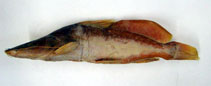 Bagrus bajad
Photo von Musschoot, T.
Bilder | Google Bild
Photo von Musschoot, T.
Klassifizierung / Names Namen | Synonyme | Catalog of Fishes(Gattung, Arten) | ITIS | CoL | WoRMS | Cloffa
> Siluriformes (Catfishes) > Bagridae (Bagrid catfishes)
Etymology: Bagrus: Mozarabic, bagre, taken from Greek, pagros = a fish (Dentex sp.) (Ref. 45335).
Etymology: Bagrus: Mozarabic, bagre, taken from Greek, pagros = a fish (Dentex sp.) (Ref. 45335).
Umwelt: Milieu / Klimazone / Tiefenbereich / Verbreitungsgebiet Ökologie
; süßwasser demersal; potamodrom (Ref. 51243); tiefenbereich ? - 60 m (Ref. 43507). Tropical; 22°C - 28°C (Ref. 12468)
Verbreitung Territorien | FAO Gebiete | Ökosysteme | Vorkommen | Punkt Karte | Einführungen | Faunafri
Africa: Nile River, Lake Chad, Niger and Senegal rivers, lakes Mobutu [=Lake Albert] and Turkana (Ref. 3236). Reported from Sanaga River basin (Ref. 27691).
Länge bei der ersten Reifung / Größe / Gewicht / Alter
Geschlechtsreife: Lm 37.4, range 29 - 34 cm
Max length : 112 cm FL Männchen/unbestimmt; (Ref. 43434); common length : 50.0 cm TL Männchen/unbestimmt; (Ref. 13851); max. veröff. Gewicht: 12.5 kg (Ref. 43434); max. veröff. Alter: 8 Jahre (Ref. 51644)
Max length : 112 cm FL Männchen/unbestimmt; (Ref. 43434); common length : 50.0 cm TL Männchen/unbestimmt; (Ref. 13851); max. veröff. Gewicht: 12.5 kg (Ref. 43434); max. veröff. Alter: 8 Jahre (Ref. 51644)
Kurzbeschreibung Bestimmungsschlüssel | Morphologie | Morphometrie
Rückenflossenstacheln (insgesamt) : 1; Rückenflossenweichstrahlen (insgesamt) : 8 - 12; Afterflossenstacheln: 0; Afterflossenweichstrahlen: 13 - 15; Wirbelzahl: 48 - 53. Diagnosis: head much depressed, often ridged (Ref. 4903), roundly pointed when viewed from above (Ref. 28714). Head width 1.6-2.2 times in head length (Ref. 28714, 57125) or 47.5-63% HL (Ref. 81641). Body rather elongate, 5-6 times longer than deep (Ref. 7324, 57125). Premaxillary tooth plate 6-7 times as long as broad, a little shorter than the vomerine tooth plate (Ref. 43434). Occipital process 4-6 times longer than broad (Ref. 57125). 9-11 branched dorsal-fin rays (Ref. 57125), the first prolonged into short filaments (Ref. 13851, 31256, 57125). Longest filament comprised 3-4 times in standard length (Ref. 7324, 57125). Predorsal length 2.4-2.6 times in standard length (Ref. 57125). Adipose fin long, its origin well in front of the anal fin (Ref. 28714), narrowly separated from dorsal fin (Ref. 43434). Width of premaxillary tooth plate 2.5-2.8 times in head length (Ref. 57125). Lobes of caudal fin often with short filaments (Ref. 7324, 13851, 57125). Upper caudal-fin lobe comprised 2-3 times in standard length (Ref. 57125).
Body shape (shape guide): fusiform / normal; Cross section: circular.
Body shape (shape guide): fusiform / normal; Cross section: circular.
Found in lakes, swamps and rivers (Ref. 31256). Avoids salt water (Ref. 31439). Spends nearly the whole of the daylight hours in crevices of rocks and is therefor seldom seen (Ref. 51850). Lives and feeds on or near the bottom (Ref. 3034). Adults exclusively piscivorous (Ref. 31256). Preys on small fish, particularly Alestes spp. (Ref. 13851), or Chrysichthys auratus as in Lake Kainji (Ref. 3034), but also feeds on insects, crustaceans and molluscs (some debris and vegetable matter may also be ingested) (Ref. 28714). Efficiency of catching prey catfish is maximised by face to face attack, avoiding damage by dorsal and pectoral spines of the prey (Ref. 33614). There is some indication that the species comes to shallower water to breed (Ref. 43507). Spawning season extends from April to July (Ref. 51850). Parents build and guard the nest, which is like a flat disc with a central hole where the eggs are dropped; size of the nest and the central hole depend on the fish size (Ref. 51638). Males become up to 7 years old, females 8 years (Ref. 51644). Mean sizes and weight of males are less than those of females from the same age (Ref. 51644, 51645). An important food fish. Flesh is good eating and of economic importance (Ref. 36900), commonly sold as food (Ref. 43521). Reputed to reach 100,000 g.
Lebenszyklus und Paarungsverhalten Geschlechtsreife | Fortpflanzung | Ablaichen | Eier | Fruchtbarkeit | Larven
Reproduction takes place during high water (Ref. 2756). There is some indication that the species comes to shallower water to breed (Ref. 43507). From 4 breeding fish taken, 3 were from inshore waters and 1 from 40m depth in the open water (Ref. 49805). The nest is a relatively large depression with the shape of a flat dish and proportions relative to the size of the fish (Ref. 51638). A single well formed hole of about 10-15cm in diameter and 10-15cm depth is present nearly in the middle (Ref. 51638). Eggs are laid inside this hole (Ref. 51638). Eggs are white, having a diameter of little more than 1 millimeter (Ref. 45962). Larvae stay in the hole a couple of days after hatching (Ref. 51638). They swim above the nest when disturbed and return to hole after disturbance has stopped (Ref. 51638).
Hauptreferenz
Laden Sie Ihre Referenzen hoch | Referenzen | Koordinator | Partner
Risch, L.M., 1986. Bagridae. p. 2-35. In J. Daget, J.-P. Gosse and D.F.E. Thys van den Audenaerde (eds.) Check-list of the freshwater fishes of Africa (CLOFFA). ISNB, Brussels; MRAC, Tervuren; and ORSTOM, Paris. Vol. 2. (Ref. 3236)
IUCN Rote Liste Status (Ref. 130435: Version 2025-2 (Global))
nicht bedroht (LC) ; Date assessed: 13 January 2020
CITES
Not Evaluated
Bedrohung für Menschen
Harmless
Nutzung durch Menschen
Fischereien: kommerziell; Sportfisch: ja
FAO - Aquakultur-Systeme: produktion; ; Publication: search | FishSource |
Mehr Information
Trophische Ökologie
Lebensmittel (Beutetiere)
Nahrungszusammensetzung
Nahrungsaufnahme
Lebensmittelrationen
Räuber
Lebensmittel (Beutetiere)
Nahrungszusammensetzung
Nahrungsaufnahme
Lebensmittelrationen
Räuber
Populationsdynamik
Wachstumsparameter
Max. Alter/Größen
Länge-Gewicht-Rel.
Länge-Länge-Verhältnis.
Längenhäufigkeiten
Massenkonvertierung
Rekrutierung
Dichte
Wachstumsparameter
Max. Alter/Größen
Länge-Gewicht-Rel.
Länge-Länge-Verhältnis.
Längenhäufigkeiten
Massenkonvertierung
Rekrutierung
Dichte
Lebenszyklus
Fortpflanzung
Geschlechtsreife
Reifung/Kiemen rel.
Fruchtbarkeit
Ablaichen
Laichaggregationen
Eier
Eientwicklung
Larven
Larven Pop.Dyn.
Fortpflanzung
Geschlechtsreife
Reifung/Kiemen rel.
Fruchtbarkeit
Ablaichen
Laichaggregationen
Eier
Eientwicklung
Larven
Larven Pop.Dyn.
Anatomie
Kiemenoberfläche
Gehirn
Otolith
Kiemenoberfläche
Gehirn
Otolith
Physiologie
Körperliche Zusammensetzung
Nährstoffe
Sauerstoffverbrauch
Schwimmart
Schwimmgeschwindigkeit
Visuelle Pigmente
Fischgeräusche
Krankheiten und Parasiten
Toxizität (LC50s)
Körperliche Zusammensetzung
Nährstoffe
Sauerstoffverbrauch
Schwimmart
Schwimmgeschwindigkeit
Visuelle Pigmente
Fischgeräusche
Krankheiten und Parasiten
Toxizität (LC50s)
Genetik
Genom
Genetik
Heterozygotie
Vererbbarkeit
Genetische Vielfalt
Genom
Genetik
Heterozygotie
Vererbbarkeit
Genetische Vielfalt
Menschenbezogen
Aquakultur-Systeme
Aquakultur Profile
Zuchtlinien
Ciguatera-Fälle
Briefmarken, Münzen, Verschiedenes.
Aquakultur-Systeme
Aquakultur Profile
Zuchtlinien
Ciguatera-Fälle
Briefmarken, Münzen, Verschiedenes.
Tools
Bio-Quiz | E-Book | Feldführer | Bestimmungsschlüssel | Längenhäufigkeits Tool | Lebensdaten Tool | Punkt Karte |
Catch-MSY |
Zusatzinformationen
Download XML
Zusammenfassung | Punktdaten | Namen | Photos
Internet Quellen
AFORO (otoliths) | Aquatic Commons | BHL | Cloffa | Websites from users | FishWatcher Einträge suchen | CISTI | Catalog of Fishes: Gattung, Arten | DiscoverLife | ECOTOX | FAO - Aquakultur-Systeme: produktion; ; Publication: search | Faunafri | Fishipedia | Fishtrace | GloBI | Google Books | Google Scholar | Google | IGFA World Record | OneZoom | Open Tree of Life | Otolith Atlas of Taiwan Fishes | PubMed | Reef Life Survey | Socotra Atlas | TreeBase | Tree of Life | Wikipedia: Gehe zu, Suchen | World Records Freshwater Fishing | Zoologischer Rekord
Schätzungen auf der Grundlage von Modellen
Phylogenetischer Diversitätsindex (Ref. 82804): PD50 = 0.5005 [Uniqueness, from 0.5 = low to 2.0 = high].
Bayesian length-weight: a=0.01072 (0.00855 - 0.01343), b=2.95 (2.89 - 3.01), in cm total length, based on LWR estimates for this species (Ref. 93245).
Trophische Ebene (Ref. 69278): 4.0 ±0.2 se; based on diet studies.
Generation time: 5.6 (4.0 - 13.6) years. Estimated as median ln(3)/K based on 10 growth studies.
Widerstandsfähigkeit (Ref. 120179): niedrig, Verdopplung der Population dauert 4,5 - 14 Jahre. (tm=4-5; tmax=8; K=0.07-0.18; Fec=18,630-47,920).
Nährstoffe (Ref. 124155): Calcium = 61.2 [28.1, 126.1] mg/100g; Iron = 1.58 [0.87, 2.84] mg/100g; Protein = 17.4 [16.1, 18.7] %; Omega3 = 0.412 [0.145, 1.122] g/100g; Selenium = 99.4 [38.0, 226.6] μg/100g; VitaminA = 36.8 [10.7, 134.3] μg/100g; Zinc = 0.968 [0.617, 1.478] mg/100g (wet weight);