



Abantennarius nummifer (Cuvier, 1817)
Spotfin frogfish
Uploaden van uw Foto's en video's
Afbeeldingen | video's | Google afbeelding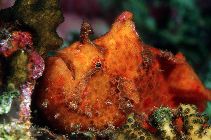 Abantennarius nummifer
Afbeelding van Hernández-González, C.L.
Afbeeldingen | video's | Google afbeelding
Afbeelding van Hernández-González, C.L.
Classificatie / Namen Lokale namen | Synoniemen | Catalog of Fishes(Genus, Soort(en)) | ITIS | CoL | WoRMS | Cloffa
Milieu: milieu / Klimaatzone / Diepte / verspreidingsgebied Ecologie
marien rifbewoner; diepte 0 - 293 m (Ref. 6773), usually 19 - 20 m (Ref. 90102). Subtropical; 40°N - 50°S, 1°W - 147°W (Ref. 57374)
Verspreiding Gebieden | FAO regio's | Ecosystemen | Voorkomen | Verspreidingskaart | Introducties | Faunafri
Eastern Atlantic: Azores, Madeira, the Canary Islands, and St. Helena. Indo-Pacific: Red Sea, Persian Gulf and East Africa to the Hawaiian and Society islands, north to Japan, south to New Zealand.
Grootte / Gewicht / Leeftijd
Korte beschrijving Determinatiesleutels | Morfologie | Morfometrie
Dorsale stekels (totaal) : 3; Dorsale zachte stralen (totaal) : 12 - 13; Anale stekels: 0; Anale zachte stralen: 7 - 8. Color variable, yellow, pink, red, brown, or black. a dark spot at base of posterior dorsal rays (a black phase with tips of pectoral rays white also occurs, Ref# 1602). Illicium about equal in length with 2nd dorsal spine. Bulbous esca with filamentous tentacles (resembling a stout-bodied shrimp, Ref# 1602). Last pelvic fin ray bifurcate. Caudal peduncle present. Eyes usually with bands radiating from its pupil (Ref. 48635).
Body shape (shape guide): short and / or deep; Cross section: compressed.
Body shape (shape guide): short and / or deep; Cross section: compressed.
Sedentary (Ref. 68964). Inhabit intertidal zone to depths of at least 25 m on both lagoon and seaward reefs. May be taken anywhere from the surface to approximately 176 m in the Indo-Pacific area, average depth of known captures at 19 m. Those from Eastern Atlantic at deeper waters, between 44 and 293 m, average depth of 107 m. In life, its esca resembles a tiny stout-bodied shrimp (Ref. 37816). Benthic (Ref. 58302). Oviparous. Eggs are bound in ribbon-like sheath or mass of gelatinous mucus called 'egg raft' or 'veil' (Ref. 6773). Voracious carnivore, attracting prey with front of their cavernous mouth by wriggling their baitshaped first dorsal spine (lure) (Ref. 68964).
Levenscyclus en paargedrag Maturiteit | Voortplanting | Paaien | Eieren | Fecunditeit | Larven
Oviparous. Eggs are bound in ribbon-like sheath or mass of gelatinous mucus called 'egg raft' or 'veil' (Ref. 6773).
Hoofdreferentie
Upload uw referenties | Referenties | Coördinator | Medewerkers
Pietsch, T.W. and D.B. Grobecker, 1987. Frogfishes of the world. Systematics, zoogeography, and behavioral ecology. Stanford University Press, Stanford, California. 420 p. (Ref. 6773)
Status op de Rode Lijst van het IUCN (Ref. 130435: Version 2025-2 (Global))
Niet bedreigd (LC) ; Date assessed: 15 July 2014
CITES
Not Evaluated
Gevaar voor de mens
Harmless
Gebruik door de mens
Visserij: van geen belang
FAO - Publication: search | FishSource |
Meer informatie
Trofische ecologie
Voedsel (prooien)
Dieetsamenstelling
Voedselconsumptie
Voedselrantsoenen
Predatoren
Voedsel (prooien)
Dieetsamenstelling
Voedselconsumptie
Voedselrantsoenen
Predatoren
Populatiedynamica
Groeiparameters
Max. leeftijden / maten
Lengte-gewicht rel.
Lengte-lengte rel.
Lengtefrequenties
Massaconversie
Rekrutering
Abundantie
Groeiparameters
Max. leeftijden / maten
Lengte-gewicht rel.
Lengte-lengte rel.
Lengtefrequenties
Massaconversie
Rekrutering
Abundantie
Levenscyclus
Voortplanting
Maturiteit
Rijpheid/kieuwen rel.
Fecunditeit
Paaien
Paaibestanden
Eieren
Ontwikkeling van de eieren
Larven
Larvale populatiedynamiek
Voortplanting
Maturiteit
Rijpheid/kieuwen rel.
Fecunditeit
Paaien
Paaibestanden
Eieren
Ontwikkeling van de eieren
Larven
Larvale populatiedynamiek
Anatomie
Kieuwoppervlak
Hersenen
Otoliet
Kieuwoppervlak
Hersenen
Otoliet
Fysiologie
Lichaamssamenstelling
Voedingsstoffen
Zuurstofverbruik
Type zwemmen
Zwemsnelheid
Visuele pigmenten
Vis geluid
Ziekten en parasieten
Toxiciteit (LC50)
Lichaamssamenstelling
Voedingsstoffen
Zuurstofverbruik
Type zwemmen
Zwemsnelheid
Visuele pigmenten
Vis geluid
Ziekten en parasieten
Toxiciteit (LC50)
Menselijk gerelateerd
Aquacultuursystemen
Aquacultuurprofielen
Kweeklijnen
Ciguatera gevallen
Postzegels, munten, diversen.
Aquacultuursystemen
Aquacultuurprofielen
Kweeklijnen
Ciguatera gevallen
Postzegels, munten, diversen.
Tools
Biologische quiz | E-boek | Veldgids | Lengtefrequentie Tool | Levenscyclus tool | Verspreidingskaart |
Vangst-MSY |
Speciale rapporten
Bekijk gegevens voor het houden in een aquarium | Bekijk Fact Sheets voor de soort | Bekijk Aquacultuur Fact Sheets
Download XML
Internetbronnen
AFORO (otoliths) | Aquatic Commons | BHL | Cloffa | Websites from users | Bekijk FishWatcher | CISTI | Catalog of Fishes: Genus, Soort(en) | DiscoverLife | ECOTOX | FAO - Publication: search | Faunafri | Fishipedia | Fishtrace | GloBI | Google Books | Google Scholar | Google | IGFA World Record | Nationale databanken | OneZoom | Open Tree of Life | Otolith Atlas of Taiwan Fishes | PubMed | Reef Life Survey | Socotra Atlas | TreeBase | Tree of Life | Wikipedia: ga naar, zoek | World Records Freshwater Fishing | Zoological Record
Schattingen op basis van modellen
Gewenste temperatuur (Ref. 123201): 24.2 - 29, mean 28.2 °C (based on 110 cells).
Fylogenetische diversiteitsindex (Ref. 82804): PD50 = 0.5020 [Uniqueness, from 0.5 = low to 2.0 = high].
Bayesian length-weight: a=0.02692 (0.01067 - 0.06789), b=2.96 (2.73 - 3.19), in cm total length, based on LWR estimates for this (Sub)family-body shape (Ref. 93245).
Trofisch niveau (Ref. 69278): 4.2 ±0.73 se; based on food items.
Weerstandsvermogen (Ref. 120179): Hoog, minimale populatieverdubbelingstijd minder dan 15 maanden (Fec = 48,800).
Voedingsstoffen (Ref. 124155): Calcium = 38.1 [15.9, 94.0] mg/100g; Iron = 0.643 [0.318, 1.325] mg/100g; Protein = 19.2 [16.7, 22.5] %; Omega3 = 0.22 [0.08, 0.60] g/100g; Selenium = 14.5 [5.5, 39.2] μg/100g; VitaminA = 146 [33, 675] μg/100g; Zinc = 0.755 [0.435, 1.248] mg/100g (wet weight);