This website uses cookies to enhance your browsing experience and ensure the functionality of our site. For more detailed information about the types of cookies we use and how we protect your privacy, please visit our Privacy Information page.
×
Cookie Settings
This website uses different types of cookies to enhance your experience. Please select your preferences below:
> Anabantiformes (Gouramies, snakeheads) > Osphronemidae (Gouramies) > Osphroneminae
Etymology: Osphronemus:Greek, osphra = smell + Greek, nema = filament; because of the olfactory organs (Ref. 45335); goramy:Malay/Javanese: ikan gurami, name for this species. More on author: Lacepède.
Asia: probably limited to Sumatra, Borneo, Java, the Malay Peninsula, Thailand and Indochina (Mekong basin). Has been introduced to several countries for aquaculture purposes. Apparently absent in Sarawak and presence in Sabah may be due to relatively late introductions.
Μέγεθος / Βάρος / Ηλικία
Γεννητική Ωρίμανση: Lm? range ? - ? cm Max length : 70.0 cm SL αρσενικό/απροσδιόριστο; (Ref. 12693); common length : 45.0 cm SL αρσενικό/απροσδιόριστο; (Ref. 12693)
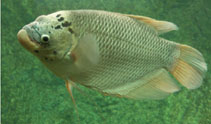
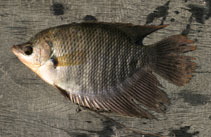
Ραχιαίες άκανθες (συνολικά) : 12 - 14; Μαλακές ραχιαίες ακτίνες (συνολικά) : 10 - 13; Εδρικές άκανθες: 9 - 13; Μαλακές εδρικές ακτίνες: 18 - 21; Σπόνδυλοι: 30 - 31. With 8-10 complete dark vertical bars in juvenile color phase; adults without vertical bars or sexual dichromatism, both sexes drab; transverse scale rows usually 6.1.12; dorsal fin spines usually 12-13 (rarely 11 or 14); soft-rayed portion of anal fin greatly enlarged, its distal margin parallel to distal margin of caudal fin; caudal fin rounded or obtusely rounded, not truncate or emarginate (Ref. 7425). Pelvic fins with first soft ray prolonged into a thread-like tentacle reaching posteriorly to or beyond hind margin of caudal fin. Body shape (shape guide): short and / or deep; Cross section: compressed.
Obligate air-breathing (Ref. 126274); Inhabits swamps, lakes and rivers (Ref. 9987), among vegetation (Ref. 56749). Enters flooded forest (Ref. 9497). Found in medium to large rivers and stagnant water bodies including sluggish flowing canals (Ref. 12975). Omnivorous. Feeds on both plants and animals such as some aquatic weeds, fish, frogs, earthworms and sometimes dead animals (Ref. 6459). Can breathe moist air, so can be kept alive for long periods out of water, making it possible to distribute it in areas lacking a cold chain (Ref. 9987). Was reported from miocene deposits in Central Sumatra (Ref. 7426). Utilized fresh and eaten steamed, pan-fried and baked (Ref. 9987).
Adults make nests made of plant fibers instead of bubble nests as some publications have claimed (Ref. 127550). This error comes from a misidentification of a species according to Bhimachar et al. (1944).
Roberts, T.R., 1992. Systematic revision of the Southeast Asian anabantoid fish genus Osphronemus, with descriptions of two new species. Ichthyol. Explor. Freshwat. 2(4):351-360. (Ref. 7425)
Κατάσταση Κόκκινου Καταλόγου IUCN (Ref. 130435: Version 2025-2 (Global))
Δείκτης φυλογενετικής ποικιλότητας (Αναφ. 82804): PD50 = 0.5625 [Uniqueness, from 0.5 = low to 2.0 = high].
Bayesian length-weight: a=0.01698 (0.00686 - 0.04207), b=3.01 (2.79 - 3.23), in cm total length, based on LWR estimates for this (Sub)family-body shape (Ref. 93245).
Τροφικό Επίπεδο (Αναφ. 69278): 2.8 ±0.32 se; based on food items.
Ελαστικότητα (Αναφ. 120179): Μεσαίο(α), ελάχιστος χρόνος για διπλασιασμό πληθυσμού 1,4 - 4,4 έτη (Assuming tm > 1).
Ευπάθεια στην αλιεία (Ref. 59153): Moderate to high vulnerability (54 of 100). 🛈