



Carica il tuo foto e Video
Immagini | Google image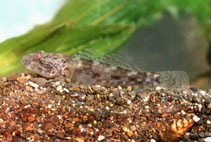 Ponticola gorlap
Immagine di Naseka, A.M.
Immagini | Google image
Immagine di Naseka, A.M.
Classificazione / Nomi Nomi Comuni | Sinonimi | Catalog of Fishes(Genere, Specie) | ITIS | CoL | WoRMS | Cloffa
Ambiente: milieu / zona climatica / distribuzione batimetrica / gamma di distribuzione Ecologia
marino; acqua dolce; salmastro demersale. Temperate
Distribuzione Territories | Aree FAO | Ecosistemi | Presenze | Mappa dei ritrovamenti | Introduzioni | Faunafri
Eurasia: Caspian Sea; in Volga upriver to Astrakhan until 1977, spreaded out to Lakes Ivankovskoje and Rybinskoje (2000); invaded Don drainage (Black Sea basin) through Volga-Don canal (first record in 1972). Abundant in Lake Tsimlyansk and lower Don.
Dimensione / Peso / Età
Maturità: Lm ? range ? - ? cm
Max length : 32.6 cm TL maschio/sesso non determinato; (Ref. 85452); common length : 12.0 cm SL maschio/sesso non determinato; (Ref. 2058)
Max length : 32.6 cm TL maschio/sesso non determinato; (Ref. 85452); common length : 12.0 cm SL maschio/sesso non determinato; (Ref. 2058)
Breve descrizione Chiavi di identificazione | Morfologia | Morfometria
This species is distinguished from its congeners in the Caspian Sea basin by the following characters: 75-95 % of distance between its origin and anus; ctenoid scales completely cover predorsal area and nape; pelvic disc fraenum with angular lobes, fraenum length 1/6-1/2 of its width at base; scales in midlateral series 68-72 + 3-4; snout length 1.5-1.6 times in eye diameter; interorbital distance 0.8-0.9 times eye diameter; first branched ray of second dorsal about as long as penultimate ray; posterior part of first dorsal without black spot. This species is different from N. kessleri in the area in having a distinctive karyotype, some osteological characters and cycloid scales on opercle and anterior part of the nape (vs. ctenoid) (Ref. 59043).
Body shape (shape guide): fusiform / normal.
Body shape (shape guide): fusiform / normal.
Inhabitant of inshore areas, estuaries, brackish and fresh water of lagoons and lakes, large rivers, harbours, on rock (stone or firm sand) bottom; mainly on well vegetated bottom (Ref.13696, 59043). Most females spawn for the first time at 1 year, males at 2 years, in April-May, rarely until July. Adhesive eggs are deposited on stones, shells and aquatic plants and the males guard the eggs after hatching. Feeds mostly on small fish, as well as a wide variety of invertebrates (Ref.59043).
Ciclo vitale e comportamento di accoppiamento Maturità | Riproduzione | Deposizione | Uova | Fecondità | Larve
Riferimento principale
Caricare le referenze | Bibliografia | Coordinatore | Collaboratori
Kottelat, M., 1997. European freshwater fishes. An heuristic checklist of the freshwater fishes of Europe (exclusive of former USSR), with an introduction for non-systematists and comments on nomenclature and conservation. Biologia, Bratislava, 52/Suppl. 5:1-271. (Ref. 13696)
Stato della Lista Rossa IUCN (Ref. 130435: Version 2025-2 (Global))
Least Concern (LC) ; Date assessed: 18 April 2022
CITES
Not Evaluated
Minaccia per l'uomo
Harmless
Usi umani
FAO - Publication: search | FishSource |
Informazioni ulteriori
Ecologia trofica
Articoli alimentari (prede)
Alimentazione
Consumo di cibo
Razioni alimentari
Predatori
Articoli alimentari (prede)
Alimentazione
Consumo di cibo
Razioni alimentari
Predatori
Dinamica della popolazione
Parametri di crescita
Età massima / dimensioni massime
Rapporto lunghezza-peso.
Lunghezza-lunghezza rel.
Lunghezza-frequenze
Conversione di massa
Reclutamento
Abbondanza
Parametri di crescita
Età massima / dimensioni massime
Rapporto lunghezza-peso.
Lunghezza-lunghezza rel.
Lunghezza-frequenze
Conversione di massa
Reclutamento
Abbondanza
Ciclo di vita
Riproduzione
Maturità
Maturità/Gli occhielli sono relativi.
Fecondità
Deposizione
Aggregazioni riproduttive
Uova
Sviluppo delle uova
Larve
Dinamica popolazioni larvali
Riproduzione
Maturità
Maturità/Gli occhielli sono relativi.
Fecondità
Deposizione
Aggregazioni riproduttive
Uova
Sviluppo delle uova
Larve
Dinamica popolazioni larvali
Anatomia
Area branchiale
Cervello
Otolite
Area branchiale
Cervello
Otolite
Fisiologia
Composizione corporea
Nutrienti
Consumo di ossigeno
Tipo di nuoto
Velocità di nuoto
Pigmenti visivi
Suono del pesce
Malattie e parassiti
Tossicità (LC50)
Composizione corporea
Nutrienti
Consumo di ossigeno
Tipo di nuoto
Velocità di nuoto
Pigmenti visivi
Suono del pesce
Malattie e parassiti
Tossicità (LC50)
Legato all'uomo
Sistemi di acquacoltura
Profili di acquacoltura
Varietà
Casi di Ciguatera
Francobolli, monete, materiale vario.
Sistemi di acquacoltura
Profili di acquacoltura
Varietà
Casi di Ciguatera
Francobolli, monete, materiale vario.
Strumenti
Libro elettronico | Giuda pratica | Generatore frequenze di lunghezza | Strumento Parametri Biologici | Mappa dei ritrovamenti |
Cattura-MSY |
Rapporti speciali
Controllo della manutenzione dell'acquario | Verificare la presenza di schede informative sulle specie | Verifica delle schede informative sull'acquacoltura
Scarica XML
Fonti Internet
AFORO (otoliths) | Aquatic Commons | BHL | Cloffa | Websites from users | Check FishWatcher | CISTI | Catalog of Fishes: Genere, Specie | DiscoverLife | ECOTOX | FAO - Publication: search | Faunafri | Fishipedia | Fishtrace | GloBI | Google Books | Google Scholar | Google | IGFA World Record | OneZoom | Open Tree of Life | Otolith Atlas of Taiwan Fishes | PubMed | Reef Life Survey | Socotra Atlas | TreeBase | Tree of Life | Wikipedia: Go, ricerca | World Records Freshwater Fishing | Record zoologico
Stime basate su modelli
Indice di diversità filogenetica (Fonte Biblio. 82804): PD50 = 0.5000 [Uniqueness, from 0.5 = low to 2.0 = high].
Bayesian length-weight: a=0.01259 (0.00631 - 0.02511), b=3.24 (3.08 - 3.40), in cm total length, based on LWR estimates for this species & Genus-body shape (Ref. 93245).
Livello trofico (Fonte Biblio. 69278): 3.8 ±0.4 se; based on diet studies.
Resilienza (Fonte Biblio. 120179): Medio, tempo minimo di raddoppiamento della popolazione 1.4 - 4.4 anni (Preliminary K or Fecundity.).