



Envoyez vos Photos et vidéos
Images | Images Google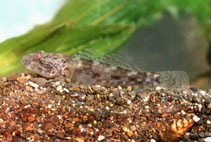 Ponticola gorlap
Photo de Naseka, A.M.
Images | Images Google
Photo de Naseka, A.M.
Classification / Noms Noms communs | Synonymes | Catalog of Fishes(Genre, Espèce) | ITIS | CoL | WoRMS | Cloffa
Environnement : milieu / zone climatique / profondeur / gamme de distribution Écologie
marin; eau douce; saumâtre démersal. Temperate
Distribution Territoires | Zones FAO | Écosystèmes | Occurrences | Carte par point | Introductions | Faunafri
Eurasia: Caspian Sea; in Volga upriver to Astrakhan until 1977, spreaded out to Lakes Ivankovskoje and Rybinskoje (2000); invaded Don drainage (Black Sea basin) through Volga-Don canal (first record in 1972). Abundant in Lake Tsimlyansk and lower Don.
Taille / Poids / Âge
Maturité: Lm ? range ? - ? cm
Max length : 32.6 cm TL mâle / non sexé; (Ref. 85452); common length : 12.0 cm SL mâle / non sexé; (Ref. 2058)
Max length : 32.6 cm TL mâle / non sexé; (Ref. 85452); common length : 12.0 cm SL mâle / non sexé; (Ref. 2058)
Description synthétique Clés d'identification | Morphologie | Morphométrie
This species is distinguished from its congeners in the Caspian Sea basin by the following characters: 75-95 % of distance between its origin and anus; ctenoid scales completely cover predorsal area and nape; pelvic disc fraenum with angular lobes, fraenum length 1/6-1/2 of its width at base; scales in midlateral series 68-72 + 3-4; snout length 1.5-1.6 times in eye diameter; interorbital distance 0.8-0.9 times eye diameter; first branched ray of second dorsal about as long as penultimate ray; posterior part of first dorsal without black spot. This species is different from N. kessleri in the area in having a distinctive karyotype, some osteological characters and cycloid scales on opercle and anterior part of the nape (vs. ctenoid) (Ref. 59043).
Body shape (shape guide): fusiform / normal.
Body shape (shape guide): fusiform / normal.
Inhabitant of inshore areas, estuaries, brackish and fresh water of lagoons and lakes, large rivers, harbours, on rock (stone or firm sand) bottom; mainly on well vegetated bottom (Ref.13696, 59043). Most females spawn for the first time at 1 year, males at 2 years, in April-May, rarely until July. Adhesive eggs are deposited on stones, shells and aquatic plants and the males guard the eggs after hatching. Feeds mostly on small fish, as well as a wide variety of invertebrates (Ref.59043).
Cycle de vie et comportement reproducteur Maturité | Reproduction | Frai | Œufs | Fécondité | Larves
Référence principale
Téléchargez vos références | Références | Coordinateur | Collaborateurs
Kottelat, M., 1997. European freshwater fishes. An heuristic checklist of the freshwater fishes of Europe (exclusive of former USSR), with an introduction for non-systematists and comments on nomenclature and conservation. Biologia, Bratislava, 52/Suppl. 5:1-271. (Ref. 13696)
Statut dans la liste rouge de l'IUCN (Ref. 130435: Version 2025-2 (Global))
Préoccupation mineure (LC) ; Date assessed: 18 April 2022
CITES
Not Evaluated
Menace pour l'homme
Harmless
Utilisations par l'homme
FAO - Publication: search | FishSource |
Plus d'informations
Écologie trophique
Aliments (proies)
Composition du régime alimentaire
Consommation alimentaire
Rations alimentaires
Prédateurs
Aliments (proies)
Composition du régime alimentaire
Consommation alimentaire
Rations alimentaires
Prédateurs
Dynamique des populations
Paramètres de croissance
Âges / tailles maximales
Longueur-poids rel.
Rel. longueur-longueur.
Fréquences de longueurs
Conversion de masse
Recrutement
Abondance
Paramètres de croissance
Âges / tailles maximales
Longueur-poids rel.
Rel. longueur-longueur.
Fréquences de longueurs
Conversion de masse
Recrutement
Abondance
Anatomie
Surface branchiale
Cerveau
Otolithe
Surface branchiale
Cerveau
Otolithe
Physiologie
Composition corporelle
Nutriments
Consommation d'oxygène
Type de natation
Vitesse de nage
Pigments visuels
Son de poisson
Maladies et parasites
Toxicité (CL50)
Composition corporelle
Nutriments
Consommation d'oxygène
Type de natation
Vitesse de nage
Pigments visuels
Son de poisson
Maladies et parasites
Toxicité (CL50)
Liées à l'homme
Systèmes d'aquaculture
Profils d'aquaculture
Souches
Cas de ciguatera
Timbres, pièces de monnaie, divers
Systèmes d'aquaculture
Profils d'aquaculture
Souches
Cas de ciguatera
Timbres, pièces de monnaie, divers
Outils
E-book | Guide de terrain | Générateur de fréquences de longueur | Outil de dynamique de population | Carte par point |
Capture-MSY |
Articles particuliers
Télécharger en XML
Sources Internet
AFORO (otoliths) | Aquatic Commons | BHL | Cloffa | Websites from users | FishWatcher | CISTI | Catalog of Fishes: Genre, Espèce | DiscoverLife | ECOTOX | FAO - Publication: search | Faunafri | Fishipedia | Fishtrace | GloBI | Google Books | Google Scholar | Google | IGFA World Record | OneZoom | Open Tree of Life | Otolith Atlas of Taiwan Fishes | PubMed | Reef Life Survey | Socotra Atlas | TreeBase | Arbre de Vie | Wikipedia: aller à, chercher | World Records Freshwater Fishing | Zoological Record
Estimations basées sur des modèles
Indice de diversité phylogénétique (Réf. 82804): PD50 = 0.5000 [Uniqueness, from 0.5 = low to 2.0 = high].
Bayesian length-weight: a=0.01259 (0.00631 - 0.02511), b=3.24 (3.08 - 3.40), in cm total length, based on LWR estimates for this species & Genus-body shape (Ref. 93245).
Niveau trophique (Réf. 69278): 3.8 ±0.4 se; based on diet studies.
Résilience (Réf. 120179): Milieu, temps minimum de doublement de population : 1,4 à 4,4 années (Preliminary K or Fecundity.).