Anabas testudineus, Climbing perch : fisheries, aquaculture, aquarium

Anabas testudineus (Bloch, 1792)

Climbing perch
Hochladen Photos und videos
Bilder | Briefmarken, Münzen, Verschiedenes. | Google Bild

Klassifizierung / Names Namen | Synonyme | Catalog of Fishes(Gattung, Arten) | ITIS | CoL | WoRMS | Cloffa

> Anabantiformes (Gouramies, snakeheads) > Anabantidae (Climbing gouramies)
Etymology: Anabas: Greek, anabasis = climbing up (Ref. 45335).
More on author: Bloch.

Umwelt: Milieu / Klimazone / Tiefenbereich / Verbreitungsgebiet Ökologie

; süßwasser; brackwasser demersal; potamodrom (Ref. 126106); tiefenbereich 0 - ? m (Ref. 4833). Tropical; 22°C - 30°C (Ref. 1672); 28°N - 10°S

Verbreitung Territorien | FAO Gebiete | Ökosysteme | Vorkommen | Punkt Karte | Einführungen | Faunafri

Asia: India to Wallace line including China. May have been distributed in more areas than were commonly reported.

Größe / Gewicht / Alter

Geschlechtsreife: Lm ?  range ? - ? cm
Max length : 25.0 cm TL Männchen/unbestimmt; (Ref. 4833); common length : 12.5 cm TL Männchen/unbestimmt; (Ref. 2686)

Kurzbeschreibung Bestimmungsschlüssel | Morphologie | Morphometrie

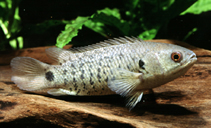
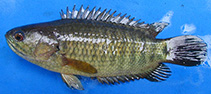
Rückenflossenstacheln (insgesamt) : 16 - 20; Rückenflossenweichstrahlen (insgesamt) : 7 - 10; Afterflossenstacheln: 9 - 11; Afterflossenweichstrahlen: 8 - 11. Color in life dark to pale greenish, very pale below, back dusky to olive; head with longitudinal stripes ventrally; posterior margin of opercle with a dark spot; iris golden reddish. Body form variable, affected by age and amount of food consumed. Scaled head with 4-5 rows between eye and rear margin of preoperculum. Scales large and regularly arranged, ciliate.
Body shape (shape guide): fusiform / normal; Cross section: compressed.

Biologie     Fachlexikon (Englisch) (z.B. epibenthic)

Obligate air-breathing (Ref. 126274); Found mostly in canals, lakes, ponds, swamps and estuaries (Ref. 41236, 57235). Adults occur in medium to large rivers, brooks, flooded fields and stagnant water bodies including sluggish flowing canals (Ref. 12975). Often found in areas with dense vegetation (Ref. 12693). Can tolerate extremely unfavorable water conditions and is associated mainly with turbid, stagnant waters (Ref. 6028). They remain buried under the mud during dry season (Ref. 1479). They feed on macrophytic vegetation, shrimps and fish fry (Ref. 6028). Reported to undertake lateral migration from the Mekong mainstream, or other permanent water bodies, to flooded areas during the flood season and return to the permanent water bodies at the onset of the dry season (Ref. 37770). During the dry season, they stay in pools associated with submerged woods and shrubs (Ref. 37770). Posses an accessory air-breathing organ (Ref. 2847). They are able to survive for several days or weeks out of water if the air breathing organs can be kept moist (Ref. 1479). Quite famous for its ability to walk; important food fish in SE Asia, considered as a tasty food fish (Ref. 6565) but not of the finest quality since it is bony (Ref. 2686). Usually sold live in markets where it is kept alive for several days by keeping it moist (Ref. 12693). Economic foodfish in the Southeast Asia (Ref. 57235).

Lebenszyklus und Paarungsverhalten Geschlechtsreife | Fortpflanzung | Ablaichen | Eier | Fruchtbarkeit | Larven

Guards eggs at the surface of hypoxic waters (Ref. 7471).

Hauptreferenz Laden Sie Ihre Referenzen hoch | Referenzen | Koordinator | Partner

Talwar, P.K. and A.G. Jhingran, 1991. Inland fishes of India and adjacent countries. Volume 2. A.A. Balkema, Rotterdam, i-xxii + 543-1158, 1 pl. (Ref. 4833)

IUCN Rote Liste Status (Ref. 130435: Version 2025-2 (Global))

  nicht bedroht (LC) ; Date assessed: 10 August 2019

CITES

Not Evaluated

CMS (Ref. 116361)

Not Evaluated

Bedrohung für Menschen

  Harmless


Nutzung durch Menschen

Fischereien: kommerziell; Aquakultur: kommerziell; Aquarium: Kommerziell
FAO - Aquakultur-Systeme: produktion; Fischereien: landungen; Publication: search | FishSource |

Mehr Information

Trophische Ökologie
Lebensmittel (Beutetiere)
Nahrungszusammensetzung
Nahrungsaufnahme
Lebensmittelrationen
Räuber
Ökologie
Ökologie
Populationsdynamik
Wachstumsparameter
Max. Alter/Größen
Länge-Gewicht-Rel.
Länge-Länge-Verhältnis.
Längenhäufigkeiten
Massenkonvertierung
Rekrutierung
Dichte
Lebenszyklus
Fortpflanzung
Geschlechtsreife
Reifung/Kiemen rel.
Fruchtbarkeit
Ablaichen
Laichaggregationen
Eier
Eientwicklung
Larven
Larven Pop.Dyn.
Anatomie
Kiemenoberfläche
Gehirn
Otolith
Physiologie
Körperliche Zusammensetzung
Nährstoffe
Sauerstoffverbrauch
Schwimmart
Schwimmgeschwindigkeit
Visuelle Pigmente
Fischgeräusche
Krankheiten und Parasiten
Toxizität (LC50s)
Genetik
Genom
Genetik
Heterozygotie
Vererbbarkeit
Genetische Vielfalt
Menschenbezogen
Aquakultur-Systeme
Aquakultur Profile
Zuchtlinien
Ciguatera-Fälle
Briefmarken, Münzen, Verschiedenes.
Aufsuchen
Partner
Referenzen
Referenzen

Tools

Zusatzinformationen

Download XML

Internet Quellen

AFORO (otoliths) | Alien/Invasive Species database | Aquatic Commons | BHL | Cloffa | Websites from users | FishWatcher Einträge suchen | CISTI | Catalog of Fishes: Gattung, Arten | DiscoverLife | ECOTOX | FAO - Aquakultur-Systeme: produktion; Fischereien: landungen; Publication: search | Faunafri | Fishipedia | Fishtrace | GloBI | Google Books | Google Scholar | Google | IGFA World Record | Nationale Datenbanken | OneZoom | Open Tree of Life | Otolith Atlas of Taiwan Fishes | PubMed | Reef Life Survey | Socotra Atlas | TreeBase | Tree of Life | Wikipedia: Gehe zu, Suchen | World Records Freshwater Fishing | Zoologischer Rekord

Schätzungen auf der Grundlage von Modellen

Phylogenetischer Diversitätsindex (Ref. 82804):  PD50 = 0.7500   [Uniqueness, from 0.5 = low to 2.0 = high].
Bayesian length-weight: a=0.02344 (0.01756 - 0.03129), b=2.93 (2.85 - 3.01), in cm total length, based on LWR estimates for this species (Ref. 93245).
Trophische Ebene (Ref. 69278):  3.0   ±0.4 se; based on diet studies.
Generation time: 0.8 ( na - na) years. Estimated as median ln(3)/K based on 1 growth studies.
Widerstandsfähigkeit (Ref. 120179):  hoch, Verdopplung der Population dauert weniger als 15 Monate. (Assuming tm=1; K=1.4; Fec=40,000-80,000).
Anfälligkeit der Fischerei (Ref. 59153):  Low vulnerability (15 of 100). 🛈
Preiskategorie (Ref. 80766):   Unknown.
Nährstoffe (Ref. 124155):  Calcium = 76.8 [41.1, 193.0] mg/100g; Iron = 1.19 [0.69, 2.09] mg/100g; Protein = 17.8 [16.8, 18.9] %; Omega3 = 0.252 [0.115, 0.556] g/100g; Selenium = 85.1 [35.7, 194.4] μg/100g; VitaminA = 43.8 [20.5, 94.6] μg/100g; Zinc = 0.958 [0.599, 1.533] mg/100g (wet weight); based on nutrient studies.