Anabas testudineus, Climbing perch : fisheries, aquaculture, aquarium

Anabas testudineus (Bloch, 1792)

Climbing perch
Envoyez vos Photos et vidéos
Images | Timbres, pièces de monnaie, divers | Images Google

Classification / Noms Noms communs | Synonymes | Catalog of Fishes(Genre, Espèce) | ITIS | CoL | WoRMS | Cloffa

> Anabantiformes (Gouramies, snakeheads) > Anabantidae (Climbing gouramies)
Etymology: Anabas: Greek, anabasis = climbing up (Ref. 45335).
More on author: Bloch.

Environnement : milieu / zone climatique / profondeur / gamme de distribution Écologie

; eau douce; saumâtre démersal; potamodrome (Ref. 126106); profondeur 0 - ? m (Ref. 4833). Tropical; 22°C - 30°C (Ref. 1672); 28°N - 10°S

Distribution Territoires | Zones FAO | Écosystèmes | Occurrences | Carte par point | Introductions | Faunafri

Asia: India to Wallace line including China. May have been distributed in more areas than were commonly reported.

Taille / Poids / Âge

Maturité: Lm ?  range ? - ? cm
Max length : 25.0 cm TL mâle / non sexé; (Ref. 4833); common length : 12.5 cm TL mâle / non sexé; (Ref. 2686)

Description synthétique Clés d'identification | Morphologie | Morphométrie

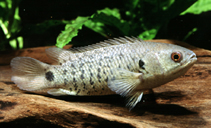
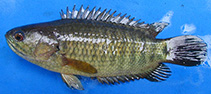
Épines dorsales (Total) : 16 - 20; Rayons mous dorsaux (Total) : 7 - 10; Épines anales: 9 - 11; Rayons mous anaux: 8 - 11. Color in life dark to pale greenish, very pale below, back dusky to olive; head with longitudinal stripes ventrally; posterior margin of opercle with a dark spot; iris golden reddish. Body form variable, affected by age and amount of food consumed. Scaled head with 4-5 rows between eye and rear margin of preoperculum. Scales large and regularly arranged, ciliate.
Body shape (shape guide): fusiform / normal; Cross section: compressed.

Biologie     Glossaire (ex. epibenthic)

Obligate air-breathing (Ref. 126274); Found mostly in canals, lakes, ponds, swamps and estuaries (Ref. 41236, 57235). Adults occur in medium to large rivers, brooks, flooded fields and stagnant water bodies including sluggish flowing canals (Ref. 12975). Often found in areas with dense vegetation (Ref. 12693). Can tolerate extremely unfavorable water conditions and is associated mainly with turbid, stagnant waters (Ref. 6028). They remain buried under the mud during dry season (Ref. 1479). They feed on macrophytic vegetation, shrimps and fish fry (Ref. 6028). Reported to undertake lateral migration from the Mekong mainstream, or other permanent water bodies, to flooded areas during the flood season and return to the permanent water bodies at the onset of the dry season (Ref. 37770). During the dry season, they stay in pools associated with submerged woods and shrubs (Ref. 37770). Posses an accessory air-breathing organ (Ref. 2847). They are able to survive for several days or weeks out of water if the air breathing organs can be kept moist (Ref. 1479). Quite famous for its ability to walk; important food fish in SE Asia, considered as a tasty food fish (Ref. 6565) but not of the finest quality since it is bony (Ref. 2686). Usually sold live in markets where it is kept alive for several days by keeping it moist (Ref. 12693). Economic foodfish in the Southeast Asia (Ref. 57235).

Cycle de vie et comportement reproducteur Maturité | Reproduction | Frai | Œufs | Fécondité | Larves

Guards eggs at the surface of hypoxic waters (Ref. 7471).

Référence principale Téléchargez vos références | Références | Coordinateur | Collaborateurs

Talwar, P.K. and A.G. Jhingran, 1991. Inland fishes of India and adjacent countries. Volume 2. A.A. Balkema, Rotterdam, i-xxii + 543-1158, 1 pl. (Ref. 4833)

Statut dans la liste rouge de l'IUCN (Ref. 130435: Version 2025-2 (Global))

  Préoccupation mineure (LC) ; Date assessed: 10 August 2019

CITES

Not Evaluated

CMS (Ref. 116361)

Not Evaluated

Menace pour l'homme

  Harmless


Utilisations par l'homme

Pêcheries: commercial; Aquaculture: commercial; Aquarium: Commercial
FAO - Systèmes d'aquaculture: production; pêcheries: débarquements; Publication: search | FishSource |

Plus d'informations

Écologie trophique
Aliments (proies)
Composition du régime alimentaire
Consommation alimentaire
Rations alimentaires
Prédateurs
Écologie
Écologie
Dynamique des populations
Paramètres de croissance
Âges / tailles maximales
Longueur-poids rel.
Rel. longueur-longueur.
Fréquences de longueurs
Conversion de masse
Recrutement
Abondance
Cycle de vie
Reproduction
Maturité
Maturité/épines rel.
Fécondité
Frai
Agrégats de frai
Œufs
Développement de l'œuf
Larves
Dynamique des populations larvaires
Anatomie
Surface branchiale
Cerveau
Otolithe
Physiologie
Composition corporelle
Nutriments
Consommation d'oxygène
Type de natation
Vitesse de nage
Pigments visuels
Son de poisson
Maladies et parasites
Toxicité (CL50)
Génétique
génôme
Génétique
Hétérozygotie
Héritabilité
Diversité génétique
Liées à l'homme
Systèmes d'aquaculture
Profils d'aquaculture
Souches
Cas de ciguatera
Timbres, pièces de monnaie, divers
Sensibilisation
Collaborateurs
Références
Références

Outils

Articles particuliers

Télécharger en XML

Sources Internet

AFORO (otoliths) | Alien/Invasive Species database | Aquatic Commons | BHL | Cloffa | Websites from users | FishWatcher | CISTI | Catalog of Fishes: Genre, Espèce | DiscoverLife | ECOTOX | FAO - Systèmes d'aquaculture: production; pêcheries: débarquements; Publication: search | Faunafri | Fishipedia | Fishtrace | GloBI | Google Books | Google Scholar | Google | IGFA World Record | Bases de données nationales | OneZoom | Open Tree of Life | Otolith Atlas of Taiwan Fishes | PubMed | Reef Life Survey | Socotra Atlas | TreeBase | Arbre de Vie | Wikipedia: aller à, chercher | World Records Freshwater Fishing | Zoological Record

Estimations basées sur des modèles

Indice de diversité phylogénétique (Réf. 82804):  PD50 = 0.7500   [Uniqueness, from 0.5 = low to 2.0 = high].
Bayesian length-weight: a=0.02344 (0.01756 - 0.03129), b=2.93 (2.85 - 3.01), in cm total length, based on LWR estimates for this species (Ref. 93245).
Niveau trophique (Réf. 69278):  3.0   ±0.4 se; based on diet studies.
Generation time: 0.8 ( na - na) years. Estimated as median ln(3)/K based on 1 growth studies.
Résilience (Réf. 120179):  Haut, temps minimum de doublement de population inférieur à 15 mois (Assuming tm=1; K=1.4; Fec=40,000-80,000).
Vulnérabilité de la pêche (Ref. 59153):  Low vulnerability (15 of 100). 🛈
Catégorie de prix (Ref. 80766):   Unknown.
Nutriments (Ref. 124155):  Calcium = 76.8 [41.1, 193.0] mg/100g; Iron = 1.19 [0.69, 2.09] mg/100g; Protein = 17.8 [16.8, 18.9] %; Omega3 = 0.252 [0.115, 0.556] g/100g; Selenium = 85.1 [35.7, 194.4] μg/100g; VitaminA = 43.8 [20.5, 94.6] μg/100g; Zinc = 0.958 [0.599, 1.533] mg/100g (wet weight); based on nutrient studies.