



Beobachtung melden im Fish Watcher
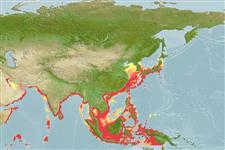
| Native range | All suitable habitat | Point map | Year 2050 |
|
| This map was computer-generated and has not yet been reviewed. |
| Pampus argenteus AquaMaps Data sources: GBIF OBIS |
Hochladen Photos und videos
Bilder | Briefmarken, Münzen, Verschiedenes. | Google Bild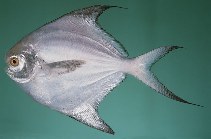 Pampus argenteus
Photo von Randall, J.E.
Bilder | Briefmarken, Münzen, Verschiedenes. | Google Bild
Photo von Randall, J.E.
Klassifizierung / Names Namen | Synonyme | Catalog of Fishes(Gattung, Arten) | ITIS | CoL | WoRMS | Cloffa
Taxonomic Remarks
Pampus cinereus is considered a valid species according to Liu et al., 2013 (Ref. 95516) and P. liuorum Liu & Li, 2013 (Ref. 95101) is a junior synonym of Pampus cinereus according to Yin et al., 2019 (Ref. 123875).
Umwelt: Milieu / Klimazone / Tiefenbereich / Verbreitungsgebiet Ökologie
seewasser benthopelagisch; ozeanodrom (Ref. 51243); tiefenbereich 5 - 110 m (Ref. 12260). Subtropical; 46°N - 10°S, 47°E - 142°E
Verbreitung Territorien | FAO Gebiete | Ökosysteme | Vorkommen | Punkt Karte | Einführungen | Faunafri
Indo-West Pacific: Persian Gulf to Indonesia, north to Hokkaido, Japan. Extralimital captures have been made from the Adriatic and off Hawaii. Not recorded from Australasia. Northeastern Atlantic: 3 reports of capture reported from this area (Ref. 86350).
Länge bei der ersten Reifung / Größe / Gewicht / Alter
Geschlechtsreife: Lm 25.3, range 18 - ? cm
Max length : 60.0 cm SL Männchen/unbestimmt; (Ref. 9811); common length : 30.0 cm SL Männchen/unbestimmt; (Ref. 9811); max. veröff. Alter: 7 Jahre (Ref. 45538)
Max length : 60.0 cm SL Männchen/unbestimmt; (Ref. 9811); common length : 30.0 cm SL Männchen/unbestimmt; (Ref. 9811); max. veröff. Alter: 7 Jahre (Ref. 45538)
Kurzbeschreibung Bestimmungsschlüssel | Morphologie | Morphometrie
Rückenflossenstacheln (insgesamt) : 0; Rückenflossenweichstrahlen (insgesamt) : 37 - 43; Wirbelzahl: 34 - 37. Body firm, very deep, oval, and compressed. Operculum absent; gill opening reduced to a vertical slit on the side of the body; gill membrane broadly united to isthmus. Dorsal and anal fins preceded by a series of 5 to 10 blade-like spines with anterior and posterior points. Pelvic fins absent. Caudal fin deeply forked, the lower lobe longer than the upper. Color is gray above grading to silvery white towards the belly, with small black dots all over the body. Fins are faintly yellow; vertical fins with dark edges.
Body shape (shape guide): short and / or deep; Cross section: compressed.
Body shape (shape guide): short and / or deep; Cross section: compressed.
Inshore species, usually in schools over muddy bottoms, associated with fish species like Nemipterus and Leiognathus. Adults feed on ctenophores, salps, medusae, and other zooplankton groups. Western populations spawn from late winter through the summer with peaks from April to June. Sold fresh in local markets or shipped frozen to urban centers. Used in Chinese medicine (Ref. 12166).
Lebenszyklus und Paarungsverhalten Geschlechtsreife | Fortpflanzung | Ablaichen | Eier | Fruchtbarkeit | Larven
Also Ref. 101194.
Hauptreferenz
Laden Sie Ihre Referenzen hoch | Referenzen | Koordinator | Partner
Haedrich, R.L., 1984. Stromateidae. In W. Fischer and G. Bianchi (eds.) FAO species identification sheets for fishery purposes. Western Indian Ocean (Fishing Area 51). Vol. 4. FAO, Rome. pag. var. (Ref. 3517)
CITES
Not Evaluated
Bedrohung für Menschen
Harmless
Nutzung durch Menschen
Fischereien: hoch kommerziell
FAO - Fischereien: landungen; Publication: search | FishSource | Das Meer um uns herum
Mehr Information
Trophische Ökologie
Lebensmittel (Beutetiere)
Nahrungszusammensetzung
Nahrungsaufnahme
Lebensmittelrationen
Räuber
Lebensmittel (Beutetiere)
Nahrungszusammensetzung
Nahrungsaufnahme
Lebensmittelrationen
Räuber
Populationsdynamik
Wachstumsparameter
Max. Alter/Größen
Länge-Gewicht-Rel.
Länge-Länge-Verhältnis.
Längenhäufigkeiten
Massenkonvertierung
Rekrutierung
Dichte
Wachstumsparameter
Max. Alter/Größen
Länge-Gewicht-Rel.
Länge-Länge-Verhältnis.
Längenhäufigkeiten
Massenkonvertierung
Rekrutierung
Dichte
Lebenszyklus
Fortpflanzung
Geschlechtsreife
Reifung/Kiemen rel.
Fruchtbarkeit
Ablaichen
Laichaggregationen
Eier
Eientwicklung
Larven
Larven Pop.Dyn.
Fortpflanzung
Geschlechtsreife
Reifung/Kiemen rel.
Fruchtbarkeit
Ablaichen
Laichaggregationen
Eier
Eientwicklung
Larven
Larven Pop.Dyn.
Anatomie
Kiemenoberfläche
Gehirn
Otolith
Kiemenoberfläche
Gehirn
Otolith
Physiologie
Körperliche Zusammensetzung
Nährstoffe
Sauerstoffverbrauch
Schwimmart
Schwimmgeschwindigkeit
Visuelle Pigmente
Fischgeräusche
Krankheiten und Parasiten
Toxizität (LC50s)
Körperliche Zusammensetzung
Nährstoffe
Sauerstoffverbrauch
Schwimmart
Schwimmgeschwindigkeit
Visuelle Pigmente
Fischgeräusche
Krankheiten und Parasiten
Toxizität (LC50s)
Menschenbezogen
Aquakultur-Systeme
Aquakultur Profile
Zuchtlinien
Ciguatera-Fälle
Briefmarken, Münzen, Verschiedenes.
Aquakultur-Systeme
Aquakultur Profile
Zuchtlinien
Ciguatera-Fälle
Briefmarken, Münzen, Verschiedenes.
Tools
E-Book | Feldführer | Bestimmungsschlüssel | Längenhäufigkeits Tool | Lebensdaten Tool | Punkt Karte |
Catch-MSY |
Zusatzinformationen
Download XML
Zusammenfassung | Punktdaten | Namen | Photos
Internet Quellen
AFORO (otoliths) | Aquatic Commons | BHL | Cloffa | Websites from users | FishWatcher Einträge suchen | CISTI | Catalog of Fishes: Gattung, Arten | DiscoverLife | ECOTOX | FAO - Fischereien: landungen; Publication: search | Faunafri | Fishipedia | Fishtrace | GloBI | Google Books | Google Scholar | Google | IGFA World Record | Nationale Datenbanken | OneZoom | Open Tree of Life | Otolith Atlas of Taiwan Fishes | PubMed | Reef Life Survey | RFE Bestimmung | Socotra Atlas | TreeBase | Tree of Life | Wikipedia: Gehe zu, Suchen | World Records Freshwater Fishing | Zoologischer Rekord
Schätzungen auf der Grundlage von Modellen
Bevorzugte Temperatur (Ref. 123201): 21.9 - 29.1, mean 28.1 °C (based on 1636 cells).
Phylogenetischer Diversitätsindex (Ref. 82804): PD50 = 0.5313 [Uniqueness, from 0.5 = low to 2.0 = high].
Bayesian length-weight: a=0.01820 (0.01399 - 0.02367), b=3.02 (2.95 - 3.09), in cm total length, based on LWR estimates for this species (Ref. 93245).
Trophische Ebene (Ref. 69278): 3.3 ±0.1 se; based on diet studies.
Widerstandsfähigkeit (Ref. 120179): mittel, Verdopplung der Population dauert 1,4 - 4,4 Jahre. (K=0.24-0.26; tmax=7; Fec=5,470).
Prior r = 0.57, 95% CL = 0.37 - 0.85, Based on 9 data-limited stock assessments.
Nährstoffe (Ref. 124155): Calcium = 30.2 [12.9, 71.1] mg/100g; Iron = 0.423 [0.222, 1.065] mg/100g; Protein = 18 [17, 19] %; Omega3 = 0.264 [0.154, 0.448] g/100g; Selenium = 68.2 [22.3, 198.9] μg/100g; VitaminA = 7.21 [1.85, 26.63] μg/100g; Zinc = 0.442 [0.263, 0.770] mg/100g (wet weight); based on nutrient studies.