



Cirrhinus molitorella (Valenciennes, 1844)
Mud carp
Carica il tuo foto e Video
Immagini | Google image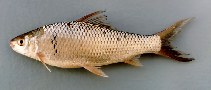 Cirrhinus molitorella
Immagine di Warren, T.
Immagini | Google image
Immagine di Warren, T.
Classificazione / Nomi Nomi Comuni | Sinonimi | Catalog of Fishes(Genere, Specie) | ITIS | CoL | WoRMS | Cloffa
> Cypriniformes (Carps) > Cyprinidae (Minnows or carps) > Labeoninae
Etymology: Cirrhinus: Latin, cirrus = curl fringe (Ref. 45335).
More on author: Valenciennes.
Etymology: Cirrhinus: Latin, cirrus = curl fringe (Ref. 45335).
More on author: Valenciennes.
Ambiente: milieu / zona climatica / distribuzione batimetrica / gamma di distribuzione Ecologia
; acqua dolce benthopelagico; potamodromo (Ref. 33488); distribuzione batimetrica 5 - 20 m (Ref. 6898). Tropical; 22°C - 26°C (Ref. 2059); 24°N - 12°N, 98°E - 108°E
Distribuzione Territories | Aree FAO | Ecosistemi | Presenze | Mappa dei ritrovamenti | Introduzioni | Faunafri
Asia: Mekong, Chao Phraya, Nam Theun, Xe Bangfai and the Nanpangjiang basins; also from the Red River (China and Viet Nam).
Dimensione / Peso / Età
Maturità: Lm ? range ? - ? cm
Max length : 55.0 cm TL maschio/sesso non determinato; (Ref. 37769); common length : 15.2 cm SL maschio/sesso non determinato; (Ref. 35840); peso massimo pubblicato: 1.5 kg (Ref. 128592)
Max length : 55.0 cm TL maschio/sesso non determinato; (Ref. 37769); common length : 15.2 cm SL maschio/sesso non determinato; (Ref. 35840); peso massimo pubblicato: 1.5 kg (Ref. 128592)
Breve descrizione Chiavi di identificazione | Morfologia | Morfometria
Spine dorsali (totale) : 0; Raggi dorsali molli (totale) : 11 - 15; Vertebre: 34 - 38. Has 37-43 scales on the lateral line (including those on base of caudal-fin); 7-8+1/2 scale rows between lateral line and dorsal-fin origin (Ref. 27732). Differs from all other species of the genus in having more or less discrete marks on each scale on the upper, middle, and sometimes lower parts of the body. Such marks, visible in most freshly caught and recently preserved specimens, are sometimes intensely developed, giving the fish a markedly reticulated appearance. C. molitorella often has a very intense humeral mark which is vivid bluish-green in life. In other Cirrhinus the humeral marks are black or bluish black (Ref. 33488). Usually a conspicuous black bar shortly behind pectoral base (Ref. 43281). Gill rakers on the lower arm of first arch 65-85 (Ref. 12693).
Body shape (shape guide): fusiform / normal.
Body shape (shape guide): fusiform / normal.
Known from midwater to bottom depths of large and medium-sized rivers. Move into flooded forests during the rainy season and grazes on algae, phytoplankton and detritus (Ref. 12693). Occur in rapids and slow deep reaches (Ref. 37769). Reported to be omnivorous (Ref. 33813). Wild stocks are strongly migratory while the cultivated stocks probably have lost the migratory behavior (Ref. 33488). Prefer flowing water and not known to proliferate in impoundments. Large fish are marketed fresh, smaller ones are used to make prahoc (Ref. 12693). Attain at least 40 cm SL (Ref. 33488).
Ciclo vitale e comportamento di accoppiamento Maturità | Riproduzione | Deposizione | Uova | Fecondità | Larve
Assuming standard cyprinid mode of reproduction. Replace ASAP.
Riferimento principale
Caricare le referenze | Bibliografia | Coordinatore | Collaboratori
Roberts, T.R., 1997. Systematic revision of the tropical Asian labeon cyprinid fish genus Cirrhinus, with descriptions of new species and biological observations on C. lobatus. Nat. Hist. Bull. Siam Soc. 45:171-203. (Ref. 33488)
Stato della Lista Rossa IUCN (Ref. 130435: Version 2025-2 (Global))
Near Threatened (NT) ; Date assessed: 19 April 2010
CITES
Not Evaluated
Minaccia per l'uomo
Harmless
Usi umani
Pesca: commerciale; Acquacoltura: commerciale
FAO - Sistemi di acquacoltura: produzione, profilo della specie; pesca: sbarchi; Publication: search | FishSource |
Informazioni ulteriori
Ecologia trofica
Articoli alimentari (prede)
Alimentazione
Consumo di cibo
Razioni alimentari
Predatori
Articoli alimentari (prede)
Alimentazione
Consumo di cibo
Razioni alimentari
Predatori
Dinamica della popolazione
Parametri di crescita
Età massima / dimensioni massime
Rapporto lunghezza-peso.
Lunghezza-lunghezza rel.
Lunghezza-frequenze
Conversione di massa
Reclutamento
Abbondanza
Parametri di crescita
Età massima / dimensioni massime
Rapporto lunghezza-peso.
Lunghezza-lunghezza rel.
Lunghezza-frequenze
Conversione di massa
Reclutamento
Abbondanza
Ciclo di vita
Riproduzione
Maturità
Maturità/Gli occhielli sono relativi.
Fecondità
Deposizione
Aggregazioni riproduttive
Uova
Sviluppo delle uova
Larve
Dinamica popolazioni larvali
Riproduzione
Maturità
Maturità/Gli occhielli sono relativi.
Fecondità
Deposizione
Aggregazioni riproduttive
Uova
Sviluppo delle uova
Larve
Dinamica popolazioni larvali
Anatomia
Area branchiale
Cervello
Otolite
Area branchiale
Cervello
Otolite
Fisiologia
Composizione corporea
Nutrienti
Consumo di ossigeno
Tipo di nuoto
Velocità di nuoto
Pigmenti visivi
Suono del pesce
Malattie e parassiti
Tossicità (LC50)
Composizione corporea
Nutrienti
Consumo di ossigeno
Tipo di nuoto
Velocità di nuoto
Pigmenti visivi
Suono del pesce
Malattie e parassiti
Tossicità (LC50)
Legato all'uomo
Sistemi di acquacoltura
Profili di acquacoltura
Varietà
Casi di Ciguatera
Francobolli, monete, materiale vario.
Sistemi di acquacoltura
Profili di acquacoltura
Varietà
Casi di Ciguatera
Francobolli, monete, materiale vario.
Strumenti
Libro elettronico | Giuda pratica | Chiavi di identificazione | Generatore frequenze di lunghezza | Strumento Parametri Biologici | Mappa dei ritrovamenti |
Cattura-MSY |
Rapporti speciali
Controllo della manutenzione dell'acquario | Verificare la presenza di schede informative sulle specie | Verifica delle schede informative sull'acquacoltura
Scarica XML
Fonti Internet
AFORO (otoliths) | Alien/Invasive Species database | Aquatic Commons | BHL | Cloffa | Websites from users | Check FishWatcher | CISTI | Catalog of Fishes: Genere, Specie | DiscoverLife | ECOTOX | FAO - Sistemi di acquacoltura: produzione, profilo della specie; pesca: sbarchi; Publication: search | Faunafri | Fishipedia | Fishtrace | GloBI | Google Books | Google Scholar | Google | IGFA World Record | Database Nazionali | OneZoom | Open Tree of Life | Otolith Atlas of Taiwan Fishes | PubMed | Reef Life Survey | Socotra Atlas | TreeBase | Tree of Life | Wikipedia: Go, ricerca | World Records Freshwater Fishing | Record zoologico
Stime basate su modelli
Indice di diversità filogenetica (Fonte Biblio. 82804): PD50 = 0.5020 [Uniqueness, from 0.5 = low to 2.0 = high].
Bayesian length-weight: a=0.00933 (0.00798 - 0.01091), b=3.05 (3.01 - 3.09), in cm total length, based on LWR estimates for this species (Ref. 93245).
Livello trofico (Fonte Biblio. 69278): 2.0 ±0.00 se; based on food items.
Generation time: 9.4 ( na - na) years. Estimated as median ln(3)/K based on 1 growth studies.
Resilienza (Fonte Biblio. 120179): Medio, tempo minimo di raddoppiamento della popolazione 1.4 - 4.4 anni (tm=3; K=0.12; Fec=100,000-204,000).
Nutrienti (Ref. 124155): Calcium = 199 [104, 403] mg/100g; Iron = 1.44 [0.71, 2.74] mg/100g; Protein = 17 [16, 18] %; Omega3 = 0.387 [0.153, 1.082] g/100g; Selenium = 192 [71, 449] μg/100g; VitaminA = 26.7 [10.8, 69.9] μg/100g; Zinc = 0.99 [0.51, 1.77] mg/100g (wet weight); based on nutrient studies.