



個人による観察記録の追加 Fish Watcher
| Native range | All suitable habitat | Point map | Year 2050 |
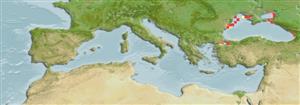
|
| This map was computer-generated and has not yet been reviewed. |
| Alosa tanaica AquaMaps Data sources: GBIF OBIS |

分類 / 名前 共通名の | 類義語 | Catalog of Fishes(部類, 種) | ITIS | CoL | WoRMS | Cloffa
> Clupeiformes (Herrings) > Alosidae (Shads and Sardines)
Etymology: Alosa: Latin, alausa = a fish cited by Ausonius and Latin, halec = pickle, dealing with the Greek word hals = salt; it is also the old Saxon name for shad = "alli" ; 1591 (Ref. 45335).
Eponymy: This is a toponym referring to Tana or Tanais, the medieval trading city on the Sea of Azov, where it occurs. (Ref. 128868), visit book page.
Etymology: Alosa: Latin, alausa = a fish cited by Ausonius and Latin, halec = pickle, dealing with the Greek word hals = salt; it is also the old Saxon name for shad = "alli" ; 1591 (Ref. 45335).
Eponymy: This is a toponym referring to Tana or Tanais, the medieval trading city on the Sea of Azov, where it occurs. (Ref. 128868), visit book page.
環境:環境 / 気候帯 / 深さの範囲 / 分布範囲 生態学
海; 新鮮な水; 汽水性の pelagic-neritic; 昇流魚 (Ref. 138126); 深さの範囲 50 - 70 m (Ref. 59043). Temperate; 48°N - 40°N, 26°E - 44°E
分布 領土 | 国連食糧農業機関の区域 | エコシステム | 事件 | 目的のマップ | 導入 | Faunafri
Eurasia: Black Sea and Sea of Azov from where adults ascend rivers, migrating a short distance upstream to spawn.
サイズ / 重さ / 年齢
成熟: Lm ? range ? - ? cm
Max length : 30.0 cm TL オス/雌雄の選別がない; (Ref. 96734); 最大公表体重: 59.00 g (Ref. 593)
Max length : 30.0 cm TL オス/雌雄の選別がない; (Ref. 96734); 最大公表体重: 59.00 g (Ref. 593)
簡単な記述 検索表 | 形態学 | 形態計測学
Distinguished from its congeners entering freshwater in Black Sea basins by having 66-96 gill rakers, longer than branchial filaments and poorly-developed teeth on palatine and vomer (Ref. 59043).
Body shape (shape guide): fusiform / normal.
Body shape (shape guide): fusiform / normal.
This species migrates from sea to mouth and lower reaches of large rivers (at 1-2 years) and spawns in fresh or slightly brackish water, usually close to the shore, upper 2-4 m, in almost still water bodies as flood plains or lakes. Many individuals spawn 2-4 seasons and spawners appear along the coast in late January to March, enter rivers when temperature reaches about 10°C in late April to May, and spawns at about 15°C or beyond in May to June. Eggs are bathypelagic or sink to bottom. Spent fish migrate to estuarine and coastal lagoons or to sea near river mouths to feed and in autumn, move to sea near river mouths to overwinter. Juveniles migrate to sea or estuaries during first summer and remain there until maturity. At sea, feeds on a wide variety of zooplankton (crustaceans), insect larvae and small fish. Populations seem to have stabilized at moderate level after most have declined during the first decades of 20th century due to water pollution. In northern Black Sea, immediate impact is foreseen due to the decline in habitat quality in suitable estuarine ecosystems. On the other hand, the species is still abundant in Azov Sea basin (Ref. 59043).
ライフサイクルと交尾行動 成熟 | 繁殖 | 放精 | 卵 | 生産力 | 幼生
Juveniles migrate to sea or estuaries during their first summer, remaining there until they mature. After 1-2 years, they migrate upriver to breed. Spawners appear along the coast in late January-March, enter rivers when temperature reaches about 10°C, in late April and May. Spawning occurs from May to June on or above 15°C. Spent individuals migrate to estuaries and coastal lagoons or to sea near river mouths to feed. In autumn, they move to the sea to overwinter (Ref. 59043).
主な参考文献
参考文献のアップロード | 参考文献 | コーディネーター | 協力者
Berg, L.S., 1962. Freshwater fishes of the U.S.S.R. and adjacent countries. volume 1, 4th edition. Israel Program for Scientific Translations Ltd, Jerusalem. (Russian version published 1948). (Ref. 593)
CITES
Not Evaluated
人間に対する脅威
Harmless
人間の用途
水産業: 商業
FAO - Publication: search | FishSource |
より多くの情報
解剖学
カマ
脳
オトリス
カマ
脳
オトリス
生理学
体組成
栄養素
酸素消費
水泳タイプ
泳ぐ速さ
視覚色素
フィッシュ・サウンド
病気と寄生虫
毒性(LC50)
体組成
栄養素
酸素消費
水泳タイプ
泳ぐ速さ
視覚色素
フィッシュ・サウンド
病気と寄生虫
毒性(LC50)
遺伝子の
ゲノム
遺伝子の
ヘテロ接合性
遺伝
遺伝的多様性
ゲノム
遺伝子の
ヘテロ接合性
遺伝
遺伝的多様性
用具
特記事項
XMLをダウンロードして下さい
インターネットの情報源
AFORO (otoliths) | Aquatic Commons | BHL | Cloffa | Websites from users | Check FishWatcher | CISTI | Catalog of Fishes: 部類, 種 | DiscoverLife | ECOTOX | FAO - Publication: search | Faunafri | Fishipedia | Fishtrace | GloBI | Google Books | Google Scholar | Google | IGFA World Record | 国のデーターベース | OneZoom | Open Tree of Life | Otolith Atlas of Taiwan Fishes | PubMed | Reef Life Survey | Socotra Atlas | TreeBase | 生命の木 | Wikipedia: 行く, 検索する | World Records Freshwater Fishing | 動物に関する記録
モデルに基づく推定値
好ましい温度 (参照 123201): 7.6 - 12, mean 7.6 °C (based on 6 cells).
系統多様性指数 (参照 82804): PD50 = 0.5000 [Uniqueness, from 0.5 = low to 2.0 = high].
Bayesian length-weight: a=0.00646 (0.00436 - 0.00957), b=3.11 (2.99 - 3.23), in cm total length, based on LWR estimates for this species & Genus-body shape (Ref. 93245).
栄養段階 (参照 69278): 3.7 ±0.4 se; based on size and trophs of closest relatives
回復力 (参照 120179): 手段, 1.4年~4.4年の倍増期間の最小個体群 (Preliminary K or Fecundity.).