



Hypoplectrus aberrans Poey, 1868
Yellowbelly hamlet
Lägg till din observation i Fish Watcher
| Native range | All suitable habitat | Point map | Year 2050 |

|
| This map was computer-generated and has not yet been reviewed. |
| Hypoplectrus aberrans AquaMaps Data sources: GBIF OBIS |
Ladda upp din foton och Videor
Bilder | Frimärken, mynt, diverse. | Google image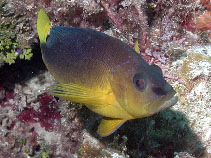 Hypoplectrus aberrans
Bild av Steele, M.A.
Bilder | Frimärken, mynt, diverse. | Google image
Bild av Steele, M.A.
Klassificering / Namn Populärnamn | synonymer | Catalog of Fishes(Släkte, Arter) | ITIS | CoL | WoRMS | Cloffa
> Perciformes/Serranoidei (Groupers) > Serranidae (Sea basses: groupers and fairy basslets)
Etymology: Hypoplectrus: Greek, hypo = under + Greek, plektron = sting, spur (Ref. 45335).
More on author: Poey.
Etymology: Hypoplectrus: Greek, hypo = under + Greek, plektron = sting, spur (Ref. 45335).
More on author: Poey.
Miljö: miljö / Klimatzon / djupintervall / distributionsområde Ekologi
marina revassocierade; djupintervall 3 - 15 m (Ref. 9710). Tropical
Utbredning Territorier | FAO områden | Ekosystem | Förekomster | Prickkarta | Utplanteringar | Faunafri
Western Central Atlantic: there are two color morphs that may be genetically different. Form 1 (brown dorsally and yellow ventrally, the brown pigment may extend farther ventrally than the blue pigment in form 2, leaving only the ventral surface yellow ) is found in Central America. Form 2 (blue or brown dorsally and yellow ventrally) is found in the Virgin Islands and the Greater Antilles. The only record from the Lesser Antilles is from Dominica. Although one specimen has been recorded from Florida (UMML 7085, specimen missing) this locality may be in error because no other specimen has been sighted in Florida apart from that record.
Storlek / Vikt / Ålder
Kort beskrivning Bestämningsnycklar | Morfologi | Morfometri
Form 1: divided into brown dorsally and yellow ventrally (margin between the two colors usually located at the midline, but the brown may sometimes extend lower leaving only the belly yellow); dorsal fin brown, all other fins yellow to yellowish brown; face brownish yellow; sometimes with a small black spot occurring at the dorsal region of the caudal peduncle. Form 2: divided into blue or brown dorsally (the blue pigment covering a much smaller area than the brown pigment in form 1, restricted to the region of the back and not extending to the midline).
Body shape (shape guide): short and / or deep.
Body shape (shape guide): short and / or deep.
A solitary species (Ref. 26340) inhabiting rocky and coral reefs (Ref. 9710). Feeds on crustaceans (primarily shrimps) (Ref. 26180).
Livscykel och parningsbeteende Könsmognad | Reproduktion | Lek | Ägg | Fekunditet | Larver
Huvudreferens
Ladda upp dina referenser | referenser | Koordinator : Heemstra, Phillip C. | Medarbetare
Domeier, M.L., 1994. Speciation in the serranid fish Hypoplectrus. Bull. Mar. Sci. 54(1):103-141. (Ref. 26407)
Status på IUCN:s rödlista (Ref. 130435: Version 2025-2 (Global))
Least Concern (LC) ; Date assessed: 21 August 2012
CITES
Not Evaluated
Hot mot människor
Harmless
Mänskliga användningsområden
Fiskeri: kommersiell
FAO - Publication: search | FishSource |
Ytterligare information
Populationsdynamik
Tillväxtparametrar
Max. åldrar / storlekar
Längd-vikt rel.
Längd-längd rel.
Längd-frekvenser
Massakonvertering
Rekrytering
Abundans
Tillväxtparametrar
Max. åldrar / storlekar
Längd-vikt rel.
Längd-längd rel.
Längd-frekvenser
Massakonvertering
Rekrytering
Abundans
Livscykel
Reproduktion
Könsmognad
Mognad/Gills rel.
Fekunditet
Lek
Lekande aggregat
Ägg
Utveckling av ägg
Larver
Larvdynamik
Reproduktion
Könsmognad
Mognad/Gills rel.
Fekunditet
Lek
Lekande aggregat
Ägg
Utveckling av ägg
Larver
Larvdynamik
Anatomi
Gälyta
Hjärna
Otolit
Gälyta
Hjärna
Otolit
Fysiologi
Kroppssammansättning
Näringsämnen
Syreförbrukning
Typ av simning
Simhastighet
Visuella pigment
Ljud från fisk
Sjukdomar & Parasiter
Toxicitet (LC50)
Kroppssammansättning
Näringsämnen
Syreförbrukning
Typ av simning
Simhastighet
Visuella pigment
Ljud från fisk
Sjukdomar & Parasiter
Toxicitet (LC50)
Genetik
Genom
Genetik
Heterozygositet
Ärftlighet
Genetisk mångfald
Genom
Genetik
Heterozygositet
Ärftlighet
Genetisk mångfald
Människorelaterad
Vattenbrukssystem
Vattenbruksprofiler
Avelslinjer
Ciguatera-fall
Frimärken, mynt, diverse.
Vattenbrukssystem
Vattenbruksprofiler
Avelslinjer
Ciguatera-fall
Frimärken, mynt, diverse.
Verktyg
Organisk frågesport | E-bok | Fälthandbok | Bestämningsnycklar | Längdfördelnings-verktyg | Livshistorie-verktyg | Prickkarta |
Fångst-MSY |
Särskilda rapporter
Kontrollera för underhåll av akvarium | Kontrollera om det finns faktablad om arter | Kontrollera om det finns faktablad om vattenbruk
Ladda ner XML
Internet-källor
AFORO (otoliths) | Aquatic Commons | BHL | Cloffa | Websites from users | Check FishWatcher | CISTI | Catalog of Fishes: Släkte, Arter | DiscoverLife | ECOTOX | FAO - Publication: search | Faunafri | Fishipedia | Fishtrace | GloBI | Google Books | Google Scholar | Google | IGFA World Record | OneZoom | Open Tree of Life | Otolith Atlas of Taiwan Fishes | PubMed | Reef Life Survey | Socotra Atlas | TreeBase | Tree of Life | Wikipedia: Go, sök | World Records Freshwater Fishing | Zoobank | Zoologiskt register
Uppskattningar baserade på modeller
Önskad temperatur (Ref. 123201): 26.7 - 28.3, mean 27.6 °C (based on 448 cells).
Index för fylogenetisk mångfald (Ref. 82804): PD50 = 0.5000 [Uniqueness, from 0.5 = low to 2.0 = high].
Bayesian length-weight: a=0.01778 (0.00686 - 0.04609), b=3.03 (2.80 - 3.26), in cm total length, based on LWR estimates for this (Sub)family-body shape (Ref. 93245).
Trofisk nivå (Ref. 69278): 3.6 ±0.59 se; based on food items.
Resiliens (Ref. 120179): Hög, lägsta populationsfördubblingstid mindre än 15 månader (Preliminary K or Fecundity.).
Näringsämnen (Ref. 124155): Calcium = 90 [50, 174] mg/100g; Iron = 0.698 [0.369, 1.316] mg/100g; Protein = 18 [16, 20] %; Omega3 = 0.122 [0.071, 0.205] g/100g; Selenium = 22.2 [12.2, 45.1] μg/100g; VitaminA = 93.3 [24.9, 398.6] μg/100g; Zinc = 1.43 [0.91, 2.18] mg/100g (wet weight);