



Hemibarbus maculatus Bleeker, 1871
Spotted steed
Envoyez vos Photos et vidéos
Images | Images Google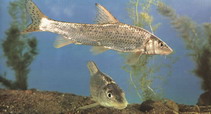 Hemibarbus maculatus
Photo de CAFS
Images | Images Google
Photo de CAFS
Classification / Noms Noms communs | Synonymes | Catalog of Fishes(Genre, Espèce) | ITIS | CoL | WoRMS | Cloffa
> Cypriniformes (Carps) > Gobionidae (Gudgeons)
Etymology: Hemibarbus: Greek, hemi = the half + Latin, barbus = barbel (Ref. 45335).
More on author: Bleeker.
Etymology: Hemibarbus: Greek, hemi = the half + Latin, barbus = barbel (Ref. 45335).
More on author: Bleeker.
Environnement : milieu / zone climatique / profondeur / gamme de distribution Écologie
; eau douce benthopélagique; pH range: 7.0 - ? ; dH range: 20 - ?. Temperate; 10°C - 24°C (Ref. 2059)
Distribution Territoires | Zones FAO | Écosystèmes | Occurrences | Carte par point | Introductions | Faunafri
Asia: China, Korea, Japan and Amur River basin. At least one country reports adverse ecological impact after introduction.
Longueur à la première maturité / Taille / Poids / Âge
Maturité: Lm ?, range 20 - ? cm
Max length : 47.0 cm TL mâle / non sexé; (Ref. 1441); 34.3 cm TL (female); common length : 26.0 cm TL mâle / non sexé; (Ref. 56557); poids max. publié: 1.7 kg (Ref. 56557)
Max length : 47.0 cm TL mâle / non sexé; (Ref. 1441); 34.3 cm TL (female); common length : 26.0 cm TL mâle / non sexé; (Ref. 56557); poids max. publié: 1.7 kg (Ref. 56557)
Description synthétique Clés d'identification | Morphologie | Morphométrie
Vertèbres: 42 - 44. Both sides of the body with 7-11 large and blackish spots. Deep body with clearly convex dorsal profile. Head length shorter than body depth. Snout length shorter or equal to postorbital head length. Lips not developed, lateral lobes of lower lip narrow, without folds, the median process large and marked. Barbel length slightly thick, 1/2-2/3 of eye diameter. Dorsal spine strong, equal to HL. Origin of dorsal fin nearer the tip of snout than the caudal base (Ref. 38453). Anal fin with 6 1/2 branched anal rays; last simple dorsal ray ossified, spine-like (Ref. 43281).
Body shape (shape guide): fusiform / normal.
Body shape (shape guide): fusiform / normal.
Adults usually found in streams and creeks with moderate flow and sandy bottom (Ref. 43281). Feed mainly on insects and mollusks in summer and on crustaceans in winter (Ref. 1441)
Cycle de vie et comportement reproducteur Maturité | Reproduction | Frai | Œufs | Fécondité | Larves
Mature at 3 years of age. Spawns from May to June, with water temperatures from 19-25 C°. Eggs are pasted at underwater plants. Egg diameter about 2mm. Development time about 4 days. Larvae live pelagic for the first 6 days.
Référence principale
Téléchargez vos références | Références | Coordinateur | Collaborateurs
Kottelat, M., 2006. Fishes of Mongolia. A check-list of the fishes known to occur in Mongolia with comments on systematics and nomenclature. The World Bank, Washington, DC. 103 p. (Ref. 57778)
Statut dans la liste rouge de l'IUCN (Ref. 130435: Version 2025-2 (Global))
Préoccupation mineure (LC) ; Date assessed: 06 April 2020
CITES
Not Evaluated
Menace pour l'homme
Potential pest (Ref. 43281)
Utilisations par l'homme
Pêcheries: commercial
FAO - Publication: search | FishSource |
Plus d'informations
Écologie trophique
Aliments (proies)
Composition du régime alimentaire
Consommation alimentaire
Rations alimentaires
Prédateurs
Aliments (proies)
Composition du régime alimentaire
Consommation alimentaire
Rations alimentaires
Prédateurs
Dynamique des populations
Paramètres de croissance
Âges / tailles maximales
Longueur-poids rel.
Rel. longueur-longueur.
Fréquences de longueurs
Conversion de masse
Recrutement
Abondance
Paramètres de croissance
Âges / tailles maximales
Longueur-poids rel.
Rel. longueur-longueur.
Fréquences de longueurs
Conversion de masse
Recrutement
Abondance
Cycle de vie
Reproduction
Maturité
Maturité/épines rel.
Fécondité
Frai
Agrégats de frai
Œufs
Développement de l'œuf
Larves
Dynamique des populations larvaires
Reproduction
Maturité
Maturité/épines rel.
Fécondité
Frai
Agrégats de frai
Œufs
Développement de l'œuf
Larves
Dynamique des populations larvaires
Anatomie
Surface branchiale
Cerveau
Otolithe
Surface branchiale
Cerveau
Otolithe
Physiologie
Composition corporelle
Nutriments
Consommation d'oxygène
Type de natation
Vitesse de nage
Pigments visuels
Son de poisson
Maladies et parasites
Toxicité (CL50)
Composition corporelle
Nutriments
Consommation d'oxygène
Type de natation
Vitesse de nage
Pigments visuels
Son de poisson
Maladies et parasites
Toxicité (CL50)
Liées à l'homme
Systèmes d'aquaculture
Profils d'aquaculture
Souches
Cas de ciguatera
Timbres, pièces de monnaie, divers
Systèmes d'aquaculture
Profils d'aquaculture
Souches
Cas de ciguatera
Timbres, pièces de monnaie, divers
Outils
Quiz bio | E-book | Guide de terrain | Clés d'identification | Générateur de fréquences de longueur | Outil de dynamique de population | Carte par point |
Capture-MSY |
Articles particuliers
Télécharger en XML
Sources Internet
AFORO (otoliths) | Alien/Invasive Species database | Aquatic Commons | BHL | Cloffa | Websites from users | FishWatcher | CISTI | Catalog of Fishes: Genre, Espèce | DiscoverLife | ECOTOX | FAO - Publication: search | Faunafri | Fishipedia | Fishtrace | GloBI | Google Books | Google Scholar | Google | IGFA World Record | Bases de données nationales | OneZoom | Open Tree of Life | Otolith Atlas of Taiwan Fishes | PubMed | Reef Life Survey | Socotra Atlas | TreeBase | Arbre de Vie | Wikipedia: aller à, chercher | | Zoobank | Zoological Record
Estimations basées sur des modèles
|
Indice de diversité phylogénétique (Réf. 82804) |
PD50 = 0.5002 [Uniqueness, from 0.5 = low to 2.0 = high]. |
| Bayesian length-weight | a=0.00794 (0.00661 - 0.00954), b=3.13 (3.08 - 3.18), in cm total length, based on LWR estimates for this species (Ref. 93245). |
|
Niveau trophique (Réf. 69278) |
3.5 ±0.47 se; based on food items. |
|
Résilience (Réf. 120179) |
Milieu, temps minimum de doublement de population : 1,4 à 4,4 années (tm=3). |
|
Vulnérabilité de la pêche (Ref. 59153) |
Moderate to high vulnerability (51 of 100). 🛈 |
|
Catégorie de prix (Ref. 80766) |
Unknown. |