



Hemibarbus maculatus Bleeker, 1871
Spotted steed
Uploaden van uw Foto's en video's
Afbeeldingen | Google afbeelding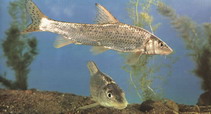 Hemibarbus maculatus
Afbeelding van CAFS
Afbeeldingen | Google afbeelding
Afbeelding van CAFS
Classificatie / Namen Lokale namen | Synoniemen | Catalog of Fishes(Genus, Soort(en)) | ITIS | CoL | WoRMS | Cloffa
> Cypriniformes (Carps) > Gobionidae (Gudgeons)
Etymology: Hemibarbus: Greek, hemi = the half + Latin, barbus = barbel (Ref. 45335).
More on author: Bleeker.
Etymology: Hemibarbus: Greek, hemi = the half + Latin, barbus = barbel (Ref. 45335).
More on author: Bleeker.
Milieu: milieu / Klimaatzone / Diepte / verspreidingsgebied Ecologie
; zoet water benthopelagisch; pH range: 7.0 - ? ; dH range: 20 - ?. Temperate; 10°C - 24°C (Ref. 2059)
Verspreiding Gebieden | FAO regio's | Ecosystemen | Voorkomen | Verspreidingskaart | Introducties | Faunafri
Asia: China, Korea, Japan and Amur River basin. At least one country reports adverse ecological impact after introduction.
Lengte bij maturiteit / Grootte / Gewicht / Leeftijd
Maturiteit: Lm ?, range 20 - ? cm
Max length : 47.0 cm TL mannelijk / geslacht onbekend; (Ref. 1441); 34.3 cm TL (female); common length : 26.0 cm TL mannelijk / geslacht onbekend; (Ref. 56557); max. gepubliceerd gewicht: 1.7 kg (Ref. 56557)
Max length : 47.0 cm TL mannelijk / geslacht onbekend; (Ref. 1441); 34.3 cm TL (female); common length : 26.0 cm TL mannelijk / geslacht onbekend; (Ref. 56557); max. gepubliceerd gewicht: 1.7 kg (Ref. 56557)
Korte beschrijving Determinatiesleutels | Morfologie | Morfometrie
Wervels: 42 - 44. Both sides of the body with 7-11 large and blackish spots. Deep body with clearly convex dorsal profile. Head length shorter than body depth. Snout length shorter or equal to postorbital head length. Lips not developed, lateral lobes of lower lip narrow, without folds, the median process large and marked. Barbel length slightly thick, 1/2-2/3 of eye diameter. Dorsal spine strong, equal to HL. Origin of dorsal fin nearer the tip of snout than the caudal base (Ref. 38453). Anal fin with 6 1/2 branched anal rays; last simple dorsal ray ossified, spine-like (Ref. 43281).
Body shape (shape guide): fusiform / normal.
Body shape (shape guide): fusiform / normal.
Adults usually found in streams and creeks with moderate flow and sandy bottom (Ref. 43281). Feed mainly on insects and mollusks in summer and on crustaceans in winter (Ref. 1441)
Levenscyclus en paargedrag Maturiteit | Voortplanting | Paaien | Eieren | Fecunditeit | Larven
Mature at 3 years of age. Spawns from May to June, with water temperatures from 19-25 C°. Eggs are pasted at underwater plants. Egg diameter about 2mm. Development time about 4 days. Larvae live pelagic for the first 6 days.
Hoofdreferentie
Upload uw referenties | Referenties | Coördinator | Medewerkers
Kottelat, M., 2006. Fishes of Mongolia. A check-list of the fishes known to occur in Mongolia with comments on systematics and nomenclature. The World Bank, Washington, DC. 103 p. (Ref. 57778)
Status op de Rode Lijst van het IUCN (Ref. 130435: Version 2025-2 (Global))
Niet bedreigd (LC) ; Date assessed: 06 April 2020
CITES
Not Evaluated
Gevaar voor de mens
Potential pest (Ref. 43281)
Gebruik door de mens
Visserij: commercieel
FAO - Publication: search | FishSource |
Meer informatie
Trofische ecologie
Voedsel (prooien)
Dieetsamenstelling
Voedselconsumptie
Voedselrantsoenen
Predatoren
Voedsel (prooien)
Dieetsamenstelling
Voedselconsumptie
Voedselrantsoenen
Predatoren
Populatiedynamica
Groeiparameters
Max. leeftijden / maten
Lengte-gewicht rel.
Lengte-lengte rel.
Lengtefrequenties
Massaconversie
Rekrutering
Abundantie
Groeiparameters
Max. leeftijden / maten
Lengte-gewicht rel.
Lengte-lengte rel.
Lengtefrequenties
Massaconversie
Rekrutering
Abundantie
Levenscyclus
Voortplanting
Maturiteit
Rijpheid/kieuwen rel.
Fecunditeit
Paaien
Paaibestanden
Eieren
Ontwikkeling van de eieren
Larven
Larvale populatiedynamiek
Voortplanting
Maturiteit
Rijpheid/kieuwen rel.
Fecunditeit
Paaien
Paaibestanden
Eieren
Ontwikkeling van de eieren
Larven
Larvale populatiedynamiek
Anatomie
Kieuwoppervlak
Hersenen
Otoliet
Kieuwoppervlak
Hersenen
Otoliet
Fysiologie
Lichaamssamenstelling
Voedingsstoffen
Zuurstofverbruik
Type zwemmen
Zwemsnelheid
Visuele pigmenten
Vis geluid
Ziekten en parasieten
Toxiciteit (LC50)
Lichaamssamenstelling
Voedingsstoffen
Zuurstofverbruik
Type zwemmen
Zwemsnelheid
Visuele pigmenten
Vis geluid
Ziekten en parasieten
Toxiciteit (LC50)
Menselijk gerelateerd
Aquacultuursystemen
Aquacultuurprofielen
Kweeklijnen
Ciguatera gevallen
Postzegels, munten, diversen.
Aquacultuursystemen
Aquacultuurprofielen
Kweeklijnen
Ciguatera gevallen
Postzegels, munten, diversen.
Tools
Biologische quiz | E-boek | Veldgids | Determinatiesleutels | Lengtefrequentie Tool | Levenscyclus tool | Verspreidingskaart |
Vangst-MSY |
Speciale rapporten
Bekijk gegevens voor het houden in een aquarium | Bekijk Fact Sheets voor de soort | Bekijk Aquacultuur Fact Sheets
Download XML
Internetbronnen
AFORO (otoliths) | Exoten/Invasieve soorten database | Aquatic Commons | BHL | Cloffa | Websites from users | Bekijk FishWatcher | CISTI | Catalog of Fishes: Genus, Soort(en) | DiscoverLife | ECOTOX | FAO - Publication: search | Faunafri | Fishipedia | Fishtrace | GloBI | Google Books | Google Scholar | Google | IGFA World Record | Nationale databanken | OneZoom | Open Tree of Life | Otolith Atlas of Taiwan Fishes | PubMed | Reef Life Survey | Socotra Atlas | TreeBase | Tree of Life | Wikipedia: ga naar, zoek | World Records Freshwater Fishing | Zoobank | Zoological Record
Schattingen op basis van modellen
Fylogenetische diversiteitsindex (Ref. 82804): PD50 = 0.5002 [Uniqueness, from 0.5 = low to 2.0 = high].
Bayesian length-weight: a=0.00794 (0.00659 - 0.00958), b=3.13 (3.08 - 3.18), in cm total length, based on LWR estimates for this species (Ref. 93245).
Trofisch niveau (Ref. 69278): 3.5 ±0.47 se; based on food items.
Weerstandsvermogen (Ref. 120179): Gemiddeld, minimale populatieverdubbelingstijd 1,4-4,4 jaar (tm=3).