



Hochladen Photos und videos
Bilder | videos | Google Bild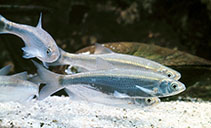 Alburnus alburnus
Photo von Muséum-Aquarium de Nancy/D. Terver
Bilder | videos | Google Bild
Photo von Muséum-Aquarium de Nancy/D. Terver
Klassifizierung / Names Namen | Synonyme | Catalog of Fishes(Gattung, Arten) | ITIS | CoL | WoRMS | Cloffa
> Cypriniformes (Carps) > Leuciscidae (Minnows) > Leuciscinae
Etymology: Alburnus: From the city of Al Bura, where the fish was known (Ref. 45335).
More on author: Linnaeus.
Etymology: Alburnus: From the city of Al Bura, where the fish was known (Ref. 45335).
More on author: Linnaeus.
Umwelt: Milieu / Klimazone / Tiefenbereich / Verbreitungsgebiet Ökologie
; süßwasser; brackwasser benthopelagisch; pH range: 7.0 - ? ; dH range: 10 - ?; potamodrom (Ref. 51243); tiefenbereich 1 - ? m (Ref. 30578). Temperate; 10°C - 20°C (Ref. 2059); 68°N - 35°N, 6°W - 60°E
Verbreitung Territorien | FAO Gebiete | Ökosysteme | Vorkommen | Punkt Karte | Einführungen | Faunafri
Europe and Asia: most of Europe north of Caucasus, Pyrénées and Alps, eastward to Ural and Emba. Naturally absent from Iberian Peninsula, Adriatic and Aegean basins (except Maritza drainage), Italy, Ireland, Great Britain (except southeast), Norway and Scandinavia north of 67°N, Caspian basin south of Volga. In Anatolia, Marmara basin. Locally introduced in Spain, Portugal and Italy. At least one country reports adverse ecological impact after introduction.
Länge bei der ersten Reifung / Größe / Gewicht / Alter
Geschlechtsreife: Lm 9.9, range 9 - ? cm
Max length : 25.0 cm TL Männchen/unbestimmt; (Ref. 30578); common length : 15.0 cm TL Männchen/unbestimmt; (Ref. 30578); max. veröff. Gewicht: 60.00 g (Ref. 30578)
Max length : 25.0 cm TL Männchen/unbestimmt; (Ref. 30578); common length : 15.0 cm TL Männchen/unbestimmt; (Ref. 30578); max. veröff. Gewicht: 60.00 g (Ref. 30578)
Kurzbeschreibung Bestimmungsschlüssel | Morphologie | Morphometrie
Rückenflossenstacheln (insgesamt) : 2 - 4; Rückenflossenweichstrahlen (insgesamt) : 7 - 9; Afterflossenstacheln: 3; Afterflossenweichstrahlen: 14 - 20; Wirbelzahl: 41 - 44. Diagnosed from congeners in Europe by the possession of the following characters: origin of anal fin below branched dorsal rays 4-5; lateral line with 45-48 + 3 scales; anal fin with 17-20½ branched rays; 16-22 gill rakers; ventral keel exposed from anus to pelvic base; lateral stripe absent in life, faint or absent in preserved specimens; and mouth slightly superior (Ref. 59043). Caudal fin with 19 rays (Ref. 2196). Also Ref. 40476.
Body shape (shape guide): fusiform / normal.
Body shape (shape guide): fusiform / normal.
Inhabits open waters of lakes and medium to large rivers. Forms large aggregations in backwaters and other still waters during winter. Adults occur in shoals near the surface. Larvae live in littoral zone of rivers and lakes while juveniles leave shores and occupy a pelagic habitat, feeding on plankton, drifting insects or invertebrates fallen on the water surface (Ref. 59043). Feeds mainly on plankton, including crustaceans (Ref. 30578) and insects (Ref. 9696). Spawns in shallow riffles or along stony shores of lakes, occasionally above submerged vegetation (Ref. 59043). Excellent as bait for carnivorous fishes. May be captured using the smallest hook and a fly as bait. Its flesh is tasty (Ref. 30578). Of little interest to commercial or sport fisheries in its native range because of its small size (Ref. 1739). Scales were previously utilized in making Essence d"Orient, a coating for artificial pearls (Ref. 59043).
Lebenszyklus und Paarungsverhalten Geschlechtsreife | Fortpflanzung | Ablaichen | Eier | Fruchtbarkeit | Larven
Eggs hatch in about 4 days (Ref. 59043).
Hauptreferenz
Laden Sie Ihre Referenzen hoch | Referenzen | Koordinator | Partner
Kottelat, M., 1997. European freshwater fishes. An heuristic checklist of the freshwater fishes of Europe (exclusive of former USSR), with an introduction for non-systematists and comments on nomenclature and conservation. Biologia, Bratislava, 52/Suppl. 5:1-271. (Ref. 13696)
IUCN Rote Liste Status (Ref. 130435: Version 2025-2 (Global))
nicht bedroht (LC) ; Date assessed: 05 December 2023
CITES
Not Evaluated
Bedrohung für Menschen
Nutzung durch Menschen
Fischereien: weniger kommerziell; Aquakultur: kommerziell; Köder: usually
FAO - Aquakultur-Systeme: produktion; Fischereien: landungen; Publication: search | FishSource |
Mehr Information
Trophische Ökologie
Lebensmittel (Beutetiere)
Nahrungszusammensetzung
Nahrungsaufnahme
Lebensmittelrationen
Räuber
Lebensmittel (Beutetiere)
Nahrungszusammensetzung
Nahrungsaufnahme
Lebensmittelrationen
Räuber
Populationsdynamik
Wachstumsparameter
Max. Alter/Größen
Länge-Gewicht-Rel.
Länge-Länge-Verhältnis.
Längenhäufigkeiten
Massenkonvertierung
Rekrutierung
Dichte
Wachstumsparameter
Max. Alter/Größen
Länge-Gewicht-Rel.
Länge-Länge-Verhältnis.
Längenhäufigkeiten
Massenkonvertierung
Rekrutierung
Dichte
Lebenszyklus
Fortpflanzung
Geschlechtsreife
Reifung/Kiemen rel.
Fruchtbarkeit
Ablaichen
Laichaggregationen
Eier
Eientwicklung
Larven
Larven Pop.Dyn.
Fortpflanzung
Geschlechtsreife
Reifung/Kiemen rel.
Fruchtbarkeit
Ablaichen
Laichaggregationen
Eier
Eientwicklung
Larven
Larven Pop.Dyn.
Anatomie
Kiemenoberfläche
Gehirn
Otolith
Kiemenoberfläche
Gehirn
Otolith
Physiologie
Körperliche Zusammensetzung
Nährstoffe
Sauerstoffverbrauch
Schwimmart
Schwimmgeschwindigkeit
Visuelle Pigmente
Fischgeräusche
Krankheiten und Parasiten
Toxizität (LC50s)
Körperliche Zusammensetzung
Nährstoffe
Sauerstoffverbrauch
Schwimmart
Schwimmgeschwindigkeit
Visuelle Pigmente
Fischgeräusche
Krankheiten und Parasiten
Toxizität (LC50s)
Menschenbezogen
Aquakultur-Systeme
Aquakultur Profile
Zuchtlinien
Ciguatera-Fälle
Briefmarken, Münzen, Verschiedenes.
Aquakultur-Systeme
Aquakultur Profile
Zuchtlinien
Ciguatera-Fälle
Briefmarken, Münzen, Verschiedenes.
Tools
Bio-Quiz | E-Book | Feldführer | Bestimmungsschlüssel | Längenhäufigkeits Tool | Lebensdaten Tool | Punkt Karte |
Catch-MSY |
Zusatzinformationen
Download XML
Zusammenfassung | Punktdaten | Namen | Photos
Internet Quellen
AFORO (otoliths) | Alien/Invasive Species database | Aquatic Commons | BHL | Cloffa | Websites from users | FishWatcher Einträge suchen | CISTI | Catalog of Fishes: Gattung, Arten | DiscoverLife | DORIS | ECOTOX | FAO - Aquakultur-Systeme: produktion; Fischereien: landungen; Publication: search | Faunafri | Fishipedia | Fishtrace | GloBI | Google Books | Google Scholar | Google | IGFA World Record | Nationale Datenbanken | OneZoom | Open Tree of Life | Otolith Atlas of Taiwan Fishes | Öffentliche Aquarien | PubMed | Reef Life Survey | Socotra Atlas | TreeBase | Tree of Life | Wikipedia: Gehe zu, Suchen | World Records Freshwater Fishing | Zoologischer Rekord
Schätzungen auf der Grundlage von Modellen
Phylogenetischer Diversitätsindex (Ref. 82804): PD50 = 0.5000 [Uniqueness, from 0.5 = low to 2.0 = high].
Bayesian length-weight: a=0.00562 (0.00484 - 0.00653), b=3.12 (3.09 - 3.15), in cm total length, based on LWR estimates for this species (Ref. 93245).
Trophische Ebene (Ref. 69278): 2.7 ±0.29 se; based on food items.
Widerstandsfähigkeit (Ref. 120179): mittel, Verdopplung der Population dauert 1,4 - 4,4 Jahre. (tm=2-3; K=0.19; tmax=7; Fec=1,500).
Nährstoffe (Ref. 124155): Calcium = 80.3 [38.4, 133.1] mg/100g; Iron = 0.46 [0.27, 0.84] mg/100g; Protein = 16.7 [15.1, 18.1] %; Omega3 = 0.697 [0.310, 1.491] g/100g; Selenium = 9.19 [4.33, 19.16] μg/100g; VitaminA = 40.5 [14.0, 121.6] μg/100g; Zinc = 0.965 [0.689, 1.367] mg/100g (wet weight);