



Callorhinchus milii Bory de Saint-Vincent, 1823
Ghost shark
Beobachtung melden im Fish Watcher
| Native range | All suitable habitat | Point map | Year 2050 |

|
| This map was computer-generated and has not yet been reviewed. |
| Callorhinchus milii AquaMaps Data sources: GBIF OBIS |
Hochladen Photos und videos
Bilder | Briefmarken, Münzen, Verschiedenes. | Google Bild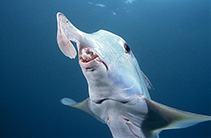 Callorhinchus milii
Photo von Aitken, K.
Bilder | Briefmarken, Münzen, Verschiedenes. | Google Bild
Photo von Aitken, K.
Klassifizierung / Names Namen | Synonyme | Catalog of Fishes(Gattung, Arten) | ITIS | CoL | WoRMS | Cloffa
Holocephali (Chimären, Seekatzen) (chimaeras) > Chimaeriformes (Chimaeras) > Callorhinchidae (Plownose chimaeras)
Etymology: Callorhinchus: Tautonymous with Chimaera callorynchus Linnaeus 1758 (but unnecessarily emended from -rynchus to -rhinchus: callum (L.), hard skin; rhynchus (L.), snout, referring to peculiar hoe-shaped proboscis (See ETYFish); milii: In honor of Bory de Saint-Vincent’s “old friend” (translation) Pierre Bernard Milius (1773‒1829), a French naval officer, naturalist and civil servant, who supplied specimen upon which description and its accompanying illustration (shown here) were based; (See ETYFish).
Eponymy: Baron Pierre Bernard Milius (1773–1829) was a French naval officer, naturalist and civil servant who took part in an exploratory voyage (1804) of the Mascarene Islands, Indian Ocean, under Nicolas Baudin, during which he became friends with Bory. [...] (Ref. 128868), visit book page.
Etymology: Callorhinchus: Tautonymous with Chimaera callorynchus Linnaeus 1758 (but unnecessarily emended from -rynchus to -rhinchus: callum (L.), hard skin; rhynchus (L.), snout, referring to peculiar hoe-shaped proboscis (See ETYFish); milii: In honor of Bory de Saint-Vincent’s “old friend” (translation) Pierre Bernard Milius (1773‒1829), a French naval officer, naturalist and civil servant, who supplied specimen upon which description and its accompanying illustration (shown here) were based; (See ETYFish).
Eponymy: Baron Pierre Bernard Milius (1773–1829) was a French naval officer, naturalist and civil servant who took part in an exploratory voyage (1804) of the Mascarene Islands, Indian Ocean, under Nicolas Baudin, during which he became friends with Bory. [...] (Ref. 128868), visit book page.
Umwelt: Milieu / Klimazone / Tiefenbereich / Verbreitungsgebiet Ökologie
seewasser; brackwasser demersal; ozeanodrom (Ref. 51243); tiefenbereich 0 - 227 m (Ref. 26346). Subtropical; 33°S - 50°S
Verbreitung Territorien | FAO Gebiete | Ökosysteme | Vorkommen | Punkt Karte | Einführungen | Faunafri
Southwest Pacific: southern Australia and New Zealand.
Länge bei der ersten Reifung / Größe / Gewicht / Alter
Geschlechtsreife: Lm 71.0, range 70 - ? cm
Max length : 125 cm TL Männchen/unbestimmt; (Ref. 26346); common length : 75.0 cm TL Männchen/unbestimmt; (Ref. 9258)
Max length : 125 cm TL Männchen/unbestimmt; (Ref. 26346); common length : 75.0 cm TL Männchen/unbestimmt; (Ref. 9258)
Kurzbeschreibung Bestimmungsschlüssel | Morphologie | Morphometrie
Body shape (shape guide): elongated.
Occurs on continental shelves to depths of at least 200 m (Ref. 6871). Migrates into large estuaries and inshore bays in the spring to breed (Ref. 6871). Feeds mainly on shellfish (Ref. 26346). Oviparous (Ref. 50449). Eggs are encased in horny shells (Ref. 205). Flesh is of good eating quality. Males have a small, club-like protuberance on the head and also long copulation organs near the pelvic fins (Ref. 557).
Lebenszyklus und Paarungsverhalten Geschlechtsreife | Fortpflanzung | Ablaichen | Eier | Fruchtbarkeit | Larven
Migrates into large estuaries and inshore bays in the spring to breed (Ref. 6871). Oviparous, two egg cases (Ref. 26346) are laid on sandy or muddy bottoms and take up to 8 months to hatch (Ref. 6871). Embryos feed solely on yolk (Ref. 50449).Young hatch at about 15 cm (Ref. 26346).
Hauptreferenz
Laden Sie Ihre Referenzen hoch | Referenzen | Koordinator | Partner
Last, P.R. and J.D. Stevens, 1994. Sharks and rays of Australia. CSIRO, Australia. 513 p. (Ref. 6871)
IUCN Rote Liste Status (Ref. 130435: Version 2025-2 (Global))
nicht bedroht (LC) ; Date assessed: 04 May 2024
CITES
Not Evaluated
Bedrohung für Menschen
Harmless
Nutzung durch Menschen
Fischereien: kommerziell
FAO - Fischereien: landungen; Publication: search | FIRMS - Stock assessments | FishSource | Das Meer um uns herum
Mehr Information
Trophische Ökologie
Lebensmittel (Beutetiere)
Nahrungszusammensetzung
Nahrungsaufnahme
Lebensmittelrationen
Räuber
Lebensmittel (Beutetiere)
Nahrungszusammensetzung
Nahrungsaufnahme
Lebensmittelrationen
Räuber
Populationsdynamik
Wachstumsparameter
Max. Alter/Größen
Länge-Gewicht-Rel.
Länge-Länge-Verhältnis.
Längenhäufigkeiten
Massenkonvertierung
Rekrutierung
Dichte
Wachstumsparameter
Max. Alter/Größen
Länge-Gewicht-Rel.
Länge-Länge-Verhältnis.
Längenhäufigkeiten
Massenkonvertierung
Rekrutierung
Dichte
Lebenszyklus
Fortpflanzung
Geschlechtsreife
Reifung/Kiemen rel.
Fruchtbarkeit
Ablaichen
Laichaggregationen
Eier
Eientwicklung
Larven
Larven Pop.Dyn.
Fortpflanzung
Geschlechtsreife
Reifung/Kiemen rel.
Fruchtbarkeit
Ablaichen
Laichaggregationen
Eier
Eientwicklung
Larven
Larven Pop.Dyn.
Physiologie
Körperliche Zusammensetzung
Nährstoffe
Sauerstoffverbrauch
Schwimmart
Schwimmgeschwindigkeit
Visuelle Pigmente
Fischgeräusche
Krankheiten und Parasiten
Toxizität (LC50s)
Körperliche Zusammensetzung
Nährstoffe
Sauerstoffverbrauch
Schwimmart
Schwimmgeschwindigkeit
Visuelle Pigmente
Fischgeräusche
Krankheiten und Parasiten
Toxizität (LC50s)
Genetik
Genom
Genetik
Heterozygotie
Vererbbarkeit
Genetische Vielfalt
Genom
Genetik
Heterozygotie
Vererbbarkeit
Genetische Vielfalt
Menschenbezogen
Aquakultur-Systeme
Aquakultur Profile
Zuchtlinien
Ciguatera-Fälle
Briefmarken, Münzen, Verschiedenes.
Aquakultur-Systeme
Aquakultur Profile
Zuchtlinien
Ciguatera-Fälle
Briefmarken, Münzen, Verschiedenes.
Tools
Zusatzinformationen
Download XML
Zusammenfassung | Punktdaten | Namen | Photos
Internet Quellen
AFORO (otoliths) | Aquatic Commons | BHL | Cloffa | Websites from users | FishWatcher Einträge suchen | CISTI | Catalog of Fishes: Gattung, Arten | DiscoverLife | ECOTOX | FAO - Fischereien: landungen; Publication: search | Faunafri | Fishipedia | Fishtrace | GloBI | Google Books | Google Scholar | Google | IGFA World Record | OneZoom | Open Tree of Life | Otolith Atlas of Taiwan Fishes | PubMed | Reef Life Survey | Socotra Atlas | TreeBase | Tree of Life | Wikipedia: Gehe zu, Suchen | World Records Freshwater Fishing | Zoologischer Rekord
Schätzungen auf der Grundlage von Modellen
Bevorzugte Temperatur (Ref. 123201): 12.1 - 18.2, mean 15.2 °C (based on 179 cells).
Phylogenetischer Diversitätsindex (Ref. 82804): PD50 = 0.7500 [Uniqueness, from 0.5 = low to 2.0 = high].
Bayesian length-weight: a=0.00479 (0.00194 - 0.01180), b=3.13 (2.91 - 3.35), in cm total length, based on LWR estimates for this species & (Sub)family-body (Ref. 93245).
Trophische Ebene (Ref. 69278): 3.6 ±0.29 se; based on food items.
Widerstandsfähigkeit (Ref. 120179): niedrig, Verdopplung der Population dauert 4,5 - 14 Jahre. (K=0.06-0.47; tm=2-6; Fec=2).
Nährstoffe (Ref. 124155): Calcium = 25.5 [6.4, 69.6] mg/100g; Iron = 0.758 [0.284, 2.957] mg/100g; Protein = 14.3 [11.2, 18.8] %; Omega3 = 0.258 [0.116, 0.579] g/100g; Selenium = 32 [9, 84] μg/100g; VitaminA = 7.14 [3.03, 17.16] μg/100g; Zinc = 0.661 [0.338, 1.252] mg/100g (wet weight);