



Nothobranchius guentheri (Pfeffer, 1893)
Redtail notho
Carica il tuo foto e Video
Immagini | Francobolli, monete, materiale vario. | Google image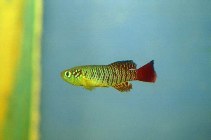 Nothobranchius guentheri
Immagine di JJPhoto
Immagini | Francobolli, monete, materiale vario. | Google image
Immagine di JJPhoto
Classificazione / Nomi Nomi Comuni | Sinonimi | Catalog of Fishes(Genere, Specie) | ITIS | CoL | WoRMS | Cloffa
> Cyprinodontiformes (Rivulines, killifishes and live bearers) > Nothobranchiidae (African rivulines)
Etymology: Nothobranchius: Greek, nothos = false + Greek, brangchia = gill (Ref. 45335).
Eponymy: Dr Albert Karl Ludwig Gotthilf Günther (1830–1914) was a German-born British zoologist, ichthyologist and herpetologist. [...] (Ref. 128868), visit book page.
Etymology: Nothobranchius: Greek, nothos = false + Greek, brangchia = gill (Ref. 45335).
Eponymy: Dr Albert Karl Ludwig Gotthilf Günther (1830–1914) was a German-born British zoologist, ichthyologist and herpetologist. [...] (Ref. 128868), visit book page.
Ambiente: milieu / zona climatica / distribuzione batimetrica / gamma di distribuzione Ecologia
; acqua dolce benthopelagico; pH range: 6.0 - 7.0; dH range: 4 - 10; non migratori (Ref. 126106). Tropical; 22°C - 25°C (Ref. 1672)
Distribuzione Territories | Aree FAO | Ecosistemi | Presenze | Mappa dei ritrovamenti | Introduzioni | Faunafri
Africa: endemic to Unguja Island, Zanzibar archipelago, eastern Tanzania (Ref. 122075).
Dimensione / Peso / Età
Maturità: Lm ? range ? - ? cm
Max length : 3.5 cm SL maschio/sesso non determinato; (Ref. 122075); 3.2 cm SL (female)
Max length : 3.5 cm SL maschio/sesso non determinato; (Ref. 122075); 3.2 cm SL (female)
Breve descrizione Chiavi di identificazione | Morfologia | Morfometria
Spine dorsali (totale) : 0; Raggi dorsali molli (totale) : 15 - 16; Spine anali: 0; Raggi anali molli: 15 - 16; Vertebre: 28. Diagnosis: It is distinguished from all congeners by the combination of the following character states: caudal fin red with black posterior margin in males; flank and fins without dark spots in females; pre-dorsal length in males 57.5-61.4% of standard length; 3 + 12-14 gill-rakers on first branchial arch; 27-28 scales in longitudinal series; 14 series of scales around caudal peduncle; single longitudinal row of scales between anterior supraorbital series of neuromasts; anterior supraorbital series of neuromasts arranged in two sections, anterior section with one well-developed neuromast, posterior with two; three neuromasts in posterior supraorbital series; 26-27 caudal-fin rays; 28 vertebrae; second proximal radial of dorsal fin between neural spines of 10th and 12th vertebrae (Ref. 122075).
Body shape (shape guide): fusiform / normal; Cross section: compressed.
Body shape (shape guide): fusiform / normal; Cross section: compressed.
Found in temporary pools, swamps, ditches and small streams (Ref. 3788). Used for biological control of mosquitos (Ref. 3788). One of the so called 'annual fishes' which has eggs that can withstand seasonal droughts (Ref. 1739). A bottom spawner, 3-4 months incubation. Quite popular with aquarists; difficult to maintain in an aquarium (Ref. 27139).
Ciclo vitale e comportamento di accoppiamento Maturità | Riproduzione | Deposizione | Uova | Fecondità | Larve
Thrives in seasonal rainwater pools. Spawns throughout the short breeding period until the pool dries up and all fish die except their drought-resistant eggs. Eggs go through a dry period of many weeks. When rain comes and pool fills, most of the eggs begin to develop and hatch within hours. Fry grow very fast. In only 6 to 8 weeks they are sexually mature and start breeding (Ref. 7062). In aquaria, males showed aggressive behavior toward each other. Females were being pushed down to the substratum by the males as a prelude to spawning.
Riferimento principale
Caricare le referenze | Bibliografia | Coordinatore | Collaboratori
Huber, J.H., 1996. Killi-Data 1996. Updated checklist of taxonomic names, collecting localities and bibliographic references of oviparous Cyprinodont fishes (Atherinomorpha, Pisces). Société Française d'Ichtyologie, Muséum National d'Histoire Naturelle, Paris, France, 399 p. (Ref. 27139)
Stato della Lista Rossa IUCN (Ref. 130435: Version 2025-2 (Global))
Endangered (EN) (B1ab(iii,iv)+2ab(iii,iv)); Date assessed: 09 December 2018
CITES
Not Evaluated
Minaccia per l'uomo
Harmless
Usi umani
Pesca: di nessun interesse; Acquario: Commerciale
FAO - Publication: search | FishSource |
Informazioni ulteriori
Ecologia trofica
Articoli alimentari (prede)
Alimentazione
Consumo di cibo
Razioni alimentari
Predatori
Articoli alimentari (prede)
Alimentazione
Consumo di cibo
Razioni alimentari
Predatori
Dinamica della popolazione
Parametri di crescita
Età massima / dimensioni massime
Rapporto lunghezza-peso.
Lunghezza-lunghezza rel.
Lunghezza-frequenze
Conversione di massa
Reclutamento
Abbondanza
Parametri di crescita
Età massima / dimensioni massime
Rapporto lunghezza-peso.
Lunghezza-lunghezza rel.
Lunghezza-frequenze
Conversione di massa
Reclutamento
Abbondanza
Ciclo di vita
Riproduzione
Maturità
Maturità/Gli occhielli sono relativi.
Fecondità
Deposizione
Aggregazioni riproduttive
Uova
Sviluppo delle uova
Larve
Dinamica popolazioni larvali
Riproduzione
Maturità
Maturità/Gli occhielli sono relativi.
Fecondità
Deposizione
Aggregazioni riproduttive
Uova
Sviluppo delle uova
Larve
Dinamica popolazioni larvali
Anatomia
Area branchiale
Cervello
Otolite
Area branchiale
Cervello
Otolite
Fisiologia
Composizione corporea
Nutrienti
Consumo di ossigeno
Tipo di nuoto
Velocità di nuoto
Pigmenti visivi
Suono del pesce
Malattie e parassiti
Tossicità (LC50)
Composizione corporea
Nutrienti
Consumo di ossigeno
Tipo di nuoto
Velocità di nuoto
Pigmenti visivi
Suono del pesce
Malattie e parassiti
Tossicità (LC50)
Legato all'uomo
Sistemi di acquacoltura
Profili di acquacoltura
Varietà
Casi di Ciguatera
Francobolli, monete, materiale vario.
Sistemi di acquacoltura
Profili di acquacoltura
Varietà
Casi di Ciguatera
Francobolli, monete, materiale vario.
Strumenti
Libro elettronico | Giuda pratica | Generatore frequenze di lunghezza | Strumento Parametri Biologici | Mappa dei ritrovamenti |
Cattura-MSY |
Rapporti speciali
Controllo della manutenzione dell'acquario | Verificare la presenza di schede informative sulle specie | Verifica delle schede informative sull'acquacoltura
Scarica XML
Fonti Internet
AFORO (otoliths) | Alien/Invasive Species database | Aquatic Commons | BHL | Cloffa | Websites from users | Check FishWatcher | CISTI | Catalog of Fishes: Genere, Specie | DiscoverLife | ECOTOX | FAO - Publication: search | Faunafri | Fishipedia | Fishtrace | GloBI | Google Books | Google Scholar | Google | IGFA World Record | OneZoom | Open Tree of Life | Otolith Atlas of Taiwan Fishes | PubMed | Reef Life Survey | Socotra Atlas | TreeBase | Tree of Life | Wikipedia: Go, ricerca | World Records Freshwater Fishing | Record zoologico
Stime basate su modelli
Indice di diversità filogenetica (Fonte Biblio. 82804): PD50 = 0.5000 [Uniqueness, from 0.5 = low to 2.0 = high].
Bayesian length-weight: a=0.01096 (0.00461 - 0.02608), b=2.94 (2.74 - 3.14), in cm total length, based on LWR estimates for this (Sub)family-body shape (Ref. 93245).
Livello trofico (Fonte Biblio. 69278): 3.2 ±0.4 se; based on size and trophs of closest relatives
Resilienza (Fonte Biblio. 120179): Alto, tempo minimo di raddoppiamento della popolazione meno di 15 mesi (tm= 0.12-0.15; tmax < 1 yr).