



Galeorhinus galeus (Linnaeus, 1758)
Tope shark
Beobachtung melden im Fish Watcher
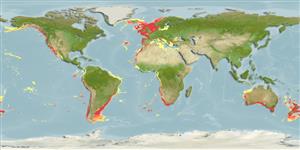
| Native range | All suitable habitat | Point map | Year 2050 |
|
| This map was computer-generated and has not yet been reviewed. |
| Galeorhinus galeus AquaMaps Data sources: GBIF OBIS |
Klassifizierung / Names Namen | Synonyme | Catalog of Fishes(Gattung, Arten) | ITIS | CoL | WoRMS | Cloffa
Elasmobranchii (Haie und Rochen) (sharks and rays) > Carcharhiniformes (Ground sharks) > Triakidae (Houndsharks) > Galeorhininae
Etymology: Galeorhinus: galeo, probably based on G. galeus (see below); rhinus, an ancient name for sharks, from rhine (Gr.), rasp, alluding to their rasp-like skin (See ETYFish); galeus: From galeos, a small shark or dogfish per Aristotle (sometimes translated as weasel), possibly referring to the pointed snouts, swift movements and/or rapacious feeding behavior of smaller predatory sharks1 (See ETYFish).
More on author: Linnaeus.
Etymology: Galeorhinus: galeo, probably based on G. galeus (see below); rhinus, an ancient name for sharks, from rhine (Gr.), rasp, alluding to their rasp-like skin (See ETYFish); galeus: From galeos, a small shark or dogfish per Aristotle (sometimes translated as weasel), possibly referring to the pointed snouts, swift movements and/or rapacious feeding behavior of smaller predatory sharks1 (See ETYFish).
More on author: Linnaeus.
Umwelt: Milieu / Klimazone / Tiefenbereich / Verbreitungsgebiet Ökologie
seewasser benthopelagisch; ozeanodrom (Ref. 51243); tiefenbereich 0 - 1100 m (Ref. 26346), usually 2 - 471 m (Ref. 43939). Subtropical; 70°N - 58°S, 111°E - 37°E
Verbreitung Territorien | FAO Gebiete | Ökosysteme | Vorkommen | Punkt Karte | Einführungen | Faunafri
World-wide in cold to warm temperate waters.
Länge bei der ersten Reifung / Größe / Gewicht / Alter
Geschlechtsreife: Lm 144.1, range 120 - 185 cm
Max length : 193 cm TL Männchen/unbestimmt; (Ref. 40637); 195.0 cm TL (female); common length : 160 cm TL Männchen/unbestimmt; (Ref. 9258); max. veröff. Gewicht: 44.7 kg (Ref. 40637); max. veröff. Alter: 55 Jahre (Ref. 6871)
Max length : 193 cm TL Männchen/unbestimmt; (Ref. 40637); 195.0 cm TL (female); common length : 160 cm TL Männchen/unbestimmt; (Ref. 9258); max. veröff. Gewicht: 44.7 kg (Ref. 40637); max. veröff. Alter: 55 Jahre (Ref. 6871)
Kurzbeschreibung Bestimmungsschlüssel | Morphologie | Morphometrie
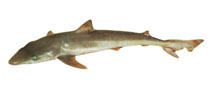
Rückenflossenstacheln (insgesamt) : 0; Afterflossenstacheln: 0. A large houndshark with a long, pointed snout, a large mouth, and small blade-like teeth; 2nd dorsal about as large as anal fin and terminal caudal lobe as long as rest of fin (Ref. 5578). Greyish above, white below; young with black markings on fins (Ref. 5578).
Body shape (shape guide): elongated.
Body shape (shape guide): elongated.
Mainly demersal on continental and insular shelves, but also on the upper slopes, at depths from near shore to 550 m (Ref. 6871), but has been shown to be pelagic in the open ocean (frequently caught on floating tuna longlines over deep water, and many New Zealand-tagged specimens have been recaptured in Australia) (Ref. 26346). Occurs in small schools that are highly migratory in higher latitudes in their range (Ref. 244). There is pronounced partial segregation by size and sex in some areas (Ref. 244). Feeds on fishes (bottom as well as pelagic species, Ref. 26346), crustaceans, cephalopods, worms, and echinoderms (Ref. 244). Ovoviviparous (Ref. 50449). Targeted for human consumption, liver for squalene oil, fins for soup (Ref. 244); also utilized as fishmeal (Ref. 13563). Marketed fresh, dried-salted, and frozen (Ref. 9987). Adapts well in captivity if carefully captured and handled (Ref. 12951).
Lebenszyklus und Paarungsverhalten Geschlechtsreife | Fortpflanzung | Ablaichen | Eier | Fruchtbarkeit | Larven
Ovoviviparous, without a yolk-sac placenta (Ref. 244). Embryos feed solely on yolk (Ref. 50449). 6 to 52 young in a litter (Ref. 26346). Litter size increases with the size of the mother. Embryos reach 30-36 cm TL at birth (Ref. 6080). In the southern waters of Australia, newly born and older juveniles (30-70 cm long) aggregate in 'nursery areas' found in shallow waters.They move to deeper coastal waters to over-winter. The following spring finds most of these young returning to their nursery areas. The older ones, aged 2 years and over move instead to eastern Bass Strait where most of the immature stock are found. The length of an average full-term embryo is 32 cm. Spawning frequency is once every year, ovulation occurring in early summer and parturition is completed by January of the following year. Gestation period lasts for about 12 months (Ref. 6390, 6871).
Hauptreferenz
Laden Sie Ihre Referenzen hoch | Referenzen | Koordinator : Compagno, Leonard J.V. | Partner
Compagno, L.J.V., 1984. FAO Species Catalogue. Vol. 4. Sharks of the world. An annotated and illustrated catalogue of shark species known to date. Part 2 - Carcharhiniformes. FAO Fish. Synop. 125(4/2):251-655. Rome: FAO. (Ref. 244)
IUCN Rote Liste Status (Ref. 130435: Version 2025-2 (Global))
vom Aussterben bedroht (CR) (A2bd); Date assessed: 14 February 2020
CITES
Not Evaluated
Bedrohung für Menschen
Harmless (Ref. 13563)
Nutzung durch Menschen
Fischereien: hoch kommerziell; Sportfisch: ja; Aquarium: Öffentliche Aquarien
FAO - Fischereien: landungen, Artbeschreibung; Publication: search | FishSource | Das Meer um uns herum
Mehr Information
Trophische Ökologie
Lebensmittel (Beutetiere)
Nahrungszusammensetzung
Nahrungsaufnahme
Lebensmittelrationen
Räuber
Lebensmittel (Beutetiere)
Nahrungszusammensetzung
Nahrungsaufnahme
Lebensmittelrationen
Räuber
Populationsdynamik
Wachstumsparameter
Max. Alter/Größen
Länge-Gewicht-Rel.
Länge-Länge-Verhältnis.
Längenhäufigkeiten
Massenkonvertierung
Rekrutierung
Dichte
Wachstumsparameter
Max. Alter/Größen
Länge-Gewicht-Rel.
Länge-Länge-Verhältnis.
Längenhäufigkeiten
Massenkonvertierung
Rekrutierung
Dichte
Lebenszyklus
Fortpflanzung
Geschlechtsreife
Reifung/Kiemen rel.
Fruchtbarkeit
Ablaichen
Laichaggregationen
Eier
Eientwicklung
Larven
Larven Pop.Dyn.
Fortpflanzung
Geschlechtsreife
Reifung/Kiemen rel.
Fruchtbarkeit
Ablaichen
Laichaggregationen
Eier
Eientwicklung
Larven
Larven Pop.Dyn.
Physiologie
Körperliche Zusammensetzung
Nährstoffe
Sauerstoffverbrauch
Schwimmart
Schwimmgeschwindigkeit
Visuelle Pigmente
Fischgeräusche
Krankheiten und Parasiten
Toxizität (LC50s)
Körperliche Zusammensetzung
Nährstoffe
Sauerstoffverbrauch
Schwimmart
Schwimmgeschwindigkeit
Visuelle Pigmente
Fischgeräusche
Krankheiten und Parasiten
Toxizität (LC50s)
Menschenbezogen
Aquakultur-Systeme
Aquakultur Profile
Zuchtlinien
Ciguatera-Fälle
Briefmarken, Münzen, Verschiedenes.
Aquakultur-Systeme
Aquakultur Profile
Zuchtlinien
Ciguatera-Fälle
Briefmarken, Münzen, Verschiedenes.
Tools
Bio-Quiz | E-Book | Feldführer | Bestimmungsschlüssel | Längenhäufigkeits Tool | Lebensdaten Tool | Punkt Karte |
Catch-MSY |
Zusatzinformationen
Download XML
Zusammenfassung | Punktdaten | Namen | Photos
Internet Quellen
AFORO (otoliths) | Aquatic Commons | BHL | Cloffa | Websites from users | FishWatcher Einträge suchen | CISTI | Catalog of Fishes: Gattung, Arten | DiscoverLife | ECOTOX | FAO - Fischereien: landungen, Artbeschreibung; Publication: search | Faunafri | Fishipedia | Fishtrace | GloBI | Google Books | Google Scholar | Google | IGFA World Record | Nationale Datenbanken | OceanAdapt | OneZoom | Open Tree of Life | Otolith Atlas of Taiwan Fishes | Öffentliche Aquarien | PubMed | Reef Life Survey | Socotra Atlas | TreeBase | Tree of Life | Wikipedia: Gehe zu, Suchen | World Records Freshwater Fishing | Zoologischer Rekord
Schätzungen auf der Grundlage von Modellen
Bevorzugte Temperatur (Ref. 123201): 6.7 - 23.2, mean 12.3 °C (based on 7314 cells).
Phylogenetischer Diversitätsindex (Ref. 82804): PD50 = 1.0000 [Uniqueness, from 0.5 = low to 2.0 = high].
Bayesian length-weight: a=0.00479 (0.00363 - 0.00631), b=2.99 (2.91 - 3.07), in cm total length, based on LWR estimates for this species (Ref. 93245).
Trophische Ebene (Ref. 69278): 4.3 ±0.1 se; based on diet studies.
Generation time: 11.9 (6.9 - 14.7) years. Estimated as median ln(3)/K based on 12 growth studies.
Widerstandsfähigkeit (Ref. 120179): niedrig, Verdopplung der Population dauert 4,5 - 14 Jahre. (rm=0.033; tmax=55; Fec=6-52).
Prior r = 0.06, 95% CL = 0.04 - 0.09, Based on 2 full stock assessments.
Nährstoffe (Ref. 124155): Calcium = 8.56 [1.46, 48.15] mg/100g; Iron = 0.465 [0.128, 1.502] mg/100g; Protein = 20 [18, 22] %; Omega3 = 0.18 [0.11, 0.30] g/100g; Selenium = 44.2 [13.5, 139.5] μg/100g; VitaminA = 13.1 [4.2, 44.7] μg/100g; Zinc = 0.409 [0.194, 0.769] mg/100g (wet weight); based on nutrient studies.