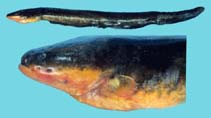
>
Gymnotiformes (Knifefishes) >
Gymnotidae (Naked-back knifefishes) > Electrophorinae
Etymology: Electrophorus: Greek, elektron = amber + Greek,pherein = to carry (Ref. 45335).
More on author: Linnaeus.
Taxonomic Remarks
If confirmed as having been actually made available before Gymnotus electricus Linnaeus (1766), Gymnotus tremulus Houttuyn (1764) should be regarded as the senior synonym. However, following Articles 23.9.1 and 23.9.2 of the Code (ICZN, 1999), Gymnotus electricus must be regarded as the valid name, and qualified as a nomen protectum, and Gymnotus tremulus as a nomen oblitum. It seems that both Houttuyn’s (1764) and Linnaeus’ (1766) descriptions were based on previous descriptions by other authors (i.e., primarily, Gronovius and Seba), and that no specimens were actually examined by these authors regarding their proposals of new species. Gronovius’ specimen (or specimens) is currently probably lost, but Seba’s specimen (which apparently have come from the Essequibo river; Seba, 1758, III, p.108, pl. 34, fig. 6) is probably housed in the Rijksmuseum van Natuurlijke Historie, Leiden (Netherlands). That should, then, be considered the remaining name-bearing type for both species above (ICZN, 1999, Article 72.5.6).
Miljö: miljö / Klimatzon / djupintervall / distributionsområde
Ekologi
; sötvatten bentopelagisk. Tropical; 23°C - 28°C (Ref. 1672)
South America: restricted to the Guiana Shield.
Storlek / Vikt / Ålder
Könsmognad: Lm ? range ? - ? cm
Max length : 250 cm SL hane/ej könsbestämd; (Ref. 27188); publicerad maxvikt: 20.0 kg (Ref. 27188)
Kort beskrivning
Bestämningsnycklar | Morfologi | Morfometri
Taggstrålar i ryggfenan (totalt) : 0; Mjukstrålar i ryggfenan (totalt) : 0. This species is distinguished by the following characters: ventral outline of head U-shaped, widest at terminus of branchial opening and lateral-line pores 88-101 (vs. ovoid, widest anterior to branchial opening, 112-146 in E. voltai); differs from E. varii with skull depressed, cleithrum lies between vertebrae 5 and 6 (vs. (vs. skull deep with cleithrum lying between vertebrae 1 and 2), pectoral-fin rays 32-38 (vs. 20-28) and lateral-line pores 88-101 (vs. 124-186). Low-voltage (Sachs’ organ) electric organ discharges or EODs and high-voltage (main/Hunter’s organ) with head-positive monophasic waveform. Low voltage EOD 2.03-2.19 ms duration; high-voltage EOD 480 V at 760mm TL (Ref. 120918).
Body shape (shape guide): elongated; Cross section: oval.
Prefer muddy bottoms and calm waters; frequently found in coastal plains, swamps and creeks but is also found inland where a favorable biotope exist. Juveniles feed on invertebrates, adults feed on fish and small mammals (Ref. 12225), first-born larvae prey on other eggs and embryos coming from late spawning batches (Ref. 40645). The electric organ of this species consists of flattened electrocytes, numbering to about hundreds of thousands, connected in series (Ref. 10840; 10011). Generates two type of electric organ discharges (EODs) from different electric organs which are of myogenic derivation: 1) low-voltage EODs (about 10 V) emitted by the Sach's organ at rates of up to 25 Hz, and 2) high-voltage EODs (about 50-fold) emitted by the main and Hunter's organs at peak rates of up to several hundred Hz. Low-voltage EOD has been associated with electro location whereas high-voltage EOD has been noted during predatory attacks (Ref. 10011). An EOD of 500 V was recorded from a 1 m specimen (Ref. 10530), making it a potentially dangerous species. Incorporation of this species in fish-based house security systems has been suggested (see Ref. 9506). Also possesses high-frequency sensitive tuberous receptors patchily distributed over the body that seems useful for hunting other gymnotiforms (Ref. 10583). A nocturnal species; captive specimens showed higher low-voltage EOD activity during the night compared to daytime (Ref. 10011). This cycle seems to be free-running (internally controlled) (Ref. 10829). Probably a fractional spawner; fecundity count was17,000 eggs (Ref. 10630). An obligatory air breather (Ref. 10011) and can withstand poorly oxygenated water (Ref. 26457). Used in experimental studies.
Males construct foam nests and guard the growing larvae until mid-January when the first seasonal rains flood the breeding area, causing the about 10 cm long young eels to disperse (Ref. 40645).
Males outnumber females (3:1) and are considerably larger than females (Ref. 40645).
There are three successive batches of eggs deposited in a spawning period. Not all eels with fully developed gonads (in Goiapi drainnage) participated in the annual spawning activity suggesting that mating success depends in part on finding suitable breeding sites (Ref. 40645).
de Santana, C.D., W.G.R. Crampton, C.B. Dillman, R.G. Frederico, M.H. Sabaj, R. Covain, J. Ready, J. Zuanon, R.R. de Oliveira, R.N. Mendes-Júnior, D.A. Bastos, T.F. Teixeira, J. Mol, W. Ohara, N.C. de Castro, L.A. Peixoto et al., 2019. Unexpected species diversity in electric eels with a description of the strongest living bioelectricity generator. Nature Communications (2019)10:4000. [+authors; Nagamachi, C.; Sousa, L.; Montag, L.F.A.; Ribeiro, F.; Waddell, J.C.; Piorsky, N.M.; Vari, R.P.; Wosiacki, W.B.] (Ref. 120918)
Status på IUCN:s rödlista (Ref. 130435: Version 2025-2 (Global))
Mänskliga användningsområden
Fiskeri: kommersiell; sportfisk: ja; Akvarium: Offentliga akvarier
Verktyg
Särskilda rapporter
Ladda ner XML
Internet-källor
Uppskattningar baserade på modeller
Index för fylogenetisk mångfald (Ref.
82804): PD
50 = 0.6250 [Uniqueness, from 0.5 = low to 2.0 = high].
Bayesian length-weight: a=0.00389 (0.00180 - 0.00842), b=3.12 (2.94 - 3.30), in cm total length, based on all LWR estimates for this body shape (Ref.
93245).
Trofisk nivå (Ref.
69278): 3.9 ±0.52 se; based on food items.
Resiliens (Ref.
120179): Mellan, lägsta populationsfördubblingstid 1,4-4,4 år (tm=3; tmax=6 (captive); Fec=17,000).
Sårbarhet i fisket (Ref.
59153): Very high vulnerability (90 of 100).
🛈