



Lates angustifrons Boulenger, 1906
Tanganyika lates
Hochladen Photos und videos
Bilder | Google Bild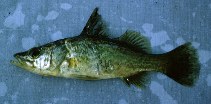 Lates angustifrons
Photo von de Vos, L.
Bilder | Google Bild
Photo von de Vos, L.
Klassifizierung / Names Namen | Synonyme | Catalog of Fishes(Gattung, Arten) | ITIS | CoL | WoRMS | Cloffa
> Carangaria/misc (Various families in series Carangaria) > Latidae (Lates perches)
Etymology: Lates: Latin, lateo, latere = to be hidden.
More on author: Boulenger.
Etymology: Lates: Latin, lateo, latere = to be hidden.
More on author: Boulenger.
Umwelt: Milieu / Klimazone / Tiefenbereich / Verbreitungsgebiet Ökologie
; süßwasser demersal; pH range: 7.5 - 8.2; dH range: 20 - 40; standorttreu (Ref. 126106). Tropical; 22°C - 28°C (Ref. 12468); 3°S - 9°S
Verbreitung Territorien | FAO Gebiete | Ökosysteme | Vorkommen | Punkt Karte | Einführungen | Faunafri
Africa: widely distributed in Lake Tanganyika (Ref. 2216, 36901) and present in the Malagarazi River delta (Ref. 54847).
Länge bei der ersten Reifung / Größe / Gewicht / Alter
Geschlechtsreife: Lm 56.5 range ? - ? cm
Max length : 200 cm SL Männchen/unbestimmt; (Ref. 4967); max. veröff. Gewicht: 100.0 kg (Ref. 58490)
Max length : 200 cm SL Männchen/unbestimmt; (Ref. 4967); max. veröff. Gewicht: 100.0 kg (Ref. 58490)
Kurzbeschreibung Bestimmungsschlüssel | Morphologie | Morphometrie
Spacing between dorsal fins more than between last spines of first dorsal fin. Caudal fin rounded in adults, rounded and spotted in juveniles. Eyes small, less than interorbital with.
Body shape (shape guide): fusiform / normal; Cross section: compressed.
Body shape (shape guide): fusiform / normal; Cross section: compressed.
Juveniles live in a specific inshore habitat until they reach 18 cm (Ref. 2216) also found near and in slow flowing affluents (Ref. 36901). Adults found from the littoral to near the limit of the oxygenated zone (Ref. 2216). Solitary, lurking predator, probably favoring rocky bottoms and unspecialized in its fish diet; highly susceptible to intensive fishing (Ref. 2216). They feed largely on benthic cichlids (Ref. 4967, 36901), but also takes sardines (Ref. 4967). Threatened due to over harvesting (Ref. 58490).
Lebenszyklus und Paarungsverhalten Geschlechtsreife | Fortpflanzung | Ablaichen | Eier | Fruchtbarkeit | Larven
Hauptreferenz
Laden Sie Ihre Referenzen hoch | Referenzen | Koordinator | Partner
Coulter, G.W., 1976. The biology of Lates species in Lake Tanganyika, and the status of the pelagic fishery for Lates species and Luciolates stapersii. J. Fish Biol. 9(3):235-259. (Ref. 2216)
IUCN Rote Liste Status (Ref. 130435: Version 2025-2 (Global))
stark gefährdet (EN) (A3d); Date assessed: 04 March 2025
CITES
Not Evaluated
Bedrohung für Menschen
Harmless
Nutzung durch Menschen
Fischereien: kommerziell; Sportfisch: ja
FAO - Publication: search | FishSource |
Mehr Information
Trophische Ökologie
Lebensmittel (Beutetiere)
Nahrungszusammensetzung
Nahrungsaufnahme
Lebensmittelrationen
Räuber
Lebensmittel (Beutetiere)
Nahrungszusammensetzung
Nahrungsaufnahme
Lebensmittelrationen
Räuber
Populationsdynamik
Wachstumsparameter
Max. Alter/Größen
Länge-Gewicht-Rel.
Länge-Länge-Verhältnis.
Längenhäufigkeiten
Massenkonvertierung
Rekrutierung
Dichte
Wachstumsparameter
Max. Alter/Größen
Länge-Gewicht-Rel.
Länge-Länge-Verhältnis.
Längenhäufigkeiten
Massenkonvertierung
Rekrutierung
Dichte
Lebenszyklus
Fortpflanzung
Geschlechtsreife
Reifung/Kiemen rel.
Fruchtbarkeit
Ablaichen
Laichaggregationen
Eier
Eientwicklung
Larven
Larven Pop.Dyn.
Fortpflanzung
Geschlechtsreife
Reifung/Kiemen rel.
Fruchtbarkeit
Ablaichen
Laichaggregationen
Eier
Eientwicklung
Larven
Larven Pop.Dyn.
Anatomie
Kiemenoberfläche
Gehirn
Otolith
Kiemenoberfläche
Gehirn
Otolith
Physiologie
Körperliche Zusammensetzung
Nährstoffe
Sauerstoffverbrauch
Schwimmart
Schwimmgeschwindigkeit
Visuelle Pigmente
Fischgeräusche
Krankheiten und Parasiten
Toxizität (LC50s)
Körperliche Zusammensetzung
Nährstoffe
Sauerstoffverbrauch
Schwimmart
Schwimmgeschwindigkeit
Visuelle Pigmente
Fischgeräusche
Krankheiten und Parasiten
Toxizität (LC50s)
Genetik
Genom
Genetik
Heterozygotie
Vererbbarkeit
Genetische Vielfalt
Genom
Genetik
Heterozygotie
Vererbbarkeit
Genetische Vielfalt
Menschenbezogen
Aquakultur-Systeme
Aquakultur Profile
Zuchtlinien
Ciguatera-Fälle
Briefmarken, Münzen, Verschiedenes.
Aquakultur-Systeme
Aquakultur Profile
Zuchtlinien
Ciguatera-Fälle
Briefmarken, Münzen, Verschiedenes.
Tools
Zusatzinformationen
Download XML
Zusammenfassung | Punktdaten | Namen | Photos
Internet Quellen
AFORO (otoliths) | Alien/Invasive Species database | Aquatic Commons | BHL | Cloffa | Websites from users | FishWatcher Einträge suchen | CISTI | Catalog of Fishes: Gattung, Arten | DiscoverLife | ECOTOX | FAO - Publication: search | Faunafri | Fishipedia | Fishtrace | GloBI | Google Books | Google Scholar | Google | IGFA World Record | OneZoom | Open Tree of Life | Otolith Atlas of Taiwan Fishes | PubMed | Reef Life Survey | Socotra Atlas | TreeBase | Tree of Life | Wikipedia: Gehe zu, Suchen | World Records Freshwater Fishing | Zoobank | Zoologischer Rekord
Schätzungen auf der Grundlage von Modellen
Phylogenetischer Diversitätsindex (Ref. 82804): PD50 = 0.5005 [Uniqueness, from 0.5 = low to 2.0 = high].
Bayesian length-weight: a=0.01096 (0.00638 - 0.01885), b=3.02 (2.87 - 3.17), in cm total length, based on LWR estimates for this species & Genus-body shape (Ref. 93245).
Trophische Ebene (Ref. 69278): 4.5 ±0.80 se; based on food items.
Generation time: 4.4 ( na - na) years. Estimated as median ln(3)/K based on 1 growth studies.
Widerstandsfähigkeit (Ref. 120179): niedrig, Verdopplung der Population dauert 4,5 - 14 Jahre. (tm=3-5; K=0.25; tmax=13).
Nährstoffe (Ref. 124155): Calcium = 111 [25, 234] mg/100g; Iron = 1.46 [0.72, 3.44] mg/100g; Protein = 20 [19, 22] %; Omega3 = 0.386 [0.157, 0.959] g/100g; Selenium = 215 [57, 655] μg/100g; VitaminA = 17.9 [4.1, 96.2] μg/100g; Zinc = 0.694 [0.286, 1.525] mg/100g (wet weight);