



Lates angustifrons Boulenger, 1906
Tanganyika lates
Envoyez vos Photos et vidéos
Images | Images Google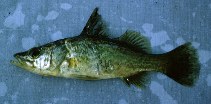 Lates angustifrons
Photo de de Vos, L.
Images | Images Google
Photo de de Vos, L.
Classification / Noms Noms communs | Synonymes | Catalog of Fishes(Genre, Espèce) | ITIS | CoL | WoRMS | Cloffa
> Carangaria/misc (Various families in series Carangaria) > Latidae (Lates perches)
Etymology: Lates: Latin, lateo, latere = to be hidden.
More on author: Boulenger.
Etymology: Lates: Latin, lateo, latere = to be hidden.
More on author: Boulenger.
Environnement : milieu / zone climatique / profondeur / gamme de distribution Écologie
; eau douce démersal; pH range: 7.5 - 8.2; dH range: 20 - 40; non migrateur (Ref. 126106). Tropical; 22°C - 28°C (Ref. 12468); 3°S - 9°S
Distribution Territoires | Zones FAO | Écosystèmes | Occurrences | Carte par point | Introductions | Faunafri
Africa: widely distributed in Lake Tanganyika (Ref. 2216, 36901) and present in the Malagarazi River delta (Ref. 54847).
Longueur à la première maturité / Taille / Poids / Âge
Maturité: Lm 56.5 range ? - ? cm
Max length : 200 cm SL mâle / non sexé; (Ref. 4967); poids max. publié: 100.0 kg (Ref. 58490)
Max length : 200 cm SL mâle / non sexé; (Ref. 4967); poids max. publié: 100.0 kg (Ref. 58490)
Description synthétique Clés d'identification | Morphologie | Morphométrie
Spacing between dorsal fins more than between last spines of first dorsal fin. Caudal fin rounded in adults, rounded and spotted in juveniles. Eyes small, less than interorbital with.
Body shape (shape guide): fusiform / normal; Cross section: compressed.
Body shape (shape guide): fusiform / normal; Cross section: compressed.
Juveniles live in a specific inshore habitat until they reach 18 cm (Ref. 2216) also found near and in slow flowing affluents (Ref. 36901). Adults found from the littoral to near the limit of the oxygenated zone (Ref. 2216). Solitary, lurking predator, probably favoring rocky bottoms and unspecialized in its fish diet; highly susceptible to intensive fishing (Ref. 2216). They feed largely on benthic cichlids (Ref. 4967, 36901), but also takes sardines (Ref. 4967). Threatened due to over harvesting (Ref. 58490).
Cycle de vie et comportement reproducteur Maturité | Reproduction | Frai | Œufs | Fécondité | Larves
Référence principale
Téléchargez vos références | Références | Coordinateur | Collaborateurs
Coulter, G.W., 1976. The biology of Lates species in Lake Tanganyika, and the status of the pelagic fishery for Lates species and Luciolates stapersii. J. Fish Biol. 9(3):235-259. (Ref. 2216)
Statut dans la liste rouge de l'IUCN (Ref. 130435: Version 2025-2 (Global))
Menacé (EN) (A3d); Date assessed: 04 March 2025
CITES
Not Evaluated
Menace pour l'homme
Harmless
Utilisations par l'homme
Pêcheries: commercial; pêche sportive: oui
FAO - Publication: search | FishSource |
Plus d'informations
Écologie trophique
Aliments (proies)
Composition du régime alimentaire
Consommation alimentaire
Rations alimentaires
Prédateurs
Aliments (proies)
Composition du régime alimentaire
Consommation alimentaire
Rations alimentaires
Prédateurs
Dynamique des populations
Paramètres de croissance
Âges / tailles maximales
Longueur-poids rel.
Rel. longueur-longueur.
Fréquences de longueurs
Conversion de masse
Recrutement
Abondance
Paramètres de croissance
Âges / tailles maximales
Longueur-poids rel.
Rel. longueur-longueur.
Fréquences de longueurs
Conversion de masse
Recrutement
Abondance
Anatomie
Surface branchiale
Cerveau
Otolithe
Surface branchiale
Cerveau
Otolithe
Physiologie
Composition corporelle
Nutriments
Consommation d'oxygène
Type de natation
Vitesse de nage
Pigments visuels
Son de poisson
Maladies et parasites
Toxicité (CL50)
Composition corporelle
Nutriments
Consommation d'oxygène
Type de natation
Vitesse de nage
Pigments visuels
Son de poisson
Maladies et parasites
Toxicité (CL50)
Génétique
génôme
Génétique
Hétérozygotie
Héritabilité
Diversité génétique
génôme
Génétique
Hétérozygotie
Héritabilité
Diversité génétique
Liées à l'homme
Systèmes d'aquaculture
Profils d'aquaculture
Souches
Cas de ciguatera
Timbres, pièces de monnaie, divers
Systèmes d'aquaculture
Profils d'aquaculture
Souches
Cas de ciguatera
Timbres, pièces de monnaie, divers
Outils
E-book | Guide de terrain | Générateur de fréquences de longueur | Outil de dynamique de population | Carte par point |
Capture-MSY |
Articles particuliers
Télécharger en XML
Sources Internet
AFORO (otoliths) | Alien/Invasive Species database | Aquatic Commons | BHL | Cloffa | Websites from users | FishWatcher | CISTI | Catalog of Fishes: Genre, Espèce | DiscoverLife | ECOTOX | FAO - Publication: search | Faunafri | Fishipedia | Fishtrace | GloBI | Google Books | Google Scholar | Google | IGFA World Record | OneZoom | Open Tree of Life | Otolith Atlas of Taiwan Fishes | PubMed | Reef Life Survey | Socotra Atlas | TreeBase | Arbre de Vie | Wikipedia: aller à, chercher | | Zoobank | Zoological Record
Estimations basées sur des modèles
|
Indice de diversité phylogénétique (Réf. 82804) |
PD50 = 0.5005 [Uniqueness, from 0.5 = low to 2.0 = high]. |
| Bayesian length-weight | a=0.01122 (0.00653 - 0.01928), b=3.02 (2.87 - 3.17), in cm total length, based on LWR estimates for this species & Genus-body shape (Ref. 93245). |
|
Niveau trophique (Réf. 69278) |
4.5 ±0.80 se; based on food items. |
| Generation time | 4.4 ( na - na) years. Estimated as median ln(3)/K based on 1 growth studies. |
|
Résilience (Réf. 120179) |
Faible, temps minimum de doublement de population : 4,5 à 14 années (tm=3-5; K=0.25; tmax=13). |
|
Vulnérabilité de la pêche (Ref. 59153) |
Moderate to high vulnerability (55 of 100). 🛈 |
|
Catégorie de prix (Ref. 80766) |
Unknown. |
|
Nutriments (Ref. 124155) |
Calcium = 111 [25, 234] mg/100g; Iron = 1.46 [0.72, 3.44] mg/100g; Protein = 20 [19, 22] %; Omega3 = 0.386 [0.157, 0.959] g/100g; Selenium = 215 [57, 655] μg/100g; VitaminA = 17.9 [4.1, 96.2] μg/100g; Zinc = 0.694 [0.286, 1.525] mg/100g (wet weight); |