



Hydrocynus vittatus Castelnau, 1861
Tiger fish
Envoyez vos Photos et vidéos
Images | Timbres, pièces de monnaie, divers | Images Google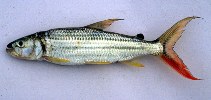 Hydrocynus vittatus
Photo de de Vos, L.
Images | Timbres, pièces de monnaie, divers | Images Google
Photo de de Vos, L.
Classification / Noms Noms communs | Synonymes | Catalog of Fishes(Genre, Espèce) | ITIS | CoL | WoRMS | Cloffa
> Characiformes (Characins) > Alestidae (African tetras)
Etymology: Hydrocynus: Greek, hydr = water + Greek, kyon = dog (Ref. 45335).
More on author: Castelnau.
Etymology: Hydrocynus: Greek, hydr = water + Greek, kyon = dog (Ref. 45335).
More on author: Castelnau.
Environnement : milieu / zone climatique / profondeur / gamme de distribution Écologie
Distribution Territoires | Zones FAO | Écosystèmes | Occurrences | Carte par point | Introductions | Faunafri
West Africa: Niger, Bénoué, Ouémé, Senegal (Ref. 2880, 5331, 7248, 81279), Ouémé (unconfirmed, Ref. 81279), Chad (Ref. 2880, 5331, 81279). Also found in the Volta (Ref. 5331, 81279) and Mono rivers (Ref. 81279). Lower Guinea: Cross and Sanaga basins (Ref. 80290). Widespread throughout the Congo River basin (Ref. 4910, 41585, 41594, 42510, 45616, 52070, 89725, 106290). Also reported from Nile, Omo, Zambezi, Limpopo, Rovuma, Shire, Rufiji, Ruaha, Lake Tanganyika, Lake Rukwa (Ref. 2880, 80290), Lake Albert (Ref. 4903) and Lake Kariba (Ref. 27602), Malagarazi, Okavango and lower reaches of coastal systems south to the Pongolo (Ref. 7248).
Longueur à la première maturité / Taille / Poids / Âge
Maturité: Lm 39.8 range ? - ? cm
Max length : 105 cm FL mâle / non sexé; (Ref. 40637); 74.0 cm FL (female); poids max. publié: 28.0 kg (Ref. 40637); âge max. reporté: 8 années (Ref. 2754)
Max length : 105 cm FL mâle / non sexé; (Ref. 40637); 74.0 cm FL (female); poids max. publié: 28.0 kg (Ref. 40637); âge max. reporté: 8 années (Ref. 2754)
Description synthétique Clés d'identification | Morphologie | Morphométrie
Épines dorsales (Total) : 0; Rayons mous dorsaux (Total) : 10; Épines anales: 0; Rayons mous anaux: 15. Diagnosis: large fang-like teeth overlapping the jaws when the mouth is closed; gill-rakers long, about equal to the length of gill filaments; body generally > 22% of SL (Ref. 28714). 43-53 scales in lateral line; 2 scale rows between lateral line and scaly process at pelvic-fin bases; eye < 70% of interorbital space (Ref. 2880, 81279). Dorsal-fin origin at about same level as pelvic-fin insertions (Ref. 2880, 80290, 81279). Gill rakers few (5-9/9-12) but rather long (Ref. 2880, 80290, 81279), about equal to the length of gill filaments (Ref. 28714). Tips of adipose and dorsal fins black; forked edge of caudal fin black (Ref. 2880, 80290, 81279). Dark caudal fin coloration may also extend unto median caudal rays, forming crescent-shaped blotch (Ref. 80290, 81279). Dark longitudinal streaks present above the lateral line (Ref. 28714).
Body shape (shape guide): fusiform / normal.
Body shape (shape guide): fusiform / normal.
Prefers warm, well-oxygenated water, mainly larger rivers and lakes; all but the largest form roving schools of like-sized fish; aptly described as fierce and voracious; diet increasingly piscivorous, becoming exclusive fish feeders when above 90-100 mm length; feeds on whatever prey is most abundant but Brycinus, Micralestes, Barbus, and Limnothrissa are favored (Ref. 7248, 52193). Piscivorous, but may also eat Caridina and insects (Ref. 28714). Useful food fish in some areas (Ref. 4967).
Cycle de vie et comportement reproducteur Maturité | Reproduction | Frai | Œufs | Fécondité | Larves
Référence principale
Téléchargez vos références | Références | Coordinateur | Collaborateurs
Paugy, D. and S.A. Schaefer, 2007. Alestidae. p. 347-411. In M.L.J. Stiassny, G.G. Teugels and C.D. Hopkins (eds.) Poissons d'eaux douces et saumâtres de basse Guinée, ouest de l'Afrique centrale/The fresh and brackish water fishes of Lower Guinea, west-central Africa. Vol. 1. Coll. Faune et Flore tropicales 42. Istitut de recherche pour le développement, Paris, France, Muséum nationale d'histoire naturelle, Paris, France and Musée royale de l'Afrique centrale, Tervuren, Belgique. 800 p. (Ref. 80290)
Statut dans la liste rouge de l'IUCN (Ref. 130435: Version 2025-2 (Global))
Préoccupation mineure (LC) ; Date assessed: 14 February 2025
CITES
Not Evaluated
Menace pour l'homme
Harmless
Utilisations par l'homme
Pêcheries: commercial; pêche sportive: oui
FAO - Publication: search | FishSource |
Plus d'informations
Écologie trophique
Aliments (proies)
Composition du régime alimentaire
Consommation alimentaire
Rations alimentaires
Prédateurs
Aliments (proies)
Composition du régime alimentaire
Consommation alimentaire
Rations alimentaires
Prédateurs
Dynamique des populations
Paramètres de croissance
Âges / tailles maximales
Longueur-poids rel.
Rel. longueur-longueur.
Fréquences de longueurs
Conversion de masse
Recrutement
Abondance
Paramètres de croissance
Âges / tailles maximales
Longueur-poids rel.
Rel. longueur-longueur.
Fréquences de longueurs
Conversion de masse
Recrutement
Abondance
Anatomie
Surface branchiale
Cerveau
Otolithe
Surface branchiale
Cerveau
Otolithe
Physiologie
Composition corporelle
Nutriments
Consommation d'oxygène
Type de natation
Vitesse de nage
Pigments visuels
Son de poisson
Maladies et parasites
Toxicité (CL50)
Composition corporelle
Nutriments
Consommation d'oxygène
Type de natation
Vitesse de nage
Pigments visuels
Son de poisson
Maladies et parasites
Toxicité (CL50)
Génétique
génôme
Génétique
Hétérozygotie
Héritabilité
Diversité génétique
génôme
Génétique
Hétérozygotie
Héritabilité
Diversité génétique
Liées à l'homme
Systèmes d'aquaculture
Profils d'aquaculture
Souches
Cas de ciguatera
Timbres, pièces de monnaie, divers
Systèmes d'aquaculture
Profils d'aquaculture
Souches
Cas de ciguatera
Timbres, pièces de monnaie, divers
Outils
E-book | Guide de terrain | Clés d'identification | Générateur de fréquences de longueur | Outil de dynamique de population | Carte par point |
Capture-MSY |
Articles particuliers
Télécharger en XML
Sources Internet
AFORO (otoliths) | Aquatic Commons | BHL | Cloffa | Websites from users | FishWatcher | CISTI | Catalog of Fishes: Genre, Espèce | DiscoverLife | ECOTOX | FAO - Publication: search | Faunafri | Fishipedia | Fishtrace | GloBI | Google Books | Google Scholar | Google | IGFA World Record | OneZoom | Open Tree of Life | Otolith Atlas of Taiwan Fishes | Aquariums publics | PubMed | Reef Life Survey | Socotra Atlas | TreeBase | Arbre de Vie | Wikipedia: aller à, chercher | World Records Freshwater Fishing | Zoological Record
Estimations basées sur des modèles
Indice de diversité phylogénétique (Réf. 82804): PD50 = 0.5312 [Uniqueness, from 0.5 = low to 2.0 = high].
Bayesian length-weight: a=0.01047 (0.00836 - 0.01312), b=3.03 (2.97 - 3.09), in cm total length, based on LWR estimates for this species (Ref. 93245).
Niveau trophique (Réf. 69278): 4.4 ±0.0 se; based on diet studies.
Generation time: 3.7 (3.0 - 5.0) years. Estimated as median ln(3)/K based on 14 growth studies.
Résilience (Réf. 120179): Milieu, temps minimum de doublement de population : 1,4 à 4,4 années (K=0.20-0.30; tmax=11).
Nutriments (Ref. 124155): Calcium = 69.1 [24.4, 163.4] mg/100g; Iron = 1.47 [0.76, 3.56] mg/100g; Protein = 19.5 [17.4, 21.7] %; Omega3 = 0.462 [0.179, 1.253] g/100g; Selenium = 75 [30, 165] μg/100g; VitaminA = 30.6 [9.0, 102.8] μg/100g; Zinc = 0.887 [0.602, 1.339] mg/100g (wet weight);