



Hydrocynus vittatus Castelnau, 1861
Tiger fish
Uploaden van uw Foto's en video's
Afbeeldingen | Postzegels, munten, diversen. | Google afbeelding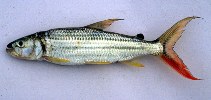 Hydrocynus vittatus
Afbeelding van de Vos, L.
Afbeeldingen | Postzegels, munten, diversen. | Google afbeelding
Afbeelding van de Vos, L.
Classificatie / Namen Lokale namen | Synoniemen | Catalog of Fishes(Genus, Soort(en)) | ITIS | CoL | WoRMS | Cloffa
> Characiformes (Characins) > Alestidae (African tetras)
Etymology: Hydrocynus: Greek, hydr = water + Greek, kyon = dog (Ref. 45335).
More on author: Castelnau.
Etymology: Hydrocynus: Greek, hydr = water + Greek, kyon = dog (Ref. 45335).
More on author: Castelnau.
Milieu: milieu / Klimaatzone / Diepte / verspreidingsgebied Ecologie
Verspreiding Gebieden | FAO regio's | Ecosystemen | Voorkomen | Verspreidingskaart | Introducties | Faunafri
West Africa: Niger, Bénoué, Ouémé, Senegal (Ref. 2880, 5331, 7248, 81279), Ouémé (unconfirmed, Ref. 81279), Chad (Ref. 2880, 5331, 81279). Also found in the Volta (Ref. 5331, 81279) and Mono rivers (Ref. 81279). Lower Guinea: Cross and Sanaga basins (Ref. 80290). Widespread throughout the Congo River basin (Ref. 4910, 41585, 41594, 42510, 45616, 52070, 89725, 106290). Also reported from Nile, Omo, Zambezi, Limpopo, Rovuma, Shire, Rufiji, Ruaha, Lake Tanganyika, Lake Rukwa (Ref. 2880, 80290), Lake Albert (Ref. 4903) and Lake Kariba (Ref. 27602), Malagarazi, Okavango and lower reaches of coastal systems south to the Pongolo (Ref. 7248).
Lengte bij maturiteit / Grootte / Gewicht / Leeftijd
Maturiteit: Lm 39.8 range ? - ? cm
Max length : 105 cm FL mannelijk / geslacht onbekend; (Ref. 40637); 74.0 cm FL (female); max. gepubliceerd gewicht: 28.0 kg (Ref. 40637); max. gerapporteerde leeftijd: 8 Jaren (Ref. 2754)
Max length : 105 cm FL mannelijk / geslacht onbekend; (Ref. 40637); 74.0 cm FL (female); max. gepubliceerd gewicht: 28.0 kg (Ref. 40637); max. gerapporteerde leeftijd: 8 Jaren (Ref. 2754)
Korte beschrijving Determinatiesleutels | Morfologie | Morfometrie
Dorsale stekels (totaal) : 0; Dorsale zachte stralen (totaal) : 10; Anale stekels: 0; Anale zachte stralen: 15. Diagnosis: large fang-like teeth overlapping the jaws when the mouth is closed; gill-rakers long, about equal to the length of gill filaments; body generally > 22% of SL (Ref. 28714). 43-53 scales in lateral line; 2 scale rows between lateral line and scaly process at pelvic-fin bases; eye < 70% of interorbital space (Ref. 2880, 81279). Dorsal-fin origin at about same level as pelvic-fin insertions (Ref. 2880, 80290, 81279). Gill rakers few (5-9/9-12) but rather long (Ref. 2880, 80290, 81279), about equal to the length of gill filaments (Ref. 28714). Tips of adipose and dorsal fins black; forked edge of caudal fin black (Ref. 2880, 80290, 81279). Dark caudal fin coloration may also extend unto median caudal rays, forming crescent-shaped blotch (Ref. 80290, 81279). Dark longitudinal streaks present above the lateral line (Ref. 28714).
Body shape (shape guide): fusiform / normal.
Body shape (shape guide): fusiform / normal.
Prefers warm, well-oxygenated water, mainly larger rivers and lakes; all but the largest form roving schools of like-sized fish; aptly described as fierce and voracious; diet increasingly piscivorous, becoming exclusive fish feeders when above 90-100 mm length; feeds on whatever prey is most abundant but Brycinus, Micralestes, Barbus, and Limnothrissa are favored (Ref. 7248, 52193). Piscivorous, but may also eat Caridina and insects (Ref. 28714). Useful food fish in some areas (Ref. 4967).
Levenscyclus en paargedrag Maturiteit | Voortplanting | Paaien | Eieren | Fecunditeit | Larven
Hoofdreferentie
Upload uw referenties | Referenties | Coördinator | Medewerkers
Paugy, D. and S.A. Schaefer, 2007. Alestidae. p. 347-411. In M.L.J. Stiassny, G.G. Teugels and C.D. Hopkins (eds.) Poissons d'eaux douces et saumâtres de basse Guinée, ouest de l'Afrique centrale/The fresh and brackish water fishes of Lower Guinea, west-central Africa. Vol. 1. Coll. Faune et Flore tropicales 42. Istitut de recherche pour le développement, Paris, France, Muséum nationale d'histoire naturelle, Paris, France and Musée royale de l'Afrique centrale, Tervuren, Belgique. 800 p. (Ref. 80290)
Status op de Rode Lijst van het IUCN (Ref. 130435: Version 2025-2 (Global))
Niet bedreigd (LC) ; Date assessed: 14 February 2025
CITES
Not Evaluated
Gevaar voor de mens
Harmless
Gebruik door de mens
Visserij: commercieel; sportvis: ja
FAO - Publication: search | FishSource |
Meer informatie
Trofische ecologie
Voedsel (prooien)
Dieetsamenstelling
Voedselconsumptie
Voedselrantsoenen
Predatoren
Voedsel (prooien)
Dieetsamenstelling
Voedselconsumptie
Voedselrantsoenen
Predatoren
Populatiedynamica
Groeiparameters
Max. leeftijden / maten
Lengte-gewicht rel.
Lengte-lengte rel.
Lengtefrequenties
Massaconversie
Rekrutering
Abundantie
Groeiparameters
Max. leeftijden / maten
Lengte-gewicht rel.
Lengte-lengte rel.
Lengtefrequenties
Massaconversie
Rekrutering
Abundantie
Levenscyclus
Voortplanting
Maturiteit
Rijpheid/kieuwen rel.
Fecunditeit
Paaien
Paaibestanden
Eieren
Ontwikkeling van de eieren
Larven
Larvale populatiedynamiek
Voortplanting
Maturiteit
Rijpheid/kieuwen rel.
Fecunditeit
Paaien
Paaibestanden
Eieren
Ontwikkeling van de eieren
Larven
Larvale populatiedynamiek
Anatomie
Kieuwoppervlak
Hersenen
Otoliet
Kieuwoppervlak
Hersenen
Otoliet
Fysiologie
Lichaamssamenstelling
Voedingsstoffen
Zuurstofverbruik
Type zwemmen
Zwemsnelheid
Visuele pigmenten
Vis geluid
Ziekten en parasieten
Toxiciteit (LC50)
Lichaamssamenstelling
Voedingsstoffen
Zuurstofverbruik
Type zwemmen
Zwemsnelheid
Visuele pigmenten
Vis geluid
Ziekten en parasieten
Toxiciteit (LC50)
Genetica
genoom
Genetica
Heterozygositeit
Erfelijkheid
Genetische diversiteit
genoom
Genetica
Heterozygositeit
Erfelijkheid
Genetische diversiteit
Menselijk gerelateerd
Aquacultuursystemen
Aquacultuurprofielen
Kweeklijnen
Ciguatera gevallen
Postzegels, munten, diversen.
Aquacultuursystemen
Aquacultuurprofielen
Kweeklijnen
Ciguatera gevallen
Postzegels, munten, diversen.
Tools
E-boek | Veldgids | Determinatiesleutels | Lengtefrequentie Tool | Levenscyclus tool | Verspreidingskaart |
Vangst-MSY |
Speciale rapporten
Bekijk gegevens voor het houden in een aquarium | Bekijk Fact Sheets voor de soort | Bekijk Aquacultuur Fact Sheets
Download XML
Internetbronnen
AFORO (otoliths) | Aquatic Commons | BHL | Cloffa | Websites from users | Bekijk FishWatcher | CISTI | Catalog of Fishes: Genus, Soort(en) | DiscoverLife | ECOTOX | FAO - Publication: search | Faunafri | Fishipedia | Fishtrace | GloBI | Google Books | Google Scholar | Google | IGFA World Record | OneZoom | Open Tree of Life | Otolith Atlas of Taiwan Fishes | Publieke aquaria | PubMed | Reef Life Survey | Socotra Atlas | TreeBase | Tree of Life | Wikipedia: ga naar, zoek | World Records Freshwater Fishing | Zoological Record
Schattingen op basis van modellen
Fylogenetische diversiteitsindex (Ref. 82804): PD50 = 0.5312 [Uniqueness, from 0.5 = low to 2.0 = high].
Bayesian length-weight: a=0.01047 (0.00836 - 0.01312), b=3.03 (2.97 - 3.09), in cm total length, based on LWR estimates for this species (Ref. 93245).
Trofisch niveau (Ref. 69278): 4.4 ±0.0 se; based on diet studies.
Generation time: 3.7 (3.0 - 5.0) years. Estimated as median ln(3)/K based on 14 growth studies.
Weerstandsvermogen (Ref. 120179): Gemiddeld, minimale populatieverdubbelingstijd 1,4-4,4 jaar (K=0.20-0.30; tmax=11).
Voedingsstoffen (Ref. 124155): Calcium = 69.1 [24.4, 163.4] mg/100g; Iron = 1.47 [0.76, 3.56] mg/100g; Protein = 19.5 [17.4, 21.7] %; Omega3 = 0.462 [0.179, 1.253] g/100g; Selenium = 75 [30, 165] μg/100g; VitaminA = 30.6 [9.0, 102.8] μg/100g; Zinc = 0.887 [0.602, 1.339] mg/100g (wet weight);