



Ptereleotris monoptera Randall & Hoese, 1985
Lyre-tail dart-goby
Waarneming toevoegen in Fish Watcher
| Native range | All suitable habitat | Point map | Year 2050 |

|
| This map was computer-generated and has not yet been reviewed. |
| Ptereleotris monoptera AquaMaps Data sources: GBIF OBIS |
Uploaden van uw Foto's en video's
Afbeeldingen | video's | Google afbeelding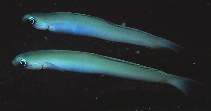 Ptereleotris monoptera
Afbeelding van Randall, J.E.
Afbeeldingen | video's | Google afbeelding
Afbeelding van Randall, J.E.
Classificatie / Namen Lokale namen | Synoniemen | Catalog of Fishes(Genus, Soort(en)) | ITIS | CoL | WoRMS | Cloffa
> Gobiiformes (Gobies) > Microdesmidae (Wormfishes) > Ptereleotrinae
Etymology: Ptereleotris: Greek, pteron = wing, fin + The name of a Nile fish, eleotris (Ref. 45335).
More on authors: Randall & Hoese.
Etymology: Ptereleotris: Greek, pteron = wing, fin + The name of a Nile fish, eleotris (Ref. 45335).
More on authors: Randall & Hoese.
Milieu: milieu / Klimaatzone / Diepte / verspreidingsgebied Ecologie
marien rifbewoner; standvastig (Ref. 52884); diepte 6 - 50 m (Ref. 48637), usually 6 - 15 m (Ref. 27115). Tropical; 22°C - 27°C (Ref. 27115); 36°N - 38°S, 53°E - 133°W
Verspreiding Gebieden | FAO regio's | Ecosystemen | Voorkomen | Verspreidingskaart | Introducties | Faunafri
Indo-Pacific: Seychelles and Chagos Islands to the western Pacific.
Grootte / Gewicht / Leeftijd
Korte beschrijving Determinatiesleutels | Morfologie | Morfometrie
Dorsale stekels (totaal) : 7; Dorsale zachte stralen (totaal) : 35 - 39; Anale stekels: 1; Anale zachte stralen: 33 - 37; Wervels: 26. Pale blue to yellowish; upper abdomen with a broad area of deeper blue; a bar, broad and blackish extending ventrally from eye onto chin; iris yellow, upper and lower edges broadly deep blue; postorbital head with irregular, iridescent markings. A single, continuous dorsal fin with spinous part lower than soft portion. Chin with fleshy protuberance narrowing to a thin low, median fold. Scales very small, fully embedded and well separated. Named as such in reference to its continuous dorsal fin.
Body shape (shape guide): elongated; Cross section: compressed.
Body shape (shape guide): elongated; Cross section: compressed.
Adults live in reef habitats from shallow coastal slopes to outer reef lagoons and slopes below drop-offs to 50 meters, among rubble (Ref. 48637). They occur in pairs and their burrows may be situated in coral rock or sand. Monogamous (Ref. 52884). Adults feed on zooplankton (Ref. 89972). They tend to form large, though diffuse, colonies; may be due to a propensity to aggregate or may be a result of the ecological requirements for the species (for which type of substratum, current pattern, and water depth among the most important) which restrict the areas of settlement of the postlarvae.
Levenscyclus en paargedrag Maturiteit | Voortplanting | Paaien | Eieren | Fecunditeit | Larven
Monogamous mating is observed as both obligate and social (Ref. 52884).
Hoofdreferentie
Upload uw referenties | Referenties | Coördinator : Randall, John E. | Medewerkers
Randall, J.E. and D.F. Hoese, 1985. Revision of the Indo-Pacific dartfishes, genus Ptereleotris (Perciformes: Gobioidei). Indo-Pac. Fish. (7):36 p. (Ref. 528)
Status op de Rode Lijst van het IUCN (Ref. 130435: Version 2025-2 (Global))
Niet bedreigd (LC) ; Date assessed: 12 March 2015
CITES
Not Evaluated
Gevaar voor de mens
Harmless
Gebruik door de mens
Visserij: commercieel; Aquarium: Commercieel
FAO - Publication: search | FishSource |
Meer informatie
Trofische ecologie
Voedsel (prooien)
Dieetsamenstelling
Voedselconsumptie
Voedselrantsoenen
Predatoren
Voedsel (prooien)
Dieetsamenstelling
Voedselconsumptie
Voedselrantsoenen
Predatoren
Populatiedynamica
Groeiparameters
Max. leeftijden / maten
Lengte-gewicht rel.
Lengte-lengte rel.
Lengtefrequenties
Massaconversie
Rekrutering
Abundantie
Groeiparameters
Max. leeftijden / maten
Lengte-gewicht rel.
Lengte-lengte rel.
Lengtefrequenties
Massaconversie
Rekrutering
Abundantie
Levenscyclus
Voortplanting
Maturiteit
Rijpheid/kieuwen rel.
Fecunditeit
Paaien
Paaibestanden
Eieren
Ontwikkeling van de eieren
Larven
Larvale populatiedynamiek
Voortplanting
Maturiteit
Rijpheid/kieuwen rel.
Fecunditeit
Paaien
Paaibestanden
Eieren
Ontwikkeling van de eieren
Larven
Larvale populatiedynamiek
Anatomie
Kieuwoppervlak
Hersenen
Otoliet
Kieuwoppervlak
Hersenen
Otoliet
Fysiologie
Lichaamssamenstelling
Voedingsstoffen
Zuurstofverbruik
Type zwemmen
Zwemsnelheid
Visuele pigmenten
Vis geluid
Ziekten en parasieten
Toxiciteit (LC50)
Lichaamssamenstelling
Voedingsstoffen
Zuurstofverbruik
Type zwemmen
Zwemsnelheid
Visuele pigmenten
Vis geluid
Ziekten en parasieten
Toxiciteit (LC50)
Genetica
genoom
Genetica
Heterozygositeit
Erfelijkheid
Genetische diversiteit
genoom
Genetica
Heterozygositeit
Erfelijkheid
Genetische diversiteit
Menselijk gerelateerd
Aquacultuursystemen
Aquacultuurprofielen
Kweeklijnen
Ciguatera gevallen
Postzegels, munten, diversen.
Aquacultuursystemen
Aquacultuurprofielen
Kweeklijnen
Ciguatera gevallen
Postzegels, munten, diversen.
Tools
Biologische quiz | E-boek | Veldgids | Determinatiesleutels | Lengtefrequentie Tool | Levenscyclus tool | Verspreidingskaart |
Vangst-MSY |
Speciale rapporten
Bekijk gegevens voor het houden in een aquarium | Bekijk Fact Sheets voor de soort | Bekijk Aquacultuur Fact Sheets
Download XML
Internetbronnen
AFORO (otoliths) | Aquatic Commons | BHL | Cloffa | Websites from users | Bekijk FishWatcher | CISTI | Catalog of Fishes: Genus, Soort(en) | DiscoverLife | ECOTOX | FAO - Publication: search | Faunafri | Fishipedia | Fishtrace | GloBI | Google Books | Google Scholar | Google | IGFA World Record | Nationale databanken | OneZoom | Open Tree of Life | Otolith Atlas of Taiwan Fishes | PubMed | Reef Life Survey | Socotra Atlas | TreeBase | Tree of Life | Wikipedia: ga naar, zoek | World Records Freshwater Fishing | Zoobank | Zoological Record
Schattingen op basis van modellen
Gewenste temperatuur (Ref. 123201): 23.3 - 29.1, mean 28 °C (based on 2128 cells).
Fylogenetische diversiteitsindex (Ref. 82804): PD50 = 0.5000 [Uniqueness, from 0.5 = low to 2.0 = high].
Bayesian length-weight: a=0.00389 (0.00180 - 0.00842), b=3.12 (2.94 - 3.30), in cm total length, based on all LWR estimates for this body shape (Ref. 93245).
Trofisch niveau (Ref. 69278): 3.4 ±0.45 se; based on food items.
Voedingsstoffen (Ref. 124155): Calcium = 111 [58, 188] mg/100g; Iron = 0.815 [0.492, 1.362] mg/100g; Protein = 18.1 [17.0, 19.1] %; Omega3 = 0.0997 [, ] g/100g; Selenium = 30.1 [14.2, 63.2] μg/100g; VitaminA = 208 [72, 629] μg/100g; Zinc = 1.84 [1.23, 2.60] mg/100g (wet weight);