



Eumicrotremus derjugini Popov, 1926
Leatherfin lumpsucker
Waarneming toevoegen in Fish Watcher
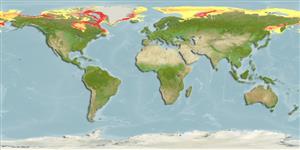
| Native range | All suitable habitat | Point map | Year 2050 |
|
| This map was computer-generated and has not yet been reviewed. |
| Eumicrotremus derjugini AquaMaps Data sources: GBIF OBIS |
Uploaden van uw Foto's en video's
Afbeeldingen | Google afbeelding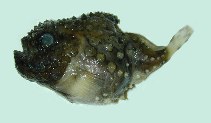 Eumicrotremus derjugini
Afbeelding van Byrkjedal, I.
Afbeeldingen | Google afbeelding
Afbeelding van Byrkjedal, I.
Classificatie / Namen Lokale namen | Synoniemen | Catalog of Fishes(Genus, Soort(en)) | ITIS | CoL | WoRMS | Cloffa
> Perciformes/Cottoidei (Sculpins) > Cyclopteridae (Lumpfishes) > Eumicrotreminae
Etymology: Eumicrotremus: Greek, eu = good + Greek, mikros = little, small + Greek, trema = hole (Ref. 45335).
Eponymy: Professor Dr Konstantin Michailovich Derjugin (1878–1938) was an oceanographer and marine zoologist at Leningrad State University, and manager of the Oceanic Division of the State Hydrological Institute in Leningrad. [...] (Ref. 128868), visit book page.
Etymology: Eumicrotremus: Greek, eu = good + Greek, mikros = little, small + Greek, trema = hole (Ref. 45335).
Eponymy: Professor Dr Konstantin Michailovich Derjugin (1878–1938) was an oceanographer and marine zoologist at Leningrad State University, and manager of the Oceanic Division of the State Hydrological Institute in Leningrad. [...] (Ref. 128868), visit book page.
Milieu: milieu / Klimaatzone / Diepte / verspreidingsgebied Ecologie
marien demersaal; diepte 5 - 1038 m (Ref. 117245), usually 5 - 575 m (Ref. 123372). Polar; 84°N - 50°N, 180°W - 180°E (Ref. 117245)
Verspreiding Gebieden | FAO regio's | Ecosystemen | Voorkomen | Verspreidingskaart | Introducties | Faunafri
Arctic Ocean: Barents-Laptev Sea and the Beaufort Sea-Greenland.
Barents Sea (except southwestern part while in the northern areas, it can be found up to Spitsbergen and Franz Josef Land); Kara Sea (reaches 80°32N); Laptev Sea (eastwards to 77°46N 131°52E; Beaufort Sea (waters of the Canadian Arctic
Arch., in the Hudson Bay and Baffin Bay off the shores of the Baffin Island); eastern
Greenland (northwards to the Danish Harbor). The southern boundary of the range in
the North-West Atlantic is 60°N.
Grootte / Gewicht / Leeftijd
Korte beschrijving Determinatiesleutels | Morfologie | Morfometrie
Dorsale stekels (totaal) : 6 - 8; Dorsale zachte stralen (totaal) : 10 - 13; Anale zachte stralen: 10 - 13. This species is distinguished by the following characters: first dorsal fin in the form of dense leathery process, does not bend down to the back, trapezoidal in shape; fish 4.0-8.5 cm TL, usually have seven rows of bony plaques in interorbital region; plaques in periorbital and preopercular rows are numerous; bare space in anus area bounded by semicircle of (6) 7-10 bony plaques; number of plaques on body and head (circumpectoral, postbranchial, supraorbital and postorbital, middle and interorbital rows) on average 32.7; distance from anus to beginning of anal fin on average 22% SL; pectoral fin short, on average 50–51% HL. Colouration: when alive (in Laptev Sea), body almost black, with slightly purple tint; without pronounced spots and stripes; lower side of head is dark, rays of D2, A, and P are dark gray; translucent fin membranes D2 and A are not colored; skin under upper caudal row of plaques light; it is a continuous dark band below it; bases of A and C with light spots; belly silvery; peritoneum (inner surface of abdominal cavity) is not pigmented; lining of oral cavity light, dotted (Ref. 123372).
Body shape (shape guide): short and / or deep; Cross section: circular.
Body shape (shape guide): short and / or deep; Cross section: circular.
Found on mud, gravel or stone bottoms at temperatures below 0° C, with the young occuring in shallower water (Ref. 4701). A benthic species feeding on crustaceans and oikopleura (Ref. 58426). This species usually occurs at depths from 5 to 575 m at high water salinity (34-35 psu), with water temperatures below zero (down to -2.0°С). Recorded in Baffin Bay, down to 1038 m, and the Canadian Arctic at water temperature up to +4.93°C; Barents–Laptev Sea region, usually at the depths from 6 to 280 m, at low (from -1.9° to +1.8°C) mostly negative water temperatures and high salinity (34.03-35.25 psu), often on silt or clay sediments. In the Olenek and Lena rivers' shoals, it is found in the waters with a reduced oxygen content (86-88%), on brown-black sediments, often with a pronounced odor of hydrogen sulfide. It has never been found in the pelagic trawls. The reproduction in the Barents–Laptev Sea region probably takes place in the autumn-winter period, since the females with mature eggs (4-5 mm) are caught in the autumn. In July, the female (6.3 cm TL) from the Barents Sea had immature eggs (<1.3 mm) in the ovaries. An individual (8.5 cm TL) caught in October was with large eggs (up to 4 mm). A female (8.2 cm TL) caught on September 1, 1980, southeast of Franz Josef Land (79°46 N, 63°08 E) was with large mature eggs. In the collections from the Laptev Sea performed in September, the diameter of the eggs in mature females (8.5-10.1 cm TL) was up to 3.5-5.0 mm (IV stage of maturity). For the Canadian Arctic, spawning is reported in late summer and autumn (Ref. 123372).
Levenscyclus en paargedrag Maturiteit | Voortplanting | Paaien | Eieren | Fecunditeit | Larven
Hoofdreferentie
Upload uw referenties | Referenties | Coördinator | Medewerkers
Chernova, N.V., O.S. Voskoboinikova, O.Yu. Kudryavtseva, S.Yu. Orlova, O.A. Maznikova and A.M. Orlov, 2019. Taxonomic status of the Okhotsk lumpsucker Eumicrotremus ochotonensis (Cyclopteridae, Cottoidei) with redescription of E. derjugini. J. Ichthyol. 59(3):289-306. (Ref. 123372)
CITES
Not Evaluated
Gevaar voor de mens
Harmless
Gebruik door de mens
FAO - Publication: search | FishSource |
Meer informatie
Trofische ecologie
Voedsel (prooien)
Dieetsamenstelling
Voedselconsumptie
Voedselrantsoenen
Predatoren
Voedsel (prooien)
Dieetsamenstelling
Voedselconsumptie
Voedselrantsoenen
Predatoren
Populatiedynamica
Groeiparameters
Max. leeftijden / maten
Lengte-gewicht rel.
Lengte-lengte rel.
Lengtefrequenties
Massaconversie
Rekrutering
Abundantie
Groeiparameters
Max. leeftijden / maten
Lengte-gewicht rel.
Lengte-lengte rel.
Lengtefrequenties
Massaconversie
Rekrutering
Abundantie
Levenscyclus
Voortplanting
Maturiteit
Rijpheid/kieuwen rel.
Fecunditeit
Paaien
Paaibestanden
Eieren
Ontwikkeling van de eieren
Larven
Larvale populatiedynamiek
Voortplanting
Maturiteit
Rijpheid/kieuwen rel.
Fecunditeit
Paaien
Paaibestanden
Eieren
Ontwikkeling van de eieren
Larven
Larvale populatiedynamiek
Anatomie
Kieuwoppervlak
Hersenen
Otoliet
Kieuwoppervlak
Hersenen
Otoliet
Fysiologie
Lichaamssamenstelling
Voedingsstoffen
Zuurstofverbruik
Type zwemmen
Zwemsnelheid
Visuele pigmenten
Vis geluid
Ziekten en parasieten
Toxiciteit (LC50)
Lichaamssamenstelling
Voedingsstoffen
Zuurstofverbruik
Type zwemmen
Zwemsnelheid
Visuele pigmenten
Vis geluid
Ziekten en parasieten
Toxiciteit (LC50)
Menselijk gerelateerd
Aquacultuursystemen
Aquacultuurprofielen
Kweeklijnen
Ciguatera gevallen
Postzegels, munten, diversen.
Aquacultuursystemen
Aquacultuurprofielen
Kweeklijnen
Ciguatera gevallen
Postzegels, munten, diversen.
Tools
Speciale rapporten
Bekijk gegevens voor het houden in een aquarium | Bekijk Fact Sheets voor de soort | Bekijk Aquacultuur Fact Sheets
Download XML
Internetbronnen
AFORO (otoliths) | Aquatic Commons | BHL | Cloffa | Websites from users | Bekijk FishWatcher | CISTI | Catalog of Fishes: Genus, Soort(en) | DiscoverLife | ECOTOX | FAO - Publication: search | Faunafri | Fishipedia | Fishtrace | GloBI | Google Books | Google Scholar | Google | IGFA World Record | OneZoom | Open Tree of Life | Otolith Atlas of Taiwan Fishes | PubMed | Reef Life Survey | Socotra Atlas | TreeBase | Tree of Life | Wikipedia: ga naar, zoek | World Records Freshwater Fishing | Zoobank | Zoological Record
Schattingen op basis van modellen
Gewenste temperatuur (Ref. 123201): -1.2 - 2.9, mean 0.2 °C (based on 2662 cells).
Fylogenetische diversiteitsindex (Ref. 82804): PD50 = 0.5000 [Uniqueness, from 0.5 = low to 2.0 = high].
Bayesian length-weight: a=0.02089 (0.00764 - 0.05716), b=3.03 (2.80 - 3.26), in cm total length, based on LWR estimates for this (Sub)family-body shape (Ref. 93245).
Trofisch niveau (Ref. 69278): 3.3 ±0.34 se; based on food items.
Weerstandsvermogen (Ref. 120179): Gemiddeld, minimale populatieverdubbelingstijd 1,4-4,4 jaar (Fecundity assumed < 1000).