



Загрузить свой Фото и Видео
изображения | Изображение на Google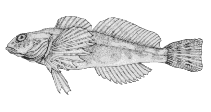 Cottus aleuticus
Изображение сделано Canadian Museum of Nature, Ottawa, Canada
изображения | Изображение на Google
Изображение сделано Canadian Museum of Nature, Ottawa, Canada
Классификация / Имена народные названия | синонимы | Catalog of Fishes(род, виды) | ITIS | CoL | WoRMS | Cloffa
> Perciformes/Cottoidei (Sculpins) > Cottidae (Sculpins)
Etymology: Cottus: Greek, kottos = a fish (Ref. 45335); aleuticus: aleuticus meaning of the Aleutians (Ref. 1998).
More on author: Gilbert.
Etymology: Cottus: Greek, kottos = a fish (Ref. 45335); aleuticus: aleuticus meaning of the Aleutians (Ref. 1998).
More on author: Gilbert.
Окружающая среда: среда / климатическая зона / пределы глубины / диапазон распространения экология
морской; пресноводный; солоноватоводный демерсальный; катадромный (Ref. 138280). Temperate; 68°N - 35°N, 175°W - 120°W
распространение Территории | регионы FAO | Экосистемы | места находок | карта точек | интродукции | Faunafri
North America: Bristol Bay and Aleutian Islands, Alaska to northern California, USA. Isolated populations in lower Kobuk River (Alaska), Cultus Lake (British Columbia, Canada), and Lake Washington (USA) (Ref. 27547).
Размер / Вес / Возраст
половая зрелость: Lm ? range ? - ? cm
Max length : 17.0 cm TL самец/пол неопределен; (Ref. 5723); common length : 6.0 cm TL самец/пол неопределен; (Ref. 12193); наибольший возраст (опубликованны данные): 8 годы (Ref. 27547)
Max length : 17.0 cm TL самец/пол неопределен; (Ref. 5723); common length : 6.0 cm TL самец/пол неопределен; (Ref. 12193); наибольший возраст (опубликованны данные): 8 годы (Ref. 27547)
Краткое описание определительные ключи | морфология | морфометрия
колючие лучи спинного плавника (общее число) : 8 - 10; членистые (мягкие) лучи спинного плавника (общее число) : 17 - 20; колючие лучи анального плавника: 0; членистые (мягкие) лучи анального плавника: 12 - 15; позвонки: 34 - 38. Distinguished by having only a single pore on the tip of the chin, no palatine teeth and no pronounced gap between 1st and 2nd dorsal fins (Ref. 27547). Dark brown to greenish or grayish on back and sides, with darker blotches; sides lighter, ventral areas white; usually two or three dark saddle-like blotches below soft part of dorsal fin; dark bars on dorsal, anal, pectoral and caudal fins; orange edge on spiny dorsal fin of spawning males (Ref. 27547).
Body shape (shape guide): elongated.
Body shape (shape guide): elongated.
Adults inhabit gravel and rubble riffles of medium to large rivers and rocky shores of lakes (Ref. 5723). They occasionally enter estuaries (Ref. 5723) and nearshore coastal water (Ref. 43939). They feed mostly at night and mostly on aquatic insects and benthic invertebrates (Ref. 27547). Generally solitary but large aggregations have been noted (Ref. 27547). Adults make regular seasonal migrations associated with spawning (Ref. 27547). Considered a forage fish for some salmonids (Ref. 1998).
Жизненный цикл и брачное поведение половая зрелость | размножение | нерест | икра | Плодовитость | личинки
Adults make regular seasonal migrations associated with spawning. They move downstream to estuaries or at least to lower reaches of rivers in the spring, mostly at night (Ref. 27547). Eggs are deposited on the undersurface of a rock, in adhesive masses (Ref. 1998). Over 7,000 eggs have been found in a single nest, suggesting that a male may spawn with several females (Ref. 1998, 27547). The male guards the nest until all eggs have hatched (Ref. 1998, 27547). A reverse, upstream migration of yearlings and adults occur in late summer to early winter, from August to December (Ref. 27547).
Основная ссылка
Загрузите свои рекомендации | ссылки | координатор | соавторы
Page, L.M. and B.M. Burr, 1991. A field guide to freshwater fishes of North America north of Mexico. Houghton Mifflin Company, Boston. 432 p. (Ref. 5723)
Статус Красного Списка МСОП (Ref. 130435: Version 2025-2 (Global))
Не вызывающий беспокойства (LC) ; Date assessed: 08 November 2011
CITES
Not Evaluated
Угроза для людей
Harmless
Использование человеком
рыболовство: интереса не представляет
FAO - Publication: search | FishSource |
дополнительная информация
Трофическая экология
Пищевые предметы (добыча)
состав пищи
потребление пищи
Продовольственные пайки
хищники
Пищевые предметы (добыча)
состав пищи
потребление пищи
Продовольственные пайки
хищники
Динамика численности населения
Параметры роста
Макс. возраст / размер
Отношение длины к весу.
Отношение длины к длине.
Размерный состав
Преобразование массы
пополнение
численность
Параметры роста
Макс. возраст / размер
Отношение длины к весу.
Отношение длины к длине.
Размерный состав
Преобразование массы
пополнение
численность
Жизненный цикл
размножение
половая зрелость
Зрелость/Жиры относительно.
Плодовитость
нерест
Нерестовые скопления
икра
Развитие икры
личинки
динамика численности личинок
размножение
половая зрелость
Зрелость/Жиры относительно.
Плодовитость
нерест
Нерестовые скопления
икра
Развитие икры
личинки
динамика численности личинок
Анатомия
жаберная область
Мозг
Отолит
жаберная область
Мозг
Отолит
Физиология
Состав тела
Питательные вещества
Потребление кислорода
Тип плавания
Скорость плавания
Зрительные пигменты
Звук рыбы
Болезни и паразиты
Токсичность (LC50s)
Состав тела
Питательные вещества
Потребление кислорода
Тип плавания
Скорость плавания
Зрительные пигменты
Звук рыбы
Болезни и паразиты
Токсичность (LC50s)
генетика
Геном
генетика
Гетерозиготность
наследуемость
Генетическое разнообразие
Геном
генетика
Гетерозиготность
наследуемость
Генетическое разнообразие
Связанные с человеком
Системы аквакультуры
особенности рыбоводства
степень растяжения
Случаи заболевания сигуатерой
Марки, монеты и прочее.
Системы аквакультуры
особенности рыбоводства
степень растяжения
Случаи заболевания сигуатерой
Марки, монеты и прочее.
инструменты
Электронная книга | полевой определитель | определительные ключи | Длина-Частота | онтогенез | карта точек |
Catch-MSY |
Специальные отчеты
Проверить содержание в аквариумах | Проверить опубликованные видовые данные | Проверить опубликованные данные по аквакультуре
Скачать в формате XML
ресурсы в Интернет
AFORO (otoliths) | Aquatic Commons | BHL | Cloffa | Websites from users | Проверить FishWatcher | CISTI | Catalog of Fishes: род, виды | DiscoverLife | ECOTOX | FAO - Publication: search | Faunafri | Fishipedia | Fishtrace | GloBI | Google Books | Google Scholar | Google | IGFA World Record | OneZoom | Open Tree of Life | Otolith Atlas of Taiwan Fishes | PubMed | Reef Life Survey | Socotra Atlas | TreeBase | Tree of Life | Wikipedia: Вперёд, поиск | World Records Freshwater Fishing | Zoobank | Зоологическая летопись
Оценки, основанные на моделях
Индекс филогенетического разнообразия (ссылка 82804): PD50 = 0.5000 [Uniqueness, from 0.5 = low to 2.0 = high].
Bayesian length-weight: a=0.00832 (0.00345 - 0.02005), b=3.16 (2.98 - 3.34), in cm total length, based on LWR estimates for this Genus-body shape (Ref. 93245).
Трофический уровень (ссылка 69278): 3.2 ±0.3 se; based on diet studies.
устойчивость к внешним воздействиям (ссылка 120179): средний (среднего размера), минимальное время удвоения популяции 1.4-4.4 года (tm=3; tmax=8; Fec=100).