



Lägg till din observation i Fish Watcher
| Native range | All suitable habitat | Point map | Year 2050 |

|
| This map was computer-generated and has not yet been reviewed. |
| Sebastes fasciatus AquaMaps Data sources: GBIF OBIS |
Ladda upp din foton och Videor
Bilder | Google image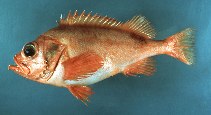 Sebastes fasciatus
Bild av Flescher, D.
Bilder | Google image
Bild av Flescher, D.
Klassificering / Namn Populärnamn | synonymer | Catalog of Fishes(Släkte, Arter) | ITIS | CoL | WoRMS | Cloffa
> Perciformes/Scorpaenoidei (Scorpionfishes) > Sebastidae (Rockfishes, rockcods and thornyheads) > Sebastinae
Etymology: Sebastes: Greek, sebastes = august, venerable (Ref. 45335).
Etymology: Sebastes: Greek, sebastes = august, venerable (Ref. 45335).
Miljö: miljö / Klimatzon / djupintervall / distributionsområde Ekologi
marina bottenlevande; djupintervall 70 - 592 m (Ref. 5951), usually 128 - 366 m (Ref. 5951). Temperate; 74°N - 35°N, 75°W - 13°W
Utbredning Territorier | FAO områden | Ekosystem | Förekomster | Prickkarta | Utplanteringar | Faunafri
Northwest Atlantic: Gulf of St. Lawrence to shelf waters of Nova Scotia in Canada. Northeast Atlantic: off Iceland and western Greenland (Ref. 4570).
Längd vid första mognad / Storlek / Vikt / Ålder
Inhabits shallow water; rocky or clay-silt bottom (Ref. 5951). Bears live young. Gregarious during all life. Feeds on euphausiids, decapods, mysids, small mollusks and fishes. Ovoviviparous (Ref. 4570). A long-lived species with estimated life span of 30-50 years, slow growing and has low fecundity. Late juveniles (11-20 cm total length) were primarily associated with boulder reefs that have deep interstices amongst the boulders; as well as in exposed boulders that do not have crevices along their lower margins, but are surrounded by dense patches of cerianthid anemones, Cerianthus borealis. The use of both boulder and cerianthid habitats are either on an encounter basis, regardless of habitat saturation or predation pressure, or because boulder reefs serve as recruitment habitats, and cerianthid habitats serve as a conduit for redfish moving away from saturated boulder reef sites (Ref. 58487).
Livscykel och parningsbeteende Könsmognad | Reproduktion | Lek | Ägg | Fekunditet | Larver
Ovoviviparous (Ref. 4570).
Huvudreferens
Ladda upp dina referenser | referenser | Koordinator | Medarbetare
Robins, C.R. and G.C. Ray, 1986. A field guide to Atlantic coast fishes of North America. Houghton Mifflin Company, Boston, U.S.A. 354 p. (Ref. 7251)
Status på IUCN:s rödlista (Ref. 130435: Version 2025-2 (Global))
Endangered (EN) (A1bd); Date assessed: 01 August 1996
CITES
Not Evaluated
Hot mot människor
Harmless
Mänskliga användningsområden
FAO - fiskeri: artprofil; Publication: search | FishSource | Havet omkring oss
Ytterligare information
Populationsdynamik
Tillväxtparametrar
Max. åldrar / storlekar
Längd-vikt rel.
Längd-längd rel.
Längd-frekvenser
Massakonvertering
Rekrytering
Abundans
Tillväxtparametrar
Max. åldrar / storlekar
Längd-vikt rel.
Längd-längd rel.
Längd-frekvenser
Massakonvertering
Rekrytering
Abundans
Livscykel
Reproduktion
Könsmognad
Mognad/Gills rel.
Fekunditet
Lek
Lekande aggregat
Ägg
Utveckling av ägg
Larver
Larvdynamik
Reproduktion
Könsmognad
Mognad/Gills rel.
Fekunditet
Lek
Lekande aggregat
Ägg
Utveckling av ägg
Larver
Larvdynamik
Anatomi
Gälyta
Hjärna
Otolit
Gälyta
Hjärna
Otolit
Fysiologi
Kroppssammansättning
Näringsämnen
Syreförbrukning
Typ av simning
Simhastighet
Visuella pigment
Ljud från fisk
Sjukdomar & Parasiter
Toxicitet (LC50)
Kroppssammansättning
Näringsämnen
Syreförbrukning
Typ av simning
Simhastighet
Visuella pigment
Ljud från fisk
Sjukdomar & Parasiter
Toxicitet (LC50)
Genetik
Genom
Genetik
Heterozygositet
Ärftlighet
Genetisk mångfald
Genom
Genetik
Heterozygositet
Ärftlighet
Genetisk mångfald
Människorelaterad
Vattenbrukssystem
Vattenbruksprofiler
Avelslinjer
Ciguatera-fall
Frimärken, mynt, diverse.
Vattenbrukssystem
Vattenbruksprofiler
Avelslinjer
Ciguatera-fall
Frimärken, mynt, diverse.
Verktyg
Särskilda rapporter
Kontrollera för underhåll av akvarium | Kontrollera om det finns faktablad om arter | Kontrollera om det finns faktablad om vattenbruk
Ladda ner XML
Internet-källor
AFORO (otoliths) | Aquatic Commons | BHL | Cloffa | Websites from users | Check FishWatcher | CISTI | Catalog of Fishes: Släkte, Arter | DiscoverLife | DORIS | ECOTOX | FAO - fiskeri: artprofil; Publication: search | Faunafri | Fishipedia | Fishtrace | GloBI | Google Books | Google Scholar | Google | IGFA World Record | OceanAdapt | OneZoom | Open Tree of Life | Otolith Atlas of Taiwan Fishes | Offentliga akvarier | PubMed | Reef Life Survey | Socotra Atlas | TreeBase | Tree of Life | Wikipedia: Go, sök | World Records Freshwater Fishing | Zoobank | Zoologiskt register
Uppskattningar baserade på modeller
Önskad temperatur (Ref. 123201): 0.8 - 7.8, mean 5.2 °C (based on 147 cells).
Index för fylogenetisk mångfald (Ref. 82804): PD50 = 0.5000 [Uniqueness, from 0.5 = low to 2.0 = high].
Bayesian length-weight: a=0.01023 (0.00680 - 0.01541), b=3.13 (3.01 - 3.25), in cm total length, based on LWR estimates for this species & Genus-body shape (Ref. 93245).
Trofisk nivå (Ref. 69278): 3.2 ±0.2 se; based on diet studies.
Resiliens (Ref. 120179): Låg, lägsta populationsfördubblingstid 4,5-14 år (tm=5.5).
Prior r = 0.07, 95% CL = 0.05 - 0.11, Based on 1 full stock assessment.
Näringsämnen (Ref. 124155): Calcium = 31.1 [11.9, 105.5] mg/100g; Iron = 0.275 [0.114, 0.699] mg/100g; Protein = 17.6 [16.4, 18.8] %; Omega3 = 1.34 [0.56, 3.30] g/100g; Selenium = 39.4 [14.5, 112.6] μg/100g; VitaminA = 28.4 [8.6, 92.1] μg/100g; Zinc = 0.469 [0.244, 0.840] mg/100g (wet weight);