



Sebastes caurinus Richardson, 1844
Copper rockfish
Beobachtung melden im Fish Watcher
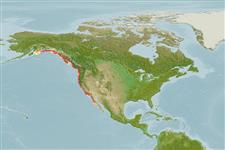
| Native range | All suitable habitat | Point map | Year 2050 |
|
| This map was computer-generated and has not yet been reviewed. |
| Sebastes caurinus AquaMaps Data sources: GBIF OBIS |
Hochladen Photos und videos
Bilder | videos | Google Bild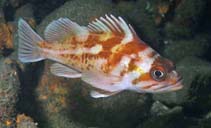 Sebastes caurinus
Photo von Lonhart, S.I.
Bilder | videos | Google Bild
Photo von Lonhart, S.I.
Klassifizierung / Names Namen | Synonyme | Catalog of Fishes(Gattung, Arten) | ITIS | CoL | WoRMS | Cloffa
> Perciformes/Scorpaenoidei (Scorpionfishes) > Sebastidae (Rockfishes, rockcods and thornyheads) > Sebastinae
Etymology: Sebastes: Greek, sebastes = august, venerable (Ref. 45335); caurinus: From the Latin caurinus, meaning 'northwest' (Ref. 27436).
More on author: Richardson.
Etymology: Sebastes: Greek, sebastes = august, venerable (Ref. 45335); caurinus: From the Latin caurinus, meaning 'northwest' (Ref. 27436).
More on author: Richardson.
Umwelt: Milieu / Klimazone / Tiefenbereich / Verbreitungsgebiet Ökologie
seewasser demersal; tiefenbereich 10 - 183 m (Ref. 2850). Subtropical; 60°N - 27°N, 152°W - 114°W
Verbreitung Territorien | FAO Gebiete | Ökosysteme | Vorkommen | Punkt Karte | Einführungen | Faunafri
Eastern Pacific: Kenai Peninsula, Gulf of Alaska to central Baja California, Mexico. The darker reddish phase from California may be a separate species (Ref. 27437).
Länge bei der ersten Reifung / Größe / Gewicht / Alter
Geschlechtsreife: Lm 34.0, range 31 - 41 cm
Max length : 58.0 cm TL Männchen/unbestimmt; (Ref. 27437); max. veröff. Gewicht: 2.7 kg (Ref. 40637); max. veröff. Alter: 57 Jahre (Ref. 5483)
Max length : 58.0 cm TL Männchen/unbestimmt; (Ref. 27437); max. veröff. Gewicht: 2.7 kg (Ref. 40637); max. veröff. Alter: 57 Jahre (Ref. 5483)
Kurzbeschreibung Bestimmungsschlüssel | Morphologie | Morphometrie
Rückenflossenstacheln (insgesamt) : 13; Rückenflossenweichstrahlen (insgesamt) : 11 - 14; Afterflossenstacheln: 3; Afterflossenweichstrahlen: 5 - 7; Wirbelzahl: 25 - 26. Head spines strong - nasal, preocular, postocular, tympanic and parietal spines present, supraocular, coronal and nuchal spines absent (Ref. 27437). Caudal fin rounded (Ref. 6885). Olive brown to copper with pink or yellow blotches, white on sides and belly; rear two thirds of lateral line is white; usually with two dark bands radiating from eye; dorsal fin dark copper brown to black with some white (Ref. 27436). Branchiostegal rays: 7 (Ref. 36715).
Body shape (shape guide): fusiform / normal.
Body shape (shape guide): fusiform / normal.
Particularly abundant in shallow, protected bays and inlets, among rocks and kelp beds; also found around pilings and jetties or under floats (Ref. 27436). Juveniles found in loose aggregations in shallow weedy bays, around wharfs, or among floating drift associated with summer tidelines (Ref. 27436). Mainly a benthic feeder, may also take pelagic fishes (Ref. 27436). Viviparous, with planktonic larvae (Ref. 36715). Flesh is tasty, firm and flaky (Ref. 27436). Sold mainly as fresh fillets or live in Chinese restaurants and fish markets; excellent for fish chips or for pan frying as fillets (Ref. 27436).
Lebenszyklus und Paarungsverhalten Geschlechtsreife | Fortpflanzung | Ablaichen | Eier | Fruchtbarkeit | Larven
Hauptreferenz
Laden Sie Ihre Referenzen hoch | Referenzen | Koordinator | Partner
Eschmeyer, W.N., E.S. Herald and H. Hammann, 1983. A field guide to Pacific coast fishes of North America. Boston (MA, USA): Houghton Mifflin Company. xii+336 p. (Ref. 2850)
IUCN Rote Liste Status (Ref. 130435: Version 2025-2 (Global))
Gefährdung zunehmend (NT) (A1bd); Date assessed: 29 February 2024
CITES
Not Evaluated
Bedrohung für Menschen
Venomous (Ref. 4690)
Nutzung durch Menschen
Fischereien: weniger kommerziell; Sportfisch: ja; Aquarium: Öffentliche Aquarien
FAO - Publication: search | FishSource |
Mehr Information
Trophische Ökologie
Lebensmittel (Beutetiere)
Nahrungszusammensetzung
Nahrungsaufnahme
Lebensmittelrationen
Räuber
Lebensmittel (Beutetiere)
Nahrungszusammensetzung
Nahrungsaufnahme
Lebensmittelrationen
Räuber
Populationsdynamik
Wachstumsparameter
Max. Alter/Größen
Länge-Gewicht-Rel.
Länge-Länge-Verhältnis.
Längenhäufigkeiten
Massenkonvertierung
Rekrutierung
Dichte
Wachstumsparameter
Max. Alter/Größen
Länge-Gewicht-Rel.
Länge-Länge-Verhältnis.
Längenhäufigkeiten
Massenkonvertierung
Rekrutierung
Dichte
Lebenszyklus
Fortpflanzung
Geschlechtsreife
Reifung/Kiemen rel.
Fruchtbarkeit
Ablaichen
Laichaggregationen
Eier
Eientwicklung
Larven
Larven Pop.Dyn.
Fortpflanzung
Geschlechtsreife
Reifung/Kiemen rel.
Fruchtbarkeit
Ablaichen
Laichaggregationen
Eier
Eientwicklung
Larven
Larven Pop.Dyn.
Anatomie
Kiemenoberfläche
Gehirn
Otolith
Kiemenoberfläche
Gehirn
Otolith
Physiologie
Körperliche Zusammensetzung
Nährstoffe
Sauerstoffverbrauch
Schwimmart
Schwimmgeschwindigkeit
Visuelle Pigmente
Fischgeräusche
Krankheiten und Parasiten
Toxizität (LC50s)
Körperliche Zusammensetzung
Nährstoffe
Sauerstoffverbrauch
Schwimmart
Schwimmgeschwindigkeit
Visuelle Pigmente
Fischgeräusche
Krankheiten und Parasiten
Toxizität (LC50s)
Genetik
Genom
Genetik
Heterozygotie
Vererbbarkeit
Genetische Vielfalt
Genom
Genetik
Heterozygotie
Vererbbarkeit
Genetische Vielfalt
Menschenbezogen
Aquakultur-Systeme
Aquakultur Profile
Zuchtlinien
Ciguatera-Fälle
Briefmarken, Münzen, Verschiedenes.
Aquakultur-Systeme
Aquakultur Profile
Zuchtlinien
Ciguatera-Fälle
Briefmarken, Münzen, Verschiedenes.
Tools
Bio-Quiz | E-Book | Feldführer | Längenhäufigkeits Tool | Lebensdaten Tool | Punkt Karte |
Catch-MSY |
Zusatzinformationen
Download XML
Zusammenfassung | Punktdaten | Namen | Photos
Internet Quellen
AFORO (otoliths) | Aquatic Commons | BHL | Cloffa | Websites from users | FishWatcher Einträge suchen | CISTI | Catalog of Fishes: Gattung, Arten | DiscoverLife | ECOTOX | FAO - Publication: search | Faunafri | Fishipedia | Fishtrace | GloBI | Google Books | Google Scholar | Google | IGFA World Record | OceanAdapt | OneZoom | Open Tree of Life | Otolith Atlas of Taiwan Fishes | Öffentliche Aquarien | PubMed | Reef Life Survey | Socotra Atlas | TreeBase | Tree of Life | Wikipedia: Gehe zu, Suchen | World Records Freshwater Fishing | Zoobank | Zoologischer Rekord
Schätzungen auf der Grundlage von Modellen
Bevorzugte Temperatur (Ref. 123201): 6.5 - 10, mean 8.3 °C (based on 53 cells).
Phylogenetischer Diversitätsindex (Ref. 82804): PD50 = 0.5000 [Uniqueness, from 0.5 = low to 2.0 = high].
Bayesian length-weight: a=0.01000 (0.00490 - 0.02040), b=3.09 (2.92 - 3.26), in cm total length, based on LWR estimates for this Genus-body shape (Ref. 93245).
Trophische Ebene (Ref. 69278): 4.1 ±0.5 se; based on diet studies.
Widerstandsfähigkeit (Ref. 120179): niedrig, Verdopplung der Population dauert 4,5 - 14 Jahre. (K=0.12; tmax=55; tm=4; Fec=20,000).
Prior r = 0.18, 95% CL = 0.12 - 0.27, Based on 2 full stock assessments.
Nährstoffe (Ref. 124155): Calcium = 47.8 [14.1, 149.9] mg/100g; Iron = 0.676 [0.278, 1.809] mg/100g; Protein = 18.6 [17.5, 19.8] %; Omega3 = 0.696 [0.303, 1.610] g/100g; Selenium = 70.3 [25.8, 227.2] μg/100g; VitaminA = 21.3 [7.3, 64.1] μg/100g; Zinc = 0.456 [0.229, 0.865] mg/100g (wet weight);