



Lepidopus fitchi Rosenblatt & Wilson, 1987
Pacific scabbardfish
Waarneming toevoegen in Fish Watcher
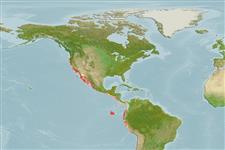
| Native range | All suitable habitat | Point map | Year 2050 |
|
| This map was computer-generated and has not yet been reviewed. |
| Lepidopus fitchi AquaMaps Data sources: GBIF OBIS |
Uploaden van uw Foto's en video's
Afbeeldingen | Google afbeelding Lepidopus fitchi
Afbeelding van Briones-Mendoza, J.
Afbeeldingen | Google afbeelding
Afbeelding van Briones-Mendoza, J.
Classificatie / Namen Lokale namen | Synoniemen | Catalog of Fishes(Genus, Soort(en)) | ITIS | CoL | WoRMS | Cloffa
> Scombriformes (Mackerels) > Trichiuridae (Cutlassfishes) > Lepidopodinae
Etymology: Lepidopus: Greek, lepis = scale + Greek, pous = foot (Ref. 45335); fitchi: Named in honor of the late John Fitch, indefatigable student of California fishes (Ref. 12696).
Eponymy: John Edgar Fitch (1918–1982) was a marine biologist and ichthyologist who was Director of the US Fisheries Laboratory, San Diego. He wrote: Offshore fishes of California (1958). (Ref. 128868), visit book page.
More on authors: Rosenblatt & Wilson.
Etymology: Lepidopus: Greek, lepis = scale + Greek, pous = foot (Ref. 45335); fitchi: Named in honor of the late John Fitch, indefatigable student of California fishes (Ref. 12696).
Eponymy: John Edgar Fitch (1918–1982) was a marine biologist and ichthyologist who was Director of the US Fisheries Laboratory, San Diego. He wrote: Offshore fishes of California (1958). (Ref. 128868), visit book page.
More on authors: Rosenblatt & Wilson.
Milieu: milieu / Klimaatzone / Diepte / verspreidingsgebied Ecologie
marien benthopelagisch; diepte 100 - 500 m (Ref. 6181), usually 100 - 250 m (Ref. 9351). Deep-water; 46°N - 17°S, 128°W - 75°W (Ref. 6181)
Verspreiding Gebieden | FAO regio's | Ecosystemen | Voorkomen | Verspreidingskaart | Introducties | Faunafri
Eastern Pacific: Cape Kiwanda, Oregon, USA to the Gulf of California; then from 5°N to southern Peru.
Grootte / Gewicht / Leeftijd
Maturiteit: Lm ? range ? - ? cm
Max length : 210 cm SL mannelijk / geslacht onbekend; (Ref. 9351); common length : 150 cm SL mannelijk / geslacht onbekend; (Ref. 9351); max. gepubliceerd gewicht: 1.4 kg (Ref. 6181)
Max length : 210 cm SL mannelijk / geslacht onbekend; (Ref. 9351); common length : 150 cm SL mannelijk / geslacht onbekend; (Ref. 9351); max. gepubliceerd gewicht: 1.4 kg (Ref. 6181)
Korte beschrijving Determinatiesleutels | Morfologie | Morfometrie
Dorsale zachte stralen (totaal) : 78 - 87; Anale stekels: 2; Anale zachte stralen: 41 - 50; Wervels: 84 - 93. Upper head profile slightly convex, rising gently from snout to dorsal-fin origin. Orbits nearly touching dorsal profile; interorbital space slightly concave. Pelvic fins reduced to 1 scale-like spine and 1 - 2 tiny rays. Pyloric caeca 16 - 18. Color of body is black or brown with a silvery shine along the abdomen.
Body shape (shape guide): elongated; Cross section: compressed.
Body shape (shape guide): elongated; Cross section: compressed.
Benthopelagic on the continental shelf and slope, up to a depth of 400 m or more; generally found over sandy bottoms at a depth between 100 and 250 m (Ref. 9351). During cold season, it is often seen near the surface at nights when the moon is full (Ref. 9351). May also be encountered in surge zones and sometimes observed to be beached in large numbers by the shore (Ref. 9351). A schooling species which feeds on cephalopods, euphausiids and small fishes, including Engraulis mordax and juvenile Merluccius productus. Marketed fresh and frozen (Ref. 9351). Excellent food fish, also processed into fish meal and oil (Ref. 9351).
Levenscyclus en paargedrag Maturiteit | Voortplanting | Paaien | Eieren | Fecunditeit | Larven
Hoofdreferentie
Upload uw referenties | Referenties | Coördinator : Parin, Nikolay V. | Medewerkers
Nakamura, I. and N.V. Parin, 1993. FAO Species Catalogue. Vol. 15. Snake mackerels and cutlassfishes of the world (families Gempylidae and Trichiuridae). An annotated and illustrated catalogue of the snake mackerels, snoeks, escolars, gemfishes, sackfishes, domine, oilfish, cutlassfishes,. scabbardfishes, hairtails, and frostfishes known to date. FAO Fish. Synop. 125(15):136 p. (Ref. 6181)
CITES
Not Evaluated
Gevaar voor de mens
Harmless
Gebruik door de mens
Visserij: van minder commercieel belang
FAO - Publication: search | FishSource |
Meer informatie
Trofische ecologie
Voedsel (prooien)
Dieetsamenstelling
Voedselconsumptie
Voedselrantsoenen
Predatoren
Voedsel (prooien)
Dieetsamenstelling
Voedselconsumptie
Voedselrantsoenen
Predatoren
Populatiedynamica
Groeiparameters
Max. leeftijden / maten
Lengte-gewicht rel.
Lengte-lengte rel.
Lengtefrequenties
Massaconversie
Rekrutering
Abundantie
Groeiparameters
Max. leeftijden / maten
Lengte-gewicht rel.
Lengte-lengte rel.
Lengtefrequenties
Massaconversie
Rekrutering
Abundantie
Levenscyclus
Voortplanting
Maturiteit
Rijpheid/kieuwen rel.
Fecunditeit
Paaien
Paaibestanden
Eieren
Ontwikkeling van de eieren
Larven
Larvale populatiedynamiek
Voortplanting
Maturiteit
Rijpheid/kieuwen rel.
Fecunditeit
Paaien
Paaibestanden
Eieren
Ontwikkeling van de eieren
Larven
Larvale populatiedynamiek
Anatomie
Kieuwoppervlak
Hersenen
Otoliet
Kieuwoppervlak
Hersenen
Otoliet
Fysiologie
Lichaamssamenstelling
Voedingsstoffen
Zuurstofverbruik
Type zwemmen
Zwemsnelheid
Visuele pigmenten
Vis geluid
Ziekten en parasieten
Toxiciteit (LC50)
Lichaamssamenstelling
Voedingsstoffen
Zuurstofverbruik
Type zwemmen
Zwemsnelheid
Visuele pigmenten
Vis geluid
Ziekten en parasieten
Toxiciteit (LC50)
Genetica
genoom
Genetica
Heterozygositeit
Erfelijkheid
Genetische diversiteit
genoom
Genetica
Heterozygositeit
Erfelijkheid
Genetische diversiteit
Menselijk gerelateerd
Aquacultuursystemen
Aquacultuurprofielen
Kweeklijnen
Ciguatera gevallen
Postzegels, munten, diversen.
Aquacultuursystemen
Aquacultuurprofielen
Kweeklijnen
Ciguatera gevallen
Postzegels, munten, diversen.
Tools
E-boek | Veldgids | Determinatiesleutels | Lengtefrequentie Tool | Levenscyclus tool | Verspreidingskaart |
Vangst-MSY |
Speciale rapporten
Bekijk gegevens voor het houden in een aquarium | Bekijk Fact Sheets voor de soort | Bekijk Aquacultuur Fact Sheets
Download XML
Internetbronnen
AFORO (otoliths) | Aquatic Commons | BHL | Cloffa | Websites from users | Bekijk FishWatcher | CISTI | Catalog of Fishes: Genus, Soort(en) | DiscoverLife | ECOTOX | FAO - Publication: search | Faunafri | Fishipedia | Fishtrace | GloBI | Google Books | Google Scholar | Google | IGFA World Record | OneZoom | Open Tree of Life | Otolith Atlas of Taiwan Fishes | PubMed | Reef Life Survey | Socotra Atlas | TreeBase | Tree of Life | Wikipedia: ga naar, zoek | World Records Freshwater Fishing | Zoobank | Zoological Record
Schattingen op basis van modellen
Gewenste temperatuur (Ref. 123201): 8.2 - 15.4, mean 12.8 °C (based on 70 cells).
Fylogenetische diversiteitsindex (Ref. 82804): PD50 = 0.5156 [Uniqueness, from 0.5 = low to 2.0 = high].
Bayesian length-weight: a=0.00275 (0.00104 - 0.00730), b=3.06 (2.83 - 3.29), in cm total length, based on LWR estimates for this (Sub)family-body shape (Ref. 93245).
Trofisch niveau (Ref. 69278): 4.1 ±0.59 se; based on food items.
Weerstandsvermogen (Ref. 120179): laag, minimale populatieverdubbelingstijd 4,5-14 jaar (Preliminary K or Fecundity.).
Voedingsstoffen (Ref. 124155): Calcium = 11.5 [5.3, 23.6] mg/100g; Iron = 0.289 [0.135, 0.650] mg/100g; Protein = 17.2 [15.5, 18.8] %; Omega3 = 0.209 [0.095, 0.481] g/100g; Selenium = 30.3 [11.9, 77.8] μg/100g; VitaminA = 8.03 [1.37, 41.90] μg/100g; Zinc = 0.26 [0.17, 0.43] mg/100g (wet weight);