



Leptoclinus maculatus (Fries, 1838)
Daubed shanny
Lägg till din observation i Fish Watcher
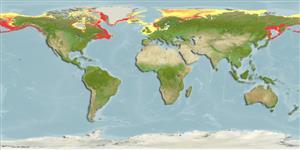
| Native range | All suitable habitat | Point map | Year 2050 |
|
| This map was computer-generated and has not yet been reviewed. |
| Leptoclinus maculatus AquaMaps Data sources: GBIF OBIS |
Ladda upp din foton och Videor
Bilder | Google image Leptoclinus maculatus
Bild av Svensen, R.
Bilder | Google image
Bild av Svensen, R.
Klassificering / Namn Populärnamn | synonymer | Catalog of Fishes(Släkte, Arter) | ITIS | CoL | WoRMS | Cloffa
> Perciformes/Zoarcoidei (Eelpouts and pricklebacks) > Lumpenidae (Eel pricklebacks)
Etymology: Leptoclinus: Greek, leptos = thin + Greek, klinein, kline = sloping and bed, due to the four apophyses of sphenoid bone (Ref. 45335).
Etymology: Leptoclinus: Greek, leptos = thin + Greek, klinein, kline = sloping and bed, due to the four apophyses of sphenoid bone (Ref. 45335).
Miljö: miljö / Klimatzon / djupintervall / distributionsområde Ekologi
marina bottenlevande; djupintervall 2 - 607 m (Ref. 58426). Polar; -2°C - 2°C (Ref. 120227); 79°N - 43°N, 180°W - 180°E (Ref. 86838)
Utbredning Territorier | FAO områden | Ekosystem | Förekomster | Prickkarta | Utplanteringar | Faunafri
Circumpolar: Arctic to temperate waters; northern hemisphere. Arctic Alaska to Sea of Okhotsk, northern Sea of Japan, Unalaska Island in the Aleutian chain and Puget Sound, Washington, USA. North Atlantic: Arctic to Labrador in Canada; along Scandinavia from Skagerrak to Finnmarken, common at Murmansk, White Sea, Iceland and Greenland (Ref. 10006). The Pacific form is sometimes treated as a subspecies Leptoclinus maculatus diaphanocarus (Ref. 51666).
Längd vid första mognad / Storlek / Vikt / Ålder
Kort beskrivning Bestämningsnycklar | Morfologi | Morfometri
Taggstrålar i ryggfenan (totalt) : 57 - 60; Mjukstrålar i ryggfenan (totalt) : 0; Taggstrålar i analfenan: 1 - 2; Mjukstrålar i analfenan: 34 - 36. Caudal rounded; lower 5 rays of pectorals greatly lengthened and exserted (Ref. 6885). Color greyish - yellow with dark irregular spots (Ref. 35388).
Body shape (shape guide): elongated.
Body shape (shape guide): elongated.
Adults, juveniles, and late postlarvae are found on sandy and mud to pebble bottoms, usually in less than 170 meters (Ref. 2850, 51666, 120227), while early postlarvae are pelagic (Ref. 120227). Food consists of polychaetes and crustaceans (Ref. 10571). They are an important prey for pelagic (as larvae) and benthic (as adults) predators (Ref. 120226). Sexual dimorphism is more pronounced after maturation with males displaying faster somatic growth (Ref. 120226). This marked dimorphism may well be linked with behavioral dissimilarities between males and
females, and is most likely associated with different roles during the breeding season with only adult males have large canines at the tip of upper jaw. It is assumed that males are territorial and defend their spawning sites, whereasfemales guard eggs within her partner’s territory (Ref. 128434).
Livscykel och parningsbeteende Könsmognad | Reproduktion | Lek | Ägg | Fekunditet | Larver
Males exhibit territorial defence (Ref. 120226).
Huvudreferens
Ladda upp dina referenser | referenser | Koordinator | Medarbetare
Eschmeyer, W.N., E.S. Herald and H. Hammann, 1983. A field guide to Pacific coast fishes of North America. Boston (MA, USA): Houghton Mifflin Company. xii+336 p. (Ref. 2850)
CITES
Not Evaluated
Hot mot människor
Harmless
Mänskliga användningsområden
Fiskeri: bycatch
FAO - Publication: search | FishSource |
Ytterligare information
Populationsdynamik
Tillväxtparametrar
Max. åldrar / storlekar
Längd-vikt rel.
Längd-längd rel.
Längd-frekvenser
Massakonvertering
Rekrytering
Abundans
Tillväxtparametrar
Max. åldrar / storlekar
Längd-vikt rel.
Längd-längd rel.
Längd-frekvenser
Massakonvertering
Rekrytering
Abundans
Livscykel
Reproduktion
Könsmognad
Mognad/Gills rel.
Fekunditet
Lek
Lekande aggregat
Ägg
Utveckling av ägg
Larver
Larvdynamik
Reproduktion
Könsmognad
Mognad/Gills rel.
Fekunditet
Lek
Lekande aggregat
Ägg
Utveckling av ägg
Larver
Larvdynamik
Anatomi
Gälyta
Hjärna
Otolit
Gälyta
Hjärna
Otolit
Fysiologi
Kroppssammansättning
Näringsämnen
Syreförbrukning
Typ av simning
Simhastighet
Visuella pigment
Ljud från fisk
Sjukdomar & Parasiter
Toxicitet (LC50)
Kroppssammansättning
Näringsämnen
Syreförbrukning
Typ av simning
Simhastighet
Visuella pigment
Ljud från fisk
Sjukdomar & Parasiter
Toxicitet (LC50)
Genetik
Genom
Genetik
Heterozygositet
Ärftlighet
Genetisk mångfald
Genom
Genetik
Heterozygositet
Ärftlighet
Genetisk mångfald
Människorelaterad
Vattenbrukssystem
Vattenbruksprofiler
Avelslinjer
Ciguatera-fall
Frimärken, mynt, diverse.
Vattenbrukssystem
Vattenbruksprofiler
Avelslinjer
Ciguatera-fall
Frimärken, mynt, diverse.
Verktyg
Särskilda rapporter
Kontrollera för underhåll av akvarium | Kontrollera om det finns faktablad om arter | Kontrollera om det finns faktablad om vattenbruk
Ladda ner XML
Internet-källor
AFORO (otoliths) | Aquatic Commons | BHL | Cloffa | Websites from users | Check FishWatcher | CISTI | Catalog of Fishes: Släkte, Arter | DiscoverLife | ECOTOX | FAO - Publication: search | Faunafri | Fishipedia | Fishtrace | GloBI | Google Books | Google Scholar | Google | IGFA World Record | Nationella databaser | OceanAdapt | OneZoom | Open Tree of Life | Otolith Atlas of Taiwan Fishes | PubMed | Reef Life Survey | Socotra Atlas | TreeBase | Tree of Life | Wikipedia: Go, sök | World Records Freshwater Fishing | Zoologiskt register
Uppskattningar baserade på modeller
Önskad temperatur (Ref. 123201): 0.2 - 7, mean 2.3 °C (based on 1058 cells).
Index för fylogenetisk mångfald (Ref. 82804): PD50 = 1.0005 [Uniqueness, from 0.5 = low to 2.0 = high].
Bayesian length-weight: a=0.00269 (0.00146 - 0.00495), b=3.06 (2.89 - 3.23), in cm total length, based on LWR estimates for this species & (Sub)family-body (Ref. 93245).
Trofisk nivå (Ref. 69278): 3.3 ±0.39 se; based on food items.
Generation time: 11.1 ( na - na) years. Estimated as median ln(3)/K based on 2 growth studies.
Resiliens (Ref. 120179): Låg, lägsta populationsfördubblingstid 4,5-14 år (tm=7; tmax=12; K=0.099; Fec=931).
Näringsämnen (Ref. 124155): Calcium = 22.3 [4.8, 93.2] mg/100g; Iron = 0.512 [0.172, 1.359] mg/100g; Protein = 16.8 [14.9, 18.9] %; Omega3 = 0.288 [0.112, 0.751] g/100g; Selenium = 9.62 [3.01, 35.80] μg/100g; VitaminA = 35.4 [6.5, 194.5] μg/100g; Zinc = 0.57 [0.29, 1.21] mg/100g (wet weight);