



Leptoclinus maculatus (Fries, 1838)
Daubed shanny
個人による観察記録の追加 Fish Watcher
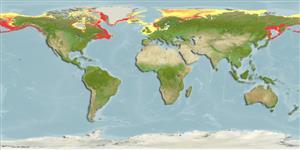
| Native range | All suitable habitat | Point map | Year 2050 |
|
| This map was computer-generated and has not yet been reviewed. |
| Leptoclinus maculatus AquaMaps Data sources: GBIF OBIS |
アップロード 写真 そして ビデオ
画像 | グーグルの画像 Leptoclinus maculatus
画像によって Svensen, R.
画像 | グーグルの画像
画像によって Svensen, R.
分類 / 名前 共通名の | 類義語 | Catalog of Fishes(部類, 種) | ITIS | CoL | WoRMS | Cloffa
> Perciformes/Zoarcoidei (Eelpouts and pricklebacks) > Lumpenidae (Eel pricklebacks)
Etymology: Leptoclinus: Greek, leptos = thin + Greek, klinein, kline = sloping and bed, due to the four apophyses of sphenoid bone (Ref. 45335).
Etymology: Leptoclinus: Greek, leptos = thin + Greek, klinein, kline = sloping and bed, due to the four apophyses of sphenoid bone (Ref. 45335).
環境:環境 / 気候帯 / 深さの範囲 / 分布範囲 生態学
海 底生の; 深さの範囲 2 - 607 m (Ref. 58426). Polar; -2°C - 2°C (Ref. 120227); 79°N - 43°N, 180°W - 180°E (Ref. 86838)
分布 領土 | 国連食糧農業機関の区域 | エコシステム | 事件 | 目的のマップ | 導入 | Faunafri
Circumpolar: Arctic to temperate waters; northern hemisphere. Arctic Alaska to Sea of Okhotsk, northern Sea of Japan, Unalaska Island in the Aleutian chain and Puget Sound, Washington, USA. North Atlantic: Arctic to Labrador in Canada; along Scandinavia from Skagerrak to Finnmarken, common at Murmansk, White Sea, Iceland and Greenland (Ref. 10006). The Pacific form is sometimes treated as a subspecies Leptoclinus maculatus diaphanocarus (Ref. 51666).
初回成熟時の長さ / サイズ / 重さ / 年齢
簡単な記述 検索表 | 形態学 | 形態計測学
背面の脊椎 (合計) : 57 - 60; 背鰭 (合計) : 0; 肛門の骨: 1 - 2; 臀鰭: 34 - 36. Caudal rounded; lower 5 rays of pectorals greatly lengthened and exserted (Ref. 6885). Color greyish - yellow with dark irregular spots (Ref. 35388).
Body shape (shape guide): elongated.
Body shape (shape guide): elongated.
Adults, juveniles, and late postlarvae are found on sandy and mud to pebble bottoms, usually in less than 170 meters (Ref. 2850, 51666, 120227), while early postlarvae are pelagic (Ref. 120227). Food consists of polychaetes and crustaceans (Ref. 10571). They are an important prey for pelagic (as larvae) and benthic (as adults) predators (Ref. 120226). Sexual dimorphism is more pronounced after maturation with males displaying faster somatic growth (Ref. 120226). This marked dimorphism may well be linked with behavioral dissimilarities between males and
females, and is most likely associated with different roles during the breeding season with only adult males have large canines at the tip of upper jaw. It is assumed that males are territorial and defend their spawning sites, whereasfemales guard eggs within her partner’s territory (Ref. 128434).
ライフサイクルと交尾行動 成熟 | 繁殖 | 放精 | 卵 | 生産力 | 幼生
Males exhibit territorial defence (Ref. 120226).
主な参考文献
参考文献のアップロード | 参考文献 | コーディネーター | 協力者
Eschmeyer, W.N., E.S. Herald and H. Hammann, 1983. A field guide to Pacific coast fishes of North America. Boston (MA, USA): Houghton Mifflin Company. xii+336 p. (Ref. 2850)
CITES
Not Evaluated
人間に対する脅威
Harmless
人間の用途
水産業: bycatch
FAO - Publication: search | FishSource |
より多くの情報
解剖学
カマ
脳
オトリス
カマ
脳
オトリス
生理学
体組成
栄養素
酸素消費
水泳タイプ
泳ぐ速さ
視覚色素
フィッシュ・サウンド
病気と寄生虫
毒性(LC50)
体組成
栄養素
酸素消費
水泳タイプ
泳ぐ速さ
視覚色素
フィッシュ・サウンド
病気と寄生虫
毒性(LC50)
遺伝子の
ゲノム
遺伝子の
ヘテロ接合性
遺伝
遺伝的多様性
ゲノム
遺伝子の
ヘテロ接合性
遺伝
遺伝的多様性
用具
特記事項
XMLをダウンロードして下さい
インターネットの情報源
AFORO (otoliths) | Aquatic Commons | BHL | Cloffa | Websites from users | Check FishWatcher | CISTI | Catalog of Fishes: 部類, 種 | DiscoverLife | ECOTOX | FAO - Publication: search | Faunafri | Fishipedia | Fishtrace | GloBI | Google Books | Google Scholar | Google | IGFA World Record | 国のデーターベース | OceanAdapt | OneZoom | Open Tree of Life | Otolith Atlas of Taiwan Fishes | PubMed | Reef Life Survey | Socotra Atlas | TreeBase | 生命の木 | Wikipedia: 行く, 検索する | World Records Freshwater Fishing | 動物に関する記録
モデルに基づく推定値
好ましい温度 (参照 123201): 0.2 - 7, mean 2.3 °C (based on 1058 cells).
系統多様性指数 (参照 82804): PD50 = 1.0005 [Uniqueness, from 0.5 = low to 2.0 = high].
Bayesian length-weight: a=0.00269 (0.00146 - 0.00495), b=3.06 (2.89 - 3.23), in cm total length, based on LWR estimates for this species & (Sub)family-body (Ref. 93245).
栄養段階 (参照 69278): 3.3 ±0.39 se; based on food items.
Generation time: 11.1 ( na - na) years. Estimated as median ln(3)/K based on 2 growth studies.
回復力 (参照 120179): 低い, 4.5年~14年の倍増期間の最小個体群 (tm=7; tmax=12; K=0.099; Fec=931).
栄養素 (Ref. 124155): Calcium = 22.3 [4.8, 93.2] mg/100g; Iron = 0.512 [0.172, 1.359] mg/100g; Protein = 16.8 [14.9, 18.9] %; Omega3 = 0.288 [0.112, 0.751] g/100g; Selenium = 9.62 [3.01, 35.80] μg/100g; VitaminA = 35.4 [6.5, 194.5] μg/100g; Zinc = 0.57 [0.29, 1.21] mg/100g (wet weight);