



Lägg till din observation i Fish Watcher
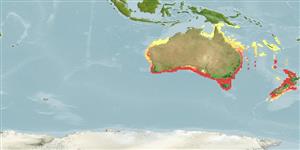
| Native range | All suitable habitat | Point map | Year 2050 |
|
| This map was computer-generated and has not yet been reviewed. |
| Trachurus declivis AquaMaps Data sources: GBIF OBIS |
Ladda upp din foton och Videor
Bilder | Google image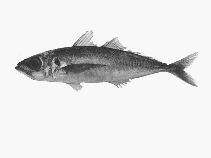 Trachurus declivis
Bild av CSIRO
Bilder | Google image
Bild av CSIRO
Klassificering / Namn Populärnamn | synonymer | Catalog of Fishes(Släkte, Arter) | ITIS | CoL | WoRMS | Cloffa
> Carangiformes (Jacks) > Carangidae (Jacks and pompanos) > Caranginae
Etymology: Trachurus: Greek, trachys, -eia, -ys = rough + Greek, oura = tail (Ref. 45335).
More on author: Jenyns.
Etymology: Trachurus: Greek, trachys, -eia, -ys = rough + Greek, oura = tail (Ref. 45335).
More on author: Jenyns.
Miljö: miljö / Klimatzon / djupintervall / distributionsområde Ekologi
marina; brackvatten bentopelagisk; djupintervall 27 - 460 m (Ref. 27930), usually ? - 300 m (Ref. 9072). Temperate; ? - 16°C (Ref. 9072); 9°S - 53°S, 112°E - 177°E (Ref. 54926)
Utbredning Territorier | FAO områden | Ekosystem | Förekomster | Prickkarta | Utplanteringar | Faunafri
Southwest Pacific: Western Australia to New South Wales, including New Zealand. Principal component analysis of morphometric and meristic characters indicates three separate subpopulations in the Great Australian Bight, off New South Wales, and off Tasmania (Ref. 7456).
Längd vid första mognad / Storlek / Vikt / Ålder
Könsmognad: Lm 31.5, range 23 - 37 cm
Max length : 64.0 cm SL hane/ej könsbestämd; (Ref. 33839); common length : 42.0 cm TL hane/ej könsbestämd; (Ref. 9258); rapporterad maxålder: 25 år (Ref. 9072)
Max length : 64.0 cm SL hane/ej könsbestämd; (Ref. 33839); common length : 42.0 cm TL hane/ej könsbestämd; (Ref. 9258); rapporterad maxålder: 25 år (Ref. 9072)
Kort beskrivning Bestämningsnycklar | Morfologi | Morfometri
Taggstrålar i ryggfenan (totalt) : 9; Mjukstrålar i ryggfenan (totalt) : 29 - 35; Taggstrålar i analfenan: 3; Mjukstrålar i analfenan: 24 - 29; Ryggkotor: 24. Adults are elongate and slightly compressed, and have a primary lateral line with 71-89 scutes, and a secondary lateral line reaching to below dorsal-fin rays 7-9 (Ref. 33616).
Body shape (shape guide): fusiform / normal.
Body shape (shape guide): fusiform / normal.
Adults are commonly found near the bottom, in midwater and occasionally at the surface (Ref. 9258) in continental shelf waters (Ref. 27930). They form pelagic schools for most of the year but may move close to the sea bed during winter (Ref. 27931). Generally found at less than 300 m water depth with temperature less than 16° C (Ref. 9072). Juveniles inhabit coastal and estuarine waters although they may sometimes be found offshore (Ref. 27930). Adults feed mostly during the day mainly on krill and other planktonic crustaceans, light fish (Sternoptychidae) and lantern fish (Myctophidae) at the edge of the continental shelf (Ref. 27933).
Livscykel och parningsbeteende Könsmognad | Reproduktion | Lek | Ägg | Fekunditet | Larver
Eggs and sperm are released amongst schooling fish, possibly deep in the water column near the edge of the continental shelf. Eggs are distributed between the surface and the thermocline and larvae are carried inshore by currents.
Huvudreferens
Ladda upp dina referenser | referenser | Koordinator : Smith-Vaniz, William F. | Medarbetare
Paxton, J.R., D.F. Hoese, G.R. Allen and J.E. Hanley, 1989. Pisces. Petromyzontidae to Carangidae. Zoological Catalogue of Australia, Vol. 7. Australian Government Publishing Service, Canberra, 665 p. (Ref. 7300)
Status på IUCN:s rödlista (Ref. 130435: Version 2025-2 (Global))
Least Concern (LC) ; Date assessed: 19 July 2017
CITES
Not Evaluated
Hot mot människor
Harmless
Mänskliga användningsområden
Fiskeri: kommersiellt viktig; sportfisk: ja; bete: usually
FAO - fiskeri: landningar, artprofil; Publication: search | FishSource | Havet omkring oss
Ytterligare information
Populationsdynamik
Tillväxtparametrar
Max. åldrar / storlekar
Längd-vikt rel.
Längd-längd rel.
Längd-frekvenser
Massakonvertering
Rekrytering
Abundans
Tillväxtparametrar
Max. åldrar / storlekar
Längd-vikt rel.
Längd-längd rel.
Längd-frekvenser
Massakonvertering
Rekrytering
Abundans
Livscykel
Reproduktion
Könsmognad
Mognad/Gills rel.
Fekunditet
Lek
Lekande aggregat
Ägg
Utveckling av ägg
Larver
Larvdynamik
Reproduktion
Könsmognad
Mognad/Gills rel.
Fekunditet
Lek
Lekande aggregat
Ägg
Utveckling av ägg
Larver
Larvdynamik
Anatomi
Gälyta
Hjärna
Otolit
Gälyta
Hjärna
Otolit
Fysiologi
Kroppssammansättning
Näringsämnen
Syreförbrukning
Typ av simning
Simhastighet
Visuella pigment
Ljud från fisk
Sjukdomar & Parasiter
Toxicitet (LC50)
Kroppssammansättning
Näringsämnen
Syreförbrukning
Typ av simning
Simhastighet
Visuella pigment
Ljud från fisk
Sjukdomar & Parasiter
Toxicitet (LC50)
Människorelaterad
Vattenbrukssystem
Vattenbruksprofiler
Avelslinjer
Ciguatera-fall
Frimärken, mynt, diverse.
Vattenbrukssystem
Vattenbruksprofiler
Avelslinjer
Ciguatera-fall
Frimärken, mynt, diverse.
Verktyg
E-bok | Fälthandbok | Bestämningsnycklar | Längdfördelnings-verktyg | Livshistorie-verktyg | Prickkarta |
Fångst-MSY |
Särskilda rapporter
Kontrollera för underhåll av akvarium | Kontrollera om det finns faktablad om arter | Kontrollera om det finns faktablad om vattenbruk
Ladda ner XML
Internet-källor
AFORO (otoliths) | Aquatic Commons | BHL | Cloffa | Websites from users | Check FishWatcher | CISTI | Catalog of Fishes: Släkte, Arter | DiscoverLife | ECOTOX | FAO - fiskeri: landningar, artprofil; Publication: search | Faunafri | Fishipedia | Fishtrace | GloBI | Google Books | Google Scholar | Google | IGFA World Record | OneZoom | Open Tree of Life | Otolith Atlas of Taiwan Fishes | PubMed | Reef Life Survey | Socotra Atlas | TreeBase | Tree of Life | Wikipedia: Go, sök | World Records Freshwater Fishing | Zoologiskt register
Uppskattningar baserade på modeller
Önskad temperatur (Ref. 123201): 11.1 - 20.2, mean 14.4 °C (based on 135 cells).
Index för fylogenetisk mångfald (Ref. 82804): PD50 = 0.5001 [Uniqueness, from 0.5 = low to 2.0 = high].
Bayesian length-weight: a=0.01230 (0.00763 - 0.01985), b=2.97 (2.83 - 3.11), in cm total length, based on LWR estimates for this species & Genus-body shape (Ref. 93245).
Trofisk nivå (Ref. 69278): 3.9 ±0.61 se; based on food items.
Resiliens (Ref. 120179): Mellan, lägsta populationsfördubblingstid 1,4-4,4 år (K=0.23; tm=2-4; tmax=28).
Näringsämnen (Ref. 124155): Calcium = 77.5 [42.0, 170.3] mg/100g; Iron = 0.869 [0.471, 1.819] mg/100g; Protein = 18.5 [17.5, 19.5] %; Omega3 = 0.576 [0.312, 1.073] g/100g; Selenium = 17.1 [7.6, 37.4] μg/100g; VitaminA = 20.1 [4.3, 87.3] μg/100g; Zinc = 1.36 [0.89, 2.08] mg/100g (wet weight);