



Masukkan pemerhatian anda di Fish Watcher
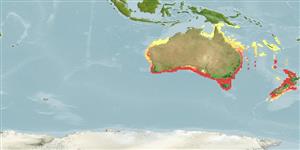
| Native range | All suitable habitat | Point map | Year 2050 |
|
| This map was computer-generated and has not yet been reviewed. |
| Trachurus declivis AquaMaps Data sources: GBIF OBIS |
muatnaik fotos/gambar dan video
Gambar | imej Google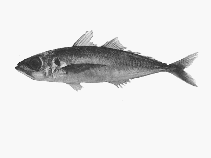 Trachurus declivis
foto/gambar oleh CSIRO
Gambar | imej Google
foto/gambar oleh CSIRO
klasifikasi / Nama Nama-nama umum | Sinonim (persamaan) | Catalog of Fishes(Marga, Jenis) | ITIS | CoL | WoRMS | Cloffa
> Carangiformes (Jacks) > Carangidae (Jacks and pompanos) > Caranginae
Etymology: Trachurus: Greek, trachys, -eia, -ys = rough + Greek, oura = tail (Ref. 45335).
More on author: Jenyns.
Etymology: Trachurus: Greek, trachys, -eia, -ys = rough + Greek, oura = tail (Ref. 45335).
More on author: Jenyns.
Lingkungan: lingkungan / zona iklim / kisaran kedalaman / jangkauan distribusi Ekologi
laut; payau bentopelagis; kisaran kedalaman 27 - 460 m (Ref. 27930), usually ? - 300 m (Ref. 9072). Temperate; ? - 16°C (Ref. 9072); 9°S - 53°S, 112°E - 177°E (Ref. 54926)
Penyebaran Wilayah | Daerah-daerah FAO | Ekosistem | Kemunculan | peta titik | Introduksi | Faunafri
Southwest Pacific: Western Australia to New South Wales, including New Zealand. Principal component analysis of morphometric and meristic characters indicates three separate subpopulations in the Great Australian Bight, off New South Wales, and off Tasmania (Ref. 7456).
Panjang pada saat jatuh tempo pertama / Ukuran / Berat / umur
Kematangan: Lm 31.5, range 23 - 37 cm
Max length : 64.0 cm SL jantan/; (Ref. 33839); common length : 42.0 cm TL jantan/; (Ref. 9258); Umur maksimum dilaporkan: 25 Tahun (Ref. 9072)
Max length : 64.0 cm SL jantan/; (Ref. 33839); common length : 42.0 cm TL jantan/; (Ref. 9258); Umur maksimum dilaporkan: 25 Tahun (Ref. 9072)
deskripsi pendek Kunci identifiaksi (pengenalan) | Morfologi | Morfometrik
Duri punggung (Keseluruhan (total)) : 9; duri punggung lunak (Keseluruhan (total)) : 29 - 35; Duri dubur: 3; Sirip dubur lunak: 24 - 29; vertebrata, bertulang belakang: 24. Adults are elongate and slightly compressed, and have a primary lateral line with 71-89 scutes, and a secondary lateral line reaching to below dorsal-fin rays 7-9 (Ref. 33616).
Body shape (shape guide): fusiform / normal.
Body shape (shape guide): fusiform / normal.
Adults are commonly found near the bottom, in midwater and occasionally at the surface (Ref. 9258) in continental shelf waters (Ref. 27930). They form pelagic schools for most of the year but may move close to the sea bed during winter (Ref. 27931). Generally found at less than 300 m water depth with temperature less than 16° C (Ref. 9072). Juveniles inhabit coastal and estuarine waters although they may sometimes be found offshore (Ref. 27930). Adults feed mostly during the day mainly on krill and other planktonic crustaceans, light fish (Sternoptychidae) and lantern fish (Myctophidae) at the edge of the continental shelf (Ref. 27933).
Siklus hidup dan perilaku kawin Kematangan | Reproduksi, perkembang biakan | Pemijahan | telur-telur | Fekunditas | Larva
Eggs and sperm are released amongst schooling fish, possibly deep in the water column near the edge of the continental shelf. Eggs are distributed between the surface and the thermocline and larvae are carried inshore by currents.
rujukan utama
Unggah referensi Anda | Acuan | Koordinator : Smith-Vaniz, William F. | mitra
Paxton, J.R., D.F. Hoese, G.R. Allen and J.E. Hanley, 1989. Pisces. Petromyzontidae to Carangidae. Zoological Catalogue of Australia, Vol. 7. Australian Government Publishing Service, Canberra, 665 p. (Ref. 7300)
Status IUCN Red List (Ref. 130435: Version 2025-2 (Global))
kurang bimbang (LC) ; Date assessed: 19 July 2017
CITES
Not Evaluated
ancaman kepada manusia
Harmless
penggunaan manusia
Perikanan: bernilai komersial tinggi; Ikan buruan: ya; umpan: usually
FAO - Perikanan: profail spesis, landings search; Publication: search | FishSource | Laut di Sekitar Kita
informasi lanjut
Dinamika populasi
Parameter pertumbuhan
Maks. usia / ukuran
Panjang-berat rel.
Panjang-panjang rel.
ukuran frekuensi
Konversi massa
pemulihan
Kelimpahan
Parameter pertumbuhan
Maks. usia / ukuran
Panjang-berat rel.
Panjang-panjang rel.
ukuran frekuensi
Konversi massa
pemulihan
Kelimpahan
Siklus hidup
Reproduksi, perkembang biakan
Kematangan
Kedewasaan / insang rel.
Fekunditas
Pemijahan
Agregasi pemijahan
telur-telur
pekembangan telor
Larva
Dinamika larva
Reproduksi, perkembang biakan
Kematangan
Kedewasaan / insang rel.
Fekunditas
Pemijahan
Agregasi pemijahan
telur-telur
pekembangan telor
Larva
Dinamika larva
Anatomi
Area insang
Otak
Otolith
Area insang
Otak
Otolith
Fisiologi
Komposisi tubuh
Nutrisi
Konsumsi oksigen
Jenis renang
Kecepatan berenang
Pigmen visual
Suara ikan
Penyakit & Parasit
Toksisitas (LC50)
Komposisi tubuh
Nutrisi
Konsumsi oksigen
Jenis renang
Kecepatan berenang
Pigmen visual
Suara ikan
Penyakit & Parasit
Toksisitas (LC50)
Yang berhubungan dengan manusia
Sistem akuakultur
profil budidaya air
Strain
Kasus Ciguatera
Perangko, koin, dll.
Sistem akuakultur
profil budidaya air
Strain
Kasus Ciguatera
Perangko, koin, dll.
Alat, peralatan
E-book | Penuntun lapangan | Kunci identifiaksi (pengenalan) | tanda freqkuenci panjang | peringkat sejarah hidup | peta titik |
Tangkap-MSY |
laporan khas
muat turun XML
Sumber internet
AFORO (otoliths) | Aquatic Commons | BHL | Cloffa | Websites from users | semak peneliti ikan | CISTI | Catalog of Fishes: Marga, Jenis | DiscoverLife | ECOTOX | FAO - Perikanan: profail spesis, landings search; Publication: search | Faunafri | Fishipedia | Fishtrace | GloBI | Google Books | Google Scholar | Google | IGFA World Record | OneZoom | Open Tree of Life | Otolith Atlas of Taiwan Fishes | PubMed | Reef Life Survey | Socotra Atlas | TreeBase | Tree of Life | Wikipedia: pergi, Cari | | Catatan Zoologi
Estimasi berdasarkan model
|
Indeks keanekaragaman filogenetik (Acuan 82804) |
PD50 = 0.5001 [Uniqueness, from 0.5 = low to 2.0 = high]. |
| Bayesian length-weight | a=0.01230 (0.00773 - 0.01958), b=2.97 (2.83 - 3.11), in cm total length, based on LWR estimates for this species & Genus-body shape (Ref. 93245). |
|
Tingkat Trofik (Acuan 69278) |
3.9 ±0.61 se; based on food items. |
|
Daya lenting (Acuan 120179) |
sedang, Waktu penggandaan populasi minimum 1.4 - 4.4 tahun (K=0.23; tm=2-4; tmax=28). |
|
Kerentanan Penangkapan Ikan (Ref. 59153) |
Moderate to high vulnerability (50 of 100). 🛈 |
|
Kerentanan Iklim (Ref. 125649) |
Moderate vulnerability (36 of 100). 🛈 |
|
kategori harga (Ref. 80766) |
Very high. |
|
Nutrisi (Ref. 124155) |
Calcium = 77.5 [42.0, 170.3] mg/100g; Iron = 0.869 [0.471, 1.819] mg/100g; Protein = 18.5 [17.5, 19.5] %; Omega3 = 0.576 [0.312, 1.073] g/100g; Selenium = 17.1 [7.6, 37.4] μg/100g; VitaminA = 20.1 [4.3, 87.3] μg/100g; Zinc = 1.36 [0.89, 2.08] mg/100g (wet weight); |