This website uses cookies to enhance your browsing experience and ensure the functionality of our site. For more detailed information about the types of cookies we use and how we protect your privacy, please visit our Privacy Information page.
×
Cookie Settings
This website uses different types of cookies to enhance your experience. Please select your preferences below:
> Ovalentaria/misc (Various families in series Ovalentaria) > Pomacentridae (Damselfishes) > Chrominae
Etymology: Chromis:Greek, chromis = a fish, perhaps a perch (Ref. 45335). More on author: Cuvier.
Umwelt: Milieu / Klimazone / Tiefenbereich / Verbreitungsgebiet Ökologie
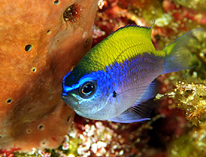
Rückenflossenstacheln (insgesamt) : 13; Rückenflossenweichstrahlen (insgesamt) : 11 - 12; Afterflossenstacheln: 2; Afterflossenweichstrahlen: 11 - 12. Adults dark olive brown dorsally, abruptly white ventral to lower edge of eye and pectoral base; dorsal and caudal fins yellowish posteriorly; a black spot at upper base of pectoral fins; juveniles bright yellow to yellow-green on upper third, abruptly violet on side, shading to whitish ventrally; a bright blue line from front of snout to upper edge of eye (Ref. 13442). Body shape (shape guide): fusiform / normal; Cross section: oval.
Adults inhabit outer and seaward reefs. Feeds on plankton (Ref. 5521). Taken incidentally in traps and small-meshed beach nets (Ref. 5217). Oviparous, distinct pairing during breeding (Ref. 205). Eggs are demersal and adhere to the substrate (Ref. 205). Males guard and aerate the eggs (Ref. 205).
Oviparous, distinct pairing during breeding (Ref. 205). Eggs are demersal and adhere to the substrate (Ref. 205). Males guard and aerate the eggs (Ref. 205).
Bevorzugte Temperatur (Ref. 123201): 20 - 27.5, mean 24.6 °C (based on 140 cells).
Phylogenetischer Diversitätsindex (Ref. 82804): PD50 = 0.5000 [Uniqueness, from 0.5 = low to 2.0 = high].
Bayesian length-weight: a=0.01259 (0.00569 - 0.02786), b=3.03 (2.84 - 3.22), in cm total length, based on LWR estimates for this (Sub)family-body shape (Ref. 93245).
Trophische Ebene (Ref. 69278): 3.4 ±0.45 se; based on food items.
Widerstandsfähigkeit (Ref. 120179): hoch, Verdopplung der Population dauert weniger als 15 Monate. (Preliminary K or Fecundity.).
Anfälligkeit der Fischerei (Ref. 59153): Low vulnerability (10 of 100). 🛈