This website uses cookies to enhance your browsing experience and ensure the functionality of our site. For more detailed information about the types of cookies we use and how we protect your privacy, please visit our Privacy Information page.
×
Cookie Settings
This website uses different types of cookies to enhance your experience. Please select your preferences below:
> Ovalentaria/misc (Various families in series Ovalentaria) > Pomacentridae (Damselfishes) > Chrominae
Etymology: Chromis:Greek, chromis = a fish, perhaps a perch (Ref. 45335). More on author: Cuvier.
Environnement : milieu / zone climatique / profondeur / gamme de distribution Écologie
marin récifal; non migrateur; profondeur 20 - 100 m (Ref. 7247). Tropical; 37°N - 7°N, 99°W - 59°W
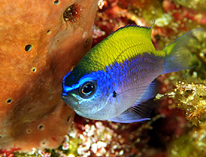
Épines dorsales (Total) : 13; Rayons mous dorsaux (Total) : 11 - 12; Épines anales: 2; Rayons mous anaux: 11 - 12. Adults dark olive brown dorsally, abruptly white ventral to lower edge of eye and pectoral base; dorsal and caudal fins yellowish posteriorly; a black spot at upper base of pectoral fins; juveniles bright yellow to yellow-green on upper third, abruptly violet on side, shading to whitish ventrally; a bright blue line from front of snout to upper edge of eye (Ref. 13442). Body shape (shape guide): fusiform / normal; Cross section: oval.
Adults inhabit outer and seaward reefs. Feeds on plankton (Ref. 5521). Taken incidentally in traps and small-meshed beach nets (Ref. 5217). Oviparous, distinct pairing during breeding (Ref. 205). Eggs are demersal and adhere to the substrate (Ref. 205). Males guard and aerate the eggs (Ref. 205).
Cycle de vie et comportement reproducteur Maturité | Reproduction | Frai | Œufs | Fécondité | Larves
Oviparous, distinct pairing during breeding (Ref. 205). Eggs are demersal and adhere to the substrate (Ref. 205). Males guard and aerate the eggs (Ref. 205).
Dynamique des populations Paramètres de croissance Âges / tailles maximales Longueur-poids rel. Rel. longueur-longueur. Fréquences de longueurs Conversion de masse Recrutement Abondance
Cycle de vie Reproduction Maturité Maturité/épines rel. Fécondité Frai Agrégats de frai Œufs Développement de l'œuf Larves Dynamique des populations larvaires
Physiologie Composition corporelle Nutriments Consommation d'oxygène Type de natation Vitesse de nage Pigments visuels Son de poisson Maladies et parasites Toxicité (CL50)
Température préférée (Réf. 123201): 20 - 27.5, mean 24.6 °C (based on 140 cells).
Indice de diversité phylogénétique (Réf. 82804): PD50 = 0.5000 [Uniqueness, from 0.5 = low to 2.0 = high].
Bayesian length-weight: a=0.01259 (0.00569 - 0.02786), b=3.03 (2.84 - 3.22), in cm total length, based on LWR estimates for this (Sub)family-body shape (Ref. 93245).
Niveau trophique (Réf. 69278): 3.4 ±0.45 se; based on food items.
Résilience (Réf. 120179): Haut, temps minimum de doublement de population inférieur à 15 mois (Preliminary K or Fecundity.).
Vulnérabilité de la pêche (Ref. 59153): Low vulnerability (10 of 100). 🛈