



Lates calcarifer (Bloch, 1790)
Barramundi
Lägg till din observation i Fish Watcher
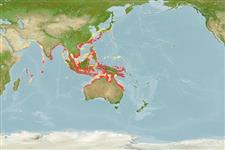
| Native range | All suitable habitat | Point map | Year 2050 |
|
| This map was computer-generated and has not yet been reviewed. |
| Lates calcarifer AquaMaps Data sources: GBIF OBIS |
Ladda upp din foton och Videor
Bilder | Frimärken, mynt, diverse. | Google image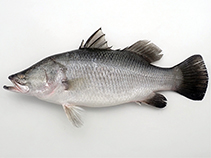 Lates calcarifer
Bild av Lai, N.-W.
Bilder | Frimärken, mynt, diverse. | Google image
Bild av Lai, N.-W.
Klassificering / Namn Populärnamn | synonymer | Catalog of Fishes(Släkte, Arter) | ITIS | CoL | WoRMS | Cloffa
> Carangaria/misc (Various families in series Carangaria) > Latidae (Lates perches)
Etymology: Lates: Latin, lateo, latere = to be hidden.
More on author: Bloch.
Etymology: Lates: Latin, lateo, latere = to be hidden.
More on author: Bloch.
Miljö: miljö / Klimatzon / djupintervall / distributionsområde Ekologi
marina; sötvatten; brackvatten bottenlevande; katadrom (Ref. 138269); djupintervall 10 - 40 m (Ref. 7261). Tropical; 15°C - 28°C (Ref. 2060); 49°N - 26°S, 56°E - 155°E (Ref. 54239)
Utbredning Territorier | FAO områden | Ekosystem | Förekomster | Prickkarta | Utplanteringar | Faunafri
Indo-West Pacific: eastern edge of the Persian Gulf to China, Taiwan and southern Japan, southward to southern Papua New Guinea and northern Australia.
Längd vid första mognad / Storlek / Vikt / Ålder
Könsmognad: Lm 44.5, range 29 - 60 cm
Max length : 200 cm TL hane/ej könsbestämd; (Ref. 7050); common length : 150 cm NG hane/ej könsbestämd; (Ref. 9799); publicerad maxvikt: 60.0 kg (Ref. 28138); rapporterad maxålder: 35 år (Ref. 125591)
Max length : 200 cm TL hane/ej könsbestämd; (Ref. 7050); common length : 150 cm NG hane/ej könsbestämd; (Ref. 9799); publicerad maxvikt: 60.0 kg (Ref. 28138); rapporterad maxålder: 35 år (Ref. 125591)
Kort beskrivning Bestämningsnycklar | Morfologi | Morfometri
Taggstrålar i ryggfenan (totalt) : 7 - 9; Mjukstrålar i ryggfenan (totalt) : 10 - 11; Taggstrålar i analfenan: 3; Mjukstrålar i analfenan: 7 - 8. Body elongate; mouth large, slightly oblique, upper jaw extending behind the eye. Lower edge of preopercle serrated, with strong spine at its angle; opercle with a small spine and with a serrated flap above the origin of the lateral line. Caudal fin rounded.
Body shape (shape guide): fusiform / normal; Cross section: compressed.
Body shape (shape guide): fusiform / normal; Cross section: compressed.
Found in coastal waters, estuaries and lagoons, in clear to turbid water (Ref. 5259, 44894). A diadromous fish, inhabiting rivers before returning to the estuaries to spawn. A protandrous hermaphrodite (Ref. 32209). Larvae and young juveniles live in brackish temporary swamps associated with estuaries, and older juveniles inhabit the upper reaches of rivers (Ref. 6390, 44894). Have preference for cover on undercut banks, submerged logs and overhanging vegetation (Ref. 44894). Feed on fishes and crustaceans. They reach 1500-3000 g in one year in ponds under optimum conditions (Ref. 11046, 44894). Juveniles also eat insects (Ref. 44894). Sold fresh and frozen; consumed steamed, pan-fried, broiled and baked (Ref. 9987). A very popular and sought-after fish of very considerable economic importance (Ref. 9799). Presently used for aquaculture in Thailand, Indonesia and Australia (Ref. 9799). Australia's most important commercial fish and one of the most popular angling species (Ref. 44894).
Livscykel och parningsbeteende Könsmognad | Reproduktion | Lek | Ägg | Fekunditet | Larver
Breed in estuaries throughout the Indo-Pacific. Maturing male barramundi migrate downstream from freshwater habitats at the start of the wet (monsoon) season to spawn with resident females in estuaries (Ref. 27132) and on tidal flats outside the mouths of rivers (Ref. 6390).
Barramundi spawn on the full moon and new moon, primarily at the beginning of an incoming tide which carries the eggs into the estuary (Ref. 28135).
Barramundi are broadcast spawners that aggregate to spawn (Ref. 6390). Spawning aggregations occur in or around the mouths of rivers (Ref. 28132). While adults and juveniles are capable of living in fresh water, brackish waters are required for embryonic development (Ref. 6136). Female barramundi are capable of producing large numbers of eggs, with estimates as high as 2.3 million eggs per kg of body weight (Ref. 28134).
Barramundi are protandrous hermaphrodites, i.e., they undergo sex reversion during their life cycle. Females are generally absent in the smaller length classes, but dominate larger length classes. Most barramundi mature first as males and function as males for one or more spawning seasons before undergoing sex inversion. A few females will develop directly from immature fish (Ref. 28132). Similarly, some males may never undergo sex inversion (Ref. 28132). Also Ref. 103751.
Huvudreferens
Ladda upp dina referenser | referenser | Koordinator | Medarbetare
Larson, H., 1999. Order Perciformes. Suborder Percoidei. Centropomidae. Sea perches. p. 2429-2432. In K.E. Carpenter and V.H. Niem (eds.) FAO species identification guide for fishery purposes. The living marine resources of the Western Central Pacific. Volume 4. Bony fishes part 2 (Mugilidae to Carangidae). FAO, Rome. (Ref. 9799)
Status på IUCN:s rödlista (Ref. 130435: Version 2025-2 (Global))
Least Concern (LC) ; Date assessed: 15 February 2019
CITES
Not Evaluated
Hot mot människor
Harmless
Mänskliga användningsområden
Fiskeri: kommersiellt viktig; Vattenbruk: kommersiell; sportfisk: ja; Akvarium: Offentliga akvarier
FAO - Vattenbrukssystem: produktion, artprofil; fiskeri: landningar, artprofil; Publication: search | FishSource | Havet omkring oss
Ytterligare information
Populationsdynamik
Tillväxtparametrar
Max. åldrar / storlekar
Längd-vikt rel.
Längd-längd rel.
Längd-frekvenser
Massakonvertering
Rekrytering
Abundans
Tillväxtparametrar
Max. åldrar / storlekar
Längd-vikt rel.
Längd-längd rel.
Längd-frekvenser
Massakonvertering
Rekrytering
Abundans
Livscykel
Reproduktion
Könsmognad
Mognad/Gills rel.
Fekunditet
Lek
Lekande aggregat
Ägg
Utveckling av ägg
Larver
Larvdynamik
Reproduktion
Könsmognad
Mognad/Gills rel.
Fekunditet
Lek
Lekande aggregat
Ägg
Utveckling av ägg
Larver
Larvdynamik
Anatomi
Gälyta
Hjärna
Otolit
Gälyta
Hjärna
Otolit
Fysiologi
Kroppssammansättning
Näringsämnen
Syreförbrukning
Typ av simning
Simhastighet
Visuella pigment
Ljud från fisk
Sjukdomar & Parasiter
Toxicitet (LC50)
Kroppssammansättning
Näringsämnen
Syreförbrukning
Typ av simning
Simhastighet
Visuella pigment
Ljud från fisk
Sjukdomar & Parasiter
Toxicitet (LC50)
Människorelaterad
Vattenbrukssystem
Vattenbruksprofiler
Avelslinjer
Ciguatera-fall
Frimärken, mynt, diverse.
Vattenbrukssystem
Vattenbruksprofiler
Avelslinjer
Ciguatera-fall
Frimärken, mynt, diverse.
Verktyg
E-bok | Fälthandbok | Bestämningsnycklar | Längdfördelnings-verktyg | Livshistorie-verktyg | Prickkarta |
Fångst-MSY |
Särskilda rapporter
Kontrollera för underhåll av akvarium | Kontrollera om det finns faktablad om arter | Kontrollera om det finns faktablad om vattenbruk
Ladda ner XML
Internet-källor
AFORO (otoliths) | Alien/Invasive Species database | Aquatic Commons | BHL | Cloffa | Websites from users | Check FishWatcher | CISTI | Catalog of Fishes: Släkte, Arter | DiscoverLife | ECOTOX | FAO - Vattenbrukssystem: produktion, artprofil; fiskeri: landningar, artprofil; Publication: search | Faunafri | Fishipedia | Fishtrace | GloBI | Google Books | Google Scholar | Google | IGFA World Record | Nationella databaser | OneZoom | Open Tree of Life | Otolith Atlas of Taiwan Fishes | PubMed | Reef Life Survey | Socotra Atlas | TreeBase | Tree of Life | Wikipedia: Go, sök | World Records Freshwater Fishing | Zoologiskt register
Uppskattningar baserade på modeller
Önskad temperatur (Ref. 123201): 25 - 29.1, mean 28.3 °C (based on 710 cells).
Index för fylogenetisk mångfald (Ref. 82804): PD50 = 0.5005 [Uniqueness, from 0.5 = low to 2.0 = high].
Bayesian length-weight: a=0.01000 (0.00634 - 0.01577), b=3.00 (2.87 - 3.13), in cm total length, based on LWR estimates for this species & Genus-body shape (Ref. 93245).
Trofisk nivå (Ref. 69278): 3.8 ±0.60 se; based on food items.
Resiliens (Ref. 120179): Mellan, lägsta populationsfördubblingstid 1,4-4,4 år (K=0.09-0.13; tm=1-5; Fec = 15,300,000).
Prior r = 0.52, 95% CL = 0.34 - 0.77, Based on 3 full stock assessments.
Näringsämnen (Ref. 124155): Calcium = 115 [26, 284] mg/100g; Iron = 1 [0, 2] mg/100g; Protein = 19.6 [18.2, 21.1] %; Omega3 = 0.187 [0.117, 0.295] g/100g; Selenium = 144 [50, 373] μg/100g; VitaminA = 7.36 [2.09, 30.74] μg/100g; Zinc = 0.84 [0.34, 1.90] mg/100g (wet weight); based on nutrient studies.