



Pollachius pollachius (Linnaeus, 1758)
Pollack
Waarneming toevoegen in Fish Watcher
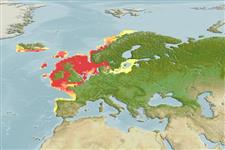
| Native range | All suitable habitat | Point map | Year 2050 |
|
| This map was computer-generated and has not yet been reviewed. |
| Pollachius pollachius AquaMaps Data sources: GBIF OBIS |
Uploaden van uw Foto's en video's
Afbeeldingen | video's | Google afbeelding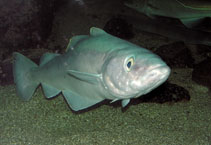 Pollachius pollachius
Afbeelding van Ueberschär, B.
Afbeeldingen | video's | Google afbeelding
Afbeelding van Ueberschär, B.
Classificatie / Namen Lokale namen | Synoniemen | Catalog of Fishes(Genus, Soort(en)) | ITIS | CoL | WoRMS | Cloffa
> Gadiformes (Cods) > Gadidae (Cods and haddocks)
Etymology: Pollachius: Scottish dialect, podlock, paddle = bumpfish (Ref. 45335).
More on author: Linnaeus.
Etymology: Pollachius: Scottish dialect, podlock, paddle = bumpfish (Ref. 45335).
More on author: Linnaeus.
Milieu: milieu / Klimaatzone / Diepte / verspreidingsgebied Ecologie
marien benthopelagisch; oceanodroom (Ref. 51243); diepte 40 - 200 m (Ref. 6302), usually 40 - 100 m (Ref. 54707). Temperate; 72°N - 36°N, 25°W - 28°E
Verspreiding Gebieden | FAO regio's | Ecosystemen | Voorkomen | Verspreidingskaart | Introducties | Faunafri
Northeast Atlantic: Iceland, the Faeroes and Norway to the Bay of Biscay (Ref. 1371); also southern Baltic Sea (Ref. 89342) with records from Poland, Latvia and Estonia (Refs. 36252, 52079).
Lengte bij maturiteit / Grootte / Gewicht / Leeftijd
Maturiteit: Lm 41.0, range 42 - ? cm
Max length : 130 cm TL mannelijk / geslacht onbekend; (Ref. 1371); common length : 75.0 cm TL mannelijk / geslacht onbekend; (Ref. 1371); max. gepubliceerd gewicht: 18.1 kg (Ref. 40637); max. gerapporteerde leeftijd: 8 Jaren (Ref. 1371)
Max length : 130 cm TL mannelijk / geslacht onbekend; (Ref. 1371); common length : 75.0 cm TL mannelijk / geslacht onbekend; (Ref. 1371); max. gepubliceerd gewicht: 18.1 kg (Ref. 40637); max. gerapporteerde leeftijd: 8 Jaren (Ref. 1371)
Korte beschrijving Determinatiesleutels | Morfologie | Morfometrie
Dorsale stekels (totaal) : 0; Dorsale zachte stralen (totaal) : 29 - 33; Anale zachte stralen: 27 - 30; Wervels: 52 - 55. Lower jaw distinctly projecting beyond upper ones. Lacks a chin barbel. Dark lateral line that sharply curves over the pectoral fin and continues over whole body. No dark spot at pectoral fin base. Dorsal and anal fin interspaces short. Sensory canals with large pores on head. Body color is variable; dark dorsally, sharply distinguished from silver-gray sides and belly; the upper part of the body with yellow to orange streaks or blotches; the lateral line greenish. The fins uniformly dark except for the pelvic fins which are yellowish.
Body shape (shape guide): fusiform / normal; Cross section: circular.
Body shape (shape guide): fusiform / normal; Cross section: circular.
Found in inshore waters but also down to 200 m depth, in areas with hard bottoms. Juveniles are pelagic, spending 2-3 years near the coast including rocky areas, kelp beds, sandy shores and estuaries (Ref. 1371, 58137, 89343, 89362). Juveniles may form schools with saithe (Pollachius virens) (Ref. 88187), and have also been found solitary and defending their feeding territory (Refs. 42174, 89363). Larger individuals move to the open sea and are often found around rocky areas at 40-100 m depth (Ref. 1371). Also observed around shipwrecks and oil platforms (Ref. 88187). Adults occur singly or in small dispersed shoals but is known to form dense shoals on spawning grounds (Ref. 89364). Suggested to undertake spawning migrations (Ref. 88171). Caught as bycatch in cod and saithe fisheries. Flesh is dry but of good flavor (Ref. 35388). Classified as a "hearing generalist" (89365); has also been found to produce sound. Juveniles have been reported to make repeated short grunts during competitive feeding and aggressive encounters (89366).
Levenscyclus en paargedrag Maturiteit | Voortplanting | Paaien | Eieren | Fecunditeit | Larven
Oviparous and gonochorous (Ref. 205).
Hoofdreferentie
Upload uw referenties | Referenties | Coördinator | Medewerkers
Cohen, D.M., T. Inada, T. Iwamoto and N. Scialabba, 1990. FAO species catalogue. Vol. 10. Gadiform fishes of the world (Order Gadiformes). An annotated and illustrated catalogue of cods, hakes, grenadiers and other gadiform fishes known to date. FAO Fish. Synop. 125(10). Rome: FAO. 442 p. (Ref. 1371)
Status op de Rode Lijst van het IUCN (Ref. 130435: Version 2025-2 (Global))
Niet bedreigd (LC) ; Date assessed: 16 October 2013
CITES
Not Evaluated
Gevaar voor de mens
Harmless
Gebruik door de mens
Visserij: commercieel; sportvis: ja
FAO - Aquacultuursystemen: productie; visserij: aanvoer, soortsprofiel; Publication: search | FishSource | Sea Around Us
Meer informatie
Trofische ecologie
Voedsel (prooien)
Dieetsamenstelling
Voedselconsumptie
Voedselrantsoenen
Predatoren
Voedsel (prooien)
Dieetsamenstelling
Voedselconsumptie
Voedselrantsoenen
Predatoren
Populatiedynamica
Groeiparameters
Max. leeftijden / maten
Lengte-gewicht rel.
Lengte-lengte rel.
Lengtefrequenties
Massaconversie
Rekrutering
Abundantie
Groeiparameters
Max. leeftijden / maten
Lengte-gewicht rel.
Lengte-lengte rel.
Lengtefrequenties
Massaconversie
Rekrutering
Abundantie
Levenscyclus
Voortplanting
Maturiteit
Rijpheid/kieuwen rel.
Fecunditeit
Paaien
Paaibestanden
Eieren
Ontwikkeling van de eieren
Larven
Larvale populatiedynamiek
Voortplanting
Maturiteit
Rijpheid/kieuwen rel.
Fecunditeit
Paaien
Paaibestanden
Eieren
Ontwikkeling van de eieren
Larven
Larvale populatiedynamiek
Fysiologie
Lichaamssamenstelling
Voedingsstoffen
Zuurstofverbruik
Type zwemmen
Zwemsnelheid
Visuele pigmenten
Vis geluid
Ziekten en parasieten
Toxiciteit (LC50)
Lichaamssamenstelling
Voedingsstoffen
Zuurstofverbruik
Type zwemmen
Zwemsnelheid
Visuele pigmenten
Vis geluid
Ziekten en parasieten
Toxiciteit (LC50)
Menselijk gerelateerd
Aquacultuursystemen
Aquacultuurprofielen
Kweeklijnen
Ciguatera gevallen
Postzegels, munten, diversen.
Aquacultuursystemen
Aquacultuurprofielen
Kweeklijnen
Ciguatera gevallen
Postzegels, munten, diversen.
Tools
Biologische quiz | E-boek | Veldgids | Determinatiesleutels | Lengtefrequentie Tool | Levenscyclus tool | Verspreidingskaart |
Vangst-MSY |
Speciale rapporten
Bekijk gegevens voor het houden in een aquarium | Bekijk Fact Sheets voor de soort | Bekijk Aquacultuur Fact Sheets
Download XML
Internetbronnen
AFORO (otoliths) | Aquatic Commons | BHL | Cloffa | Websites from users | Bekijk FishWatcher | CISTI | Catalog of Fishes: Genus, Soort(en) | DiscoverLife | DORIS | ECOTOX | FAO - Aquacultuursystemen: productie; visserij: aanvoer, soortsprofiel; Publication: search | Faunafri | Fishipedia | Fishtrace | GloBI | Google Books | Google Scholar | Google | IGFA World Record | Nationale databanken | OneZoom | Open Tree of Life | Otolith Atlas of Taiwan Fishes | Publieke aquaria | PubMed | Reef Life Survey | Socotra Atlas | TreeBase | Tree of Life | Wikipedia: ga naar, zoek | World Records Freshwater Fishing | Zoological Record
Schattingen op basis van modellen
Gewenste temperatuur (Ref. 123201): 7 - 11.9, mean 8.9 °C (based on 283 cells).
Fylogenetische diversiteitsindex (Ref. 82804): PD50 = 0.7500 [Uniqueness, from 0.5 = low to 2.0 = high].
Bayesian length-weight: a=0.00708 (0.00605 - 0.00829), b=3.08 (3.04 - 3.12), in cm total length, based on LWR estimates for this species (Ref. 93245).
Trofisch niveau (Ref. 69278): 4.3 ±0.3 se; based on diet studies.
Generation time: 5.9 ( na - na) years. Estimated as median ln(3)/K based on 1 growth studies.
Weerstandsvermogen (Ref. 120179): Gemiddeld, minimale populatieverdubbelingstijd 1,4-4,4 jaar (K=0.19; tmax=8).
Prior r = 0.63, 95% CL = 0.42 - 0.95, Based on 3 data-limited stock assessments.
Voedingsstoffen (Ref. 124155): Calcium = 8.53 [3.62, 29.51] mg/100g; Iron = 0.222 [0.085, 0.575] mg/100g; Protein = 17.7 [15.7, 19.8] %; Omega3 = 0.544 [0.279, 1.082] g/100g; Selenium = 25.4 [8.6, 76.9] μg/100g; VitaminA = 17.8 [4.6, 71.0] μg/100g; Zinc = 0.401 [0.206, 0.797] mg/100g (wet weight);