



Coryphaenoides rupestris Gunnerus, 1765
Roundnose grenadier
Ajouter votre observation dans Fish Watcher
| Native range | All suitable habitat | Point map | Year 2050 |

|
| This map was computer-generated and has not yet been reviewed. |
| Coryphaenoides rupestris AquaMaps Data sources: GBIF OBIS |
Envoyez vos Photos et vidéos
Images | Images Google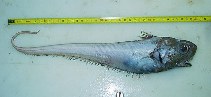 Coryphaenoides rupestris
Photo de Garazo Fabregat, A.
Images | Images Google
Photo de Garazo Fabregat, A.
Classification / Noms Noms communs | Synonymes | Catalog of Fishes(Genre, Espèce) | ITIS | CoL | WoRMS | Cloffa
> Gadiformes (Cods) > Macrouridae (Grenadiers or rattails)
Etymology: Coryphaenoides: Greek, koryphaina = dolphin fish + Suffix oides = similar to (Ref. 45335).
Etymology: Coryphaenoides: Greek, koryphaina = dolphin fish + Suffix oides = similar to (Ref. 45335).
Environnement : milieu / zone climatique / profondeur / gamme de distribution Écologie
marin bathypélagique; profondeur 180 - 2600 m (Ref. 58426), usually 400 - 1200 m (Ref. 1371). Deep-water; 73°N - 20°N, 77°W - 32°E
Distribution Territoires | Zones FAO | Écosystèmes | Occurrences | Carte par point | Introductions | Faunafri
North Atlantic: from about 37°N to Baffin Island and Greenland in the western Atlantic, and off Iceland and Norway to 73°N to Barents Sea, south to North Africa in the eastern Atlantic. Reported to occur from the tongue of the Ocean east of Andros Islands (about 24°N, 77°W) in the Bahamas.
Longueur à la première maturité / Taille / Poids / Âge
Maturité: Lm 52.7, range 60 - ? cm
Max length : 110 cm TL mâle / non sexé; (Ref. 35388); poids max. publié: 1.7 kg (Ref. 40637); âge max. reporté: 54 années (Ref. 41452)
Max length : 110 cm TL mâle / non sexé; (Ref. 35388); poids max. publié: 1.7 kg (Ref. 40637); âge max. reporté: 54 années (Ref. 41452)
Description synthétique Clés d'identification | Morphologie | Morphométrie
Épines dorsales (Total) : 2; Épines anales: 0. Head broad, rather soft; snout broad, rounded, with a large blunt tubercular scute at its tip; chin with small barbel. Scales relatively adherent; spinules dense on body scales, long, thin and recurved, narrowly lanceolate, with longitudinal anterior concavity. Pyloric caeca 29 to 31, long and slender. Color medium brown to grayish; orbits, oral and branchial cavities, and fins blackish to brownish gray.
Body shape (shape guide): elongated; Cross section: circular.
Body shape (shape guide): elongated; Cross section: circular.
Benthopelagic to bathypelagic in about 400 and 1200 m depth. Minimum depth from Ref. 1371. Form large schools at 600 to 900 m depth (Ref. 9988). Feed on a variety of fish and invertebrates, but primarily on pelagic crustaceans such as shrimps, amphipods and cumaceans; cephalopods and lantern fishes constitute a lesser portion of the diet. Batch spawner (Ref. 51846). This species is currently facing overexploitation in the North Atlantic. Utilized frozen and for fishmeal; can be fried and baked (Ref. 9988).
Cycle de vie et comportement reproducteur Maturité | Reproduction | Frai | Œufs | Fécondité | Larves
Référence principale
Téléchargez vos références | Références | Coordinateur : Iwamoto, Tomio | Collaborateurs
Cohen, D.M., T. Inada, T. Iwamoto and N. Scialabba, 1990. FAO species catalogue. Vol. 10. Gadiform fishes of the world (Order Gadiformes). An annotated and illustrated catalogue of cods, hakes, grenadiers and other gadiform fishes known to date. FAO Fish. Synop. 125(10). Rome: FAO. 442 p. (Ref. 1371)
Statut dans la liste rouge de l'IUCN (Ref. 130435: Version 2025-2 (Global))
Niveau de menace critique (CR) (A4bd); Date assessed: 11 July 2012
CITES
Not Evaluated
Menace pour l'homme
Harmless
Utilisations par l'homme
Pêcheries: commercial
FAO - pêcheries: débarquements, Résumé espèce; Publication: search | FIRMS - Stock assessments | FishSource | Sea Around Us
Plus d'informations
Écologie trophique
Aliments (proies)
Composition du régime alimentaire
Consommation alimentaire
Rations alimentaires
Prédateurs
Aliments (proies)
Composition du régime alimentaire
Consommation alimentaire
Rations alimentaires
Prédateurs
Dynamique des populations
Paramètres de croissance
Âges / tailles maximales
Longueur-poids rel.
Rel. longueur-longueur.
Fréquences de longueurs
Conversion de masse
Recrutement
Abondance
Paramètres de croissance
Âges / tailles maximales
Longueur-poids rel.
Rel. longueur-longueur.
Fréquences de longueurs
Conversion de masse
Recrutement
Abondance
Cycle de vie
Reproduction
Maturité
Maturité/épines rel.
Fécondité
Frai
Agrégats de frai
Œufs
Développement de l'œuf
Larves
Dynamique des populations larvaires
Reproduction
Maturité
Maturité/épines rel.
Fécondité
Frai
Agrégats de frai
Œufs
Développement de l'œuf
Larves
Dynamique des populations larvaires
Physiologie
Composition corporelle
Nutriments
Consommation d'oxygène
Type de natation
Vitesse de nage
Pigments visuels
Son de poisson
Maladies et parasites
Toxicité (CL50)
Composition corporelle
Nutriments
Consommation d'oxygène
Type de natation
Vitesse de nage
Pigments visuels
Son de poisson
Maladies et parasites
Toxicité (CL50)
Génétique
génôme
Génétique
Hétérozygotie
Héritabilité
Diversité génétique
génôme
Génétique
Hétérozygotie
Héritabilité
Diversité génétique
Liées à l'homme
Systèmes d'aquaculture
Profils d'aquaculture
Souches
Cas de ciguatera
Timbres, pièces de monnaie, divers
Systèmes d'aquaculture
Profils d'aquaculture
Souches
Cas de ciguatera
Timbres, pièces de monnaie, divers
Outils
E-book | Guide de terrain | Clés d'identification | Générateur de fréquences de longueur | Outil de dynamique de population | Carte par point |
Capture-MSY |
Articles particuliers
Télécharger en XML
Sources Internet
AFORO (otoliths) | Aquatic Commons | BHL | Cloffa | Websites from users | FishWatcher | CISTI | Catalog of Fishes: Genre, Espèce | DiscoverLife | ECOTOX | FAO - pêcheries: débarquements, Résumé espèce; Publication: search | Faunafri | Fishipedia | Fishtrace | GloBI | Google Books | Google Scholar | Google | IGFA World Record | Bases de données nationales | OneZoom | Open Tree of Life | Otolith Atlas of Taiwan Fishes | PubMed | Reef Life Survey | Socotra Atlas | TreeBase | Arbre de Vie | Wikipedia: aller à, chercher | World Records Freshwater Fishing | Zoobank | Zoological Record
Estimations basées sur des modèles
Température préférée (Réf. 123201): 2.7 - 9.4, mean 4.5 °C (based on 270 cells).
Indice de diversité phylogénétique (Réf. 82804): PD50 = 0.5000 [Uniqueness, from 0.5 = low to 2.0 = high].
Bayesian length-weight: a=0.00219 (0.00111 - 0.00432), b=3.20 (3.03 - 3.37), in cm total length, based on LWR estimates for this (Sub)family-body shape (Ref. 93245).
Niveau trophique (Réf. 69278): 3.7 ±0.56 se; based on food items.
Résilience (Réf. 120179): Faible, temps minimum de doublement de population : 4,5 à 14 années (K=0.1; tm=9-11; tmax=54; Fec=10,000).
Prior r = 0.27, 95% CL = 0.18 - 0.40, Based on 4 full stock assessments.
Nutriments (Ref. 124155): Calcium = 17.4 [5.5, 40.4] mg/100g; Iron = 0.296 [0.130, 0.842] mg/100g; Protein = 17.3 [15.4, 19.0] %; Omega3 = 0.104 [0.041, 0.263] g/100g; Selenium = 26.9 [9.0, 74.3] μg/100g; VitaminA = 21.2 [2.7, 168.7] μg/100g; Zinc = 0.429 [0.232, 0.866] mg/100g (wet weight);