This website uses cookies to enhance your browsing experience and ensure the functionality of our site. For more detailed information about the types of cookies we use and how we protect your privacy, please visit our Privacy Information page.
×
Cookie Settings
This website uses different types of cookies to enhance your experience. Please select your preferences below:
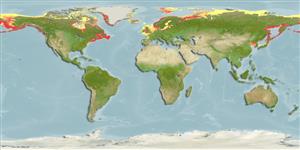
Circumarctic: Arctic and Atlantic drainages across Canada and Alaska, and as far south as New Jersey, USA; Pacific coast of Alaska; Great Lakes basin; also in Eurasia (Ref. 5723). Eurasia: coastal areas of northern Europe, from Netherlands to northern Russia, including southern Norway and Baltic basin. Widely distributed inland in eastern Scandinavia. Extends eastward to Siberia and Japan, but remains to be confirmed that East Asia populations are conspecific with European ones (Ref. 59043).
Longueur à la première maturité / Taille / Poids / Âge
Maturité: Lm3.7 range ? - ? cm Max length : 9.0 cm TL mâle / non sexé; (Ref. 27547); common length : 6.5 cm NG mâle / non sexé; (Ref. 27547); âge max. reporté: 5 années (Ref. 27547)
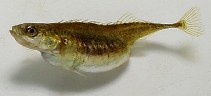
Épines dorsales (Total) : 6 - 12; Rayons mous dorsaux (Total) : 9 - 13; Épines anales: 1; Rayons mous anaux: 8 - 13; Vertèbres: 30 - 35. Distinguished uniquely from congeners in Europe by having scutes on side of caudal peduncle, forming a keel. Differs further from other members of the genus in Europe by the combination of the following characters: flank lacking scutes; dorsal fin with 7-11 spines; and caudal peduncle wider than deep (Ref. 59043). Distinguished by the presence of 7 to 12 free spines in front of the dorsal fin and a long caudal keel that usually reaches beneath the dorsal fin (Ref. 27547). Dorsal spines separated from one another, each with a rudimentary membrane on its posterior side; anal spine stout and curved; posterior edge of pectorals rounded; pelvic ray pressed close to the spine; caudal fin usually truncate, varying from slightly indented to slightly rounded (Ref. 27547). Pale green, grey, or olive above, strongly pigmented with irregularly arranged dark bars or blotches; silvery below (Ref. 1998). Fins colorless (Ref. 27547). Breeding colors may be variable, depending on sex, population and stage of breeding cycle but color of females always less intense than those of males (Ref. 27547). Aggressive females become dark on the back and paler below, then sometimes become paler with more conspicuous saddle marks as actual breeding approaches (Ref. 30380). Aggressive males become totally black except for the colorless fins and the membranes on the pelvic spines, which are white. At breeding, the males become paler on the back and more intensely black on the belly, especially under the chin (Ref. 28993, 30380). Breeding males on the east coast of North America have been reported as reddish under the head and greenish on the belly (Ref. 27547). Caudal fin with 12 rays (Ref. 2196). Body shape (shape guide): elongated.
Found in shallow vegetated areas of lakes, ponds, and pools of sluggish streams; sometimes in open water over sand (Ref. 5723). Marine populations found near shore and move into fresh water to spawn (Ref. 5723). There appears to be seasonal movements inshore to shallow water in the spring for spawning, and, in the fall, offshore to deep water, or even to the less saline parts of the sea, by the young and adults that survive spawning (Ref. 27547). Nerito-pelagic (Ref. 58426). Feed on small invertebrates; also on aquatic insects and their eggs and larvae (Ref. 1998). Eggs are found in nests constructed from plant material (Ref. 41678). Males build, guard and aerate the nest where the eggs are deposited (Ref. 205). Females grow faster and live longer than do other males (Ref. 27547). Males seldom live beyond age three, due to heavy post-spawning mortality, but females may live to age five or more (Ref. 27547). When abundant, it is preyed upon by other fishes (Ref. 1998); also preyed by birds (Ref. 27547). May be used as human or dog food or as a source of oil (Ref. 27547).
During the spawning season, both males and females set up territories which are defended against intruders of either sex. The male builds the nest with plant fragments and binds it together with a kidney secretion. The nest has two openings. The male then entices the female into the nest with quick dancing movements. An enticed female follows the male to his nest, enters it through one opening, deposits 50 to 80 eggs, then leaves through the other opening (Ref. 1998, 27547). In nests with one opening, the female enters, turns around, deposits her eggs and leaves (Ref. 27547). The male then enters the nest and fertilizes the eggs as it swims toward the other opening. More than one female may deposit eggs to the nest. The male guards one opening and aerates the eggs (Ref. 1998). Soon after releasing a clutch of eggs, a female feeds voraciously and in a day or so, is ready to be courted again (Ref. 27547). Sometimes the nest falls apart before the eggs hatch. The male may build a new nest nearby and transfer the eggs to it. At hatching, the male enters the nest to remove egg remains. Newly hatched larvae move to the top of the nest and settle on it. The male may construct a nursery above the nest. As the larvae become more active, the male catches them in his mouth and spits them back to the nest or nursery. As the larvae become more active, the male loses interest in them, and may build a new nest and repeat the process or the breeding season ends (Ref. 28993). Eggs hatch in 6-7 days (Ref. 59043).
Page, L.M. and B.M. Burr, 1991. A field guide to freshwater fishes of North America north of Mexico. Houghton Mifflin Company, Boston. 432 p. (Ref. 5723)
Statut dans la liste rouge de l'IUCN (Ref. 130435: Version 2025-2 (Global))
Physiologie Composition corporelle Nutriments Consommation d'oxygène Type de natation Vitesse de nage Pigments visuels Son de poisson Maladies et parasites Toxicité (CL50)
Température préférée (Réf. 123201): 0.4 - 10.2, mean 4.1 °C (based on 169 cells).
Indice de diversité phylogénétique (Réf. 82804): PD50 = 0.5005 [Uniqueness, from 0.5 = low to 2.0 = high].
Bayesian length-weight: a=0.00490 (0.00253 - 0.00947), b=3.01 (2.83 - 3.19), in cm total length, based on LWR estimates for this species & (Sub)family-body (Ref. 93245).
Niveau trophique (Réf. 69278): 3.3 ±0.1 se; based on diet studies.
Résilience (Réf. 120179): Milieu, temps minimum de doublement de population : 1,4 à 4,4 années (tm=1-2; tmax=5; Fec=350).
Vulnérabilité de la pêche (Ref. 59153): Low vulnerability (10 of 100). 🛈