



Merluccius gayi (Guichenot, 1848)
South Pacific hake
Adicionar o seu Fotografias e vídeos
Fotografias | Imagem do Google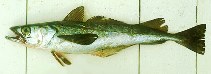 Merluccius gayi
Fotografia de Busse, K.
Fotografias | Imagem do Google
Fotografia de Busse, K.
Classificação / Nomes Nomes comuns | Sinónimos | Catalog of Fishes(Género, Espécies) | ITIS | CoL | WoRMS | Cloffa
> Gadiformes (Cods) > Merlucciidae (Merluccid hakes)
Etymology: Merluccius: Latin, mar, maris = the sea + Latin, lucius = pike (Ref. 45335).
Eponymy: Claude Gay (1800–1873) was a French botanist. [...] (Ref. 128868), visit book page.
More on author: Guichenot.
Etymology: Merluccius: Latin, mar, maris = the sea + Latin, lucius = pike (Ref. 45335).
Eponymy: Claude Gay (1800–1873) was a French botanist. [...] (Ref. 128868), visit book page.
More on author: Guichenot.
Taxonomic Remarks
A different species/subspecies is recognized on the Peruvian coasts Merluccius peruanus Ginsburg, 1954, that is recognized in FishBase as a provisionally valid species. More studies are needed to clearly differentiate it (March 2021).
Ambiente: milieu / zona climática / intervalo de profundidade / gama de distribuição Ecologia
marinhas batidemersal; oceanódromo; intervalo de profundidade 50 - 500 m (Ref. 1371). Deep-water; 5°S - 46°S, 81°W - 69°E (Ref. 54583)
Distribuição Territórios | Áreas FAO | Ecossistemas | Ocorrências | Mapa dos pontos | Introduções | Faunafri
Southeast Pacific: off the coast of Chile from Arica to Chiloé Island.
Comprimento na primeira maturidade / Tamanho / Peso / Idade
Maturidade: Lm ?, range 32 - ? cm
Max length : 87.0 cm TL macho/indeterminado; (Ref. 1371); common length : 50.0 cm TL macho/indeterminado; (Ref. 1371)
Max length : 87.0 cm TL macho/indeterminado; (Ref. 1371); common length : 50.0 cm TL macho/indeterminado; (Ref. 1371)
Descrição breve Chaves de identificação | Morfologia | Morfometria
Espinhos dorsais (total) : 1; Raios dorsais moles (total) : 45 - 54; Espinhos anais: 0; Raios anais moles: 36 - 42; Vértebras: 49 - 53. Caudal fin margin usually concave. Color is silvery on back, silvery whitish on belly. M. gayi gayi and M. gayi peruanus differ by the total number of vertebrae, total number of gill rakers and relative length of head (Ref. 1371).
Body shape (shape guide): fusiform / normal; Cross section: oval.
Body shape (shape guide): fusiform / normal; Cross section: oval.
Occurs from the shallow continental shelf to the upper continental slope (Ref. 1371). Sometimes found off the bottom or in midwater (Ref. 1371). Migrates vertically to midwater at night to feed on fishes, squids and euphausiids (Ref. 27363). Moves to southern coastal areas in summer and migrates to northern deeper waters (200-500 m depth) in winter and spring (Ref. 27363). Spawning occurs at the end of the winter and during the southern spring (Ref. 58452). Marketed fresh and frozen (Ref. 1371) and eaten steamed, fried, boiled and microwaved (Ref. 9988). Also utilized as fishmeal (Ref. 1371).
Ciclo de vida e comportamento de acasalamento Maturidade | Reprodução | Desova | Ovos | Fecundidade | Larvas
Referência principal
Carregar as suas referências | Referências | Coordenador | Colaboradores
Cohen, D.M., T. Inada, T. Iwamoto and N. Scialabba, 1990. FAO species catalogue. Vol. 10. Gadiform fishes of the world (Order Gadiformes). An annotated and illustrated catalogue of cods, hakes, grenadiers and other gadiform fishes known to date. FAO Fish. Synop. 125(10). Rome: FAO. 442 p. (Ref. 1371)
Categoria na Lista Vermelha da IUCN (Ref. 130435: Version 2025-2 (Global))
Dados insuficientes (DD) ; Date assessed: 01 May 2008
CITES
Not Evaluated
Ameaça para o homem
Harmless
Utilização humana
Pescarias: altamente comercial
FAO - pescarias: desembarques, perfil da espécie; Publication: search | FishSource | Sea Around Us
Mais informação
Ecologia Trófica
Produtos alimentares (presas)
Composição da dieta
Consumo alimentar
Rações alimentares
Predadores
Produtos alimentares (presas)
Composição da dieta
Consumo alimentar
Rações alimentares
Predadores
Dinâmica das populações
Parâmetros de crescimento
Idades / tamanhos máximos
Comprimento-peso rel.
Comprimento-comprimento rel.
Frequência de comprimento
Conversão de massa
Recrutamento
Abundância
Parâmetros de crescimento
Idades / tamanhos máximos
Comprimento-peso rel.
Comprimento-comprimento rel.
Frequência de comprimento
Conversão de massa
Recrutamento
Abundância
Ciclo de vida
Reprodução
Maturidade
Maturidade/Rel. das guelras
Fecundidade
Desova
Agregações de desova
Ovos
Desenvolvimento dos ovos
Larvas
Dinâmica larvar
Reprodução
Maturidade
Maturidade/Rel. das guelras
Fecundidade
Desova
Agregações de desova
Ovos
Desenvolvimento dos ovos
Larvas
Dinâmica larvar
Anatomia
Área branquial
Cérebro
Otólitos
Área branquial
Cérebro
Otólitos
Fisiologia
Composição corporal
Nutrientes
Consumo de oxigénio
Tipo de natação
Velocidade de natação
Pigmentos visuais
Som de peixe
Doenças e Parasitas
Toxicidade (LC50s)
Composição corporal
Nutrientes
Consumo de oxigénio
Tipo de natação
Velocidade de natação
Pigmentos visuais
Som de peixe
Doenças e Parasitas
Toxicidade (LC50s)
Genética
genoma
Genética
Heterozigotia
Hereditariedade
Diversidade genética
genoma
Genética
Heterozigotia
Hereditariedade
Diversidade genética
Relacionado com o ser humano
Sistemas de aquacultura
Perfis para aquacultura
Estirpes
Casos de Ciguatera
Selos, moedas, diversos.
Sistemas de aquacultura
Perfis para aquacultura
Estirpes
Casos de Ciguatera
Selos, moedas, diversos.
Ferramentas
E-book | Guia de campo | Chaves de identificação | Ferramenta auxiliar de frequências de comprimento | Ferramenta sobre a história de vida | Mapa dos pontos |
Captura-MSY |
Relatórios especiais
Descarregue XML
Fontes da internet
AFORO (otoliths) | Aquatic Commons | BHL | Cloffa | Websites from users | Consultar FishWatcher | CISTI | Catalog of Fishes: Género, Espécies | DiscoverLife | ECOTOX | FAO - pescarias: desembarques, perfil da espécie; Publication: search | Faunafri | Fishipedia | Fishtrace | GloBI | Google Books | Google Scholar | Google | IGFA World Record | OneZoom | Open Tree of Life | OsteoBase: skull, spine | Otolith Atlas of Taiwan Fishes | PubMed | Reef Life Survey | Socotra Atlas | TreeBase | Árvore da vida | Wikipedia: ir para, procurar | World Records Freshwater Fishing | Registo zoológico
Estimativas baseadas em modelos
Temperatura preferida (Ref. 123201): 9.3 - 14, mean 10.9 °C (based on 38 cells).
Índice de diversidade filogenética (Ref. 82804): PD50 = 0.5000 [Uniqueness, from 0.5 = low to 2.0 = high].
Bayesian length-weight: a=0.01413 (0.00630 - 0.03168), b=3.05 (2.85 - 3.25), in cm total length, based on LWR estimates for this species & (Sub)family-body (Ref. 93245).
Nível Trófico (Ref. 69278): 4.3 ±0.6 se; based on diet studies.
Resiliência (Ref. 120179): Médio, tempo mínimo de duplicação da população 1,4 - 4,4 anos (K=0.1-0.2; tm=2).
Prior r = 0.28, 95% CL = 0.18 - 0.42, Based on 3 full stock assessments.
Nutrientes (Ref. 124155): Calcium = 8.76 [3.94, 31.98] mg/100g; Iron = 0.342 [0.068, 0.925] mg/100g; Protein = 17.6 [16.3, 18.9] %; Omega3 = 0.216 [0.103, 0.404] g/100g; Selenium = 22 [10, 49] μg/100g; VitaminA = 11.9 [2.5, 54.2] μg/100g; Zinc = 0.223 [0.154, 0.356] mg/100g (wet weight); based on nutrient studies.