This website uses cookies to enhance your browsing experience and ensure the functionality of our site. For more detailed information about the types of cookies we use and how we protect your privacy, please visit our Privacy Information page.
×
Cookie Settings
This website uses different types of cookies to enhance your experience. Please select your preferences below:
> Cyprinodontiformes (Rivulines, killifishes and live bearers) > Cyprinodontidae (Pupfishes) > Cyprinodontinae
Etymology: Jordanella:Because of C. Basil Jordan, American zoologist (Ref. 45335). Eponymy: Dr David Starr Jordan (1851–1931) was a leading American ichthyologist, physician, educator, peace activist and believer in eugenics; moreover, he was founding President of Stanford University. [...] (Ref. 128868), visit book page. More on authors: Goode & Bean.
Environnement : milieu / zone climatique / profondeur / gamme de distribution Écologie
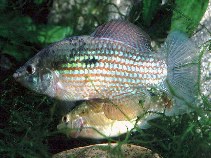
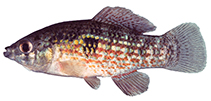
Adults are found in vegetated sloughs, ponds, lakes, and sluggish streams. They enter brackish water. They feed on worms, crustaceans, insects and plant matter (Ref. 7020). Not a seasonal killifish. Found in the Guinness Book of Records as the fish with the fewest eggs (20 eggs are spawned over a period of several days) (Ref. 6472). Is easy to maintain in the aquarium (Ref. 27139).
Cycle de vie et comportement reproducteur Maturité | Reproduction | Frai | Œufs | Fécondité | Larves
Males care for the eggs (Ref. 57667). Lays up to 100 eggs in the aquarium (Ref. 7020). The male does a 'T-dance' with a receptive female and the female lays her eggs over algal-covered rocks where they adhere by their sticky thread. In the laboratory, this was simulated by using a green orlon wool wrapped glass plate - males will continuously guard the eggs on this, fanning with their fins to keep eggs clean and aerated (D. Holdway, pers. com 2006).
Page, L.M. and B.M. Burr, 1991. A field guide to freshwater fishes of North America north of Mexico. Houghton Mifflin Company, Boston. 432 p. (Ref. 5723)
Statut dans la liste rouge de l'IUCN (Ref. 130435: Version 2025-2 (Global))
Dynamique des populations Paramètres de croissance Âges / tailles maximales Longueur-poids rel. Rel. longueur-longueur. Fréquences de longueurs Conversion de masse Recrutement Abondance
Cycle de vie Reproduction Maturité Maturité/épines rel. Fécondité Frai Agrégats de frai Œufs Développement de l'œuf Larves Dynamique des populations larvaires
Physiologie Composition corporelle Nutriments Consommation d'oxygène Type de natation Vitesse de nage Pigments visuels Son de poisson Maladies et parasites Toxicité (CL50)
Indice de diversité phylogénétique (Réf. 82804): PD50 = 1.0000 [Uniqueness, from 0.5 = low to 2.0 = high].
Bayesian length-weight: a=0.01995 (0.01209 - 0.03293), b=3.13 (2.99 - 3.27), in cm total length, based on LWR estimates for this species & (Sub)family-body (Ref. 93245).
Niveau trophique (Réf. 69278): 2.9 ±0.32 se; based on food items.
Résilience (Réf. 120179): Faible, temps minimum de doublement de population : 4,5 à 14 années (Fec=100 (aquarium)).
Vulnérabilité de la pêche (Ref. 59153): Low vulnerability (10 of 100). 🛈